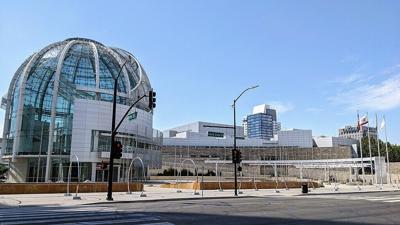



San Jose City Hall
SAN JOSE — A split federal appeals panel has determined a San Jose police officer who fired a foam baton round during a 2020 City Hall protest was entitled to qualified immunity from an excessive force lawsuit.
Court records say protestors lobbed “a volley of projectiles” at officers during the May 2020 skirmish, after which officer James Adgar filed a 40mm foam baton round that struck one of the protestors, Kyle Johnson, behind the knee. He later developed a pulmonary embolism, which doctors attributed to the leg injury, and filed a complaint alleging violations of the Fourth Amendment and California’s Tom Bane Civil Rights Act.
U.S. District Judge Beth Labson Freeman presided over a trial at which a jury found in Johnson’s favor on all counts against Adgar, but not against the city. Adgar then renewed a request for judgment as a matter of law, arguing he should be covered under qualified immunity. But Freeman denied the motion with respect to the Fourth Amendment claims.
Adgar challenged the ruling before the U.S. Ninth Circuit Court of Appeals, which addressed only the question of qualified immunity and didn’t rule on Adgar’s arguments regarding the Bane Act.
Ninth Circuit Judge Richard Tallman wrote the opinion, filed Nov. 2. Judges Richard Paez and Mark Bennett agreed Johnson suffered a Fourth Amendment violation, but Paez dissented on the qualified immunity question.
Tallman said Johnson arrived at the plaza shortly before 10 p.m. He was unarmed, had neither a sign nor anything to throw and, “unlike some other protestors, he did not engage with the police in any way.” Adgar arrived about 20 minutes after Johnson with orders to shoot “anyone he saw throwing bottles.” He fired about 10 minutes later. Although some retreated, including Johnson, they quickly returned. Adgar shot Johnson in that second wave.
The jury, which Tallman said “specifically found that Officer Adgar had fired indiscriminately into the crowd," awarded Johnson $1.35 million in damages.
Qualified immunity is not available to officers who “violate a federal statutory or constitutional right,” Tallman wrote, when their conduct was known to be unlawful at the time. The panel said there are some cases where “it makes sense to assume a constitutional violation occurred,” but said Johnson’s claims aren’t such a situation.
All three panelists agreed Johnson was “seized” in the context of the Fourth Amendment — an essential element of asserting an excessive force claim — because the round striking his knee “meaningfully interfered with Johnson’s freedom of movement, even if briefly.” The judges rejected Adgar’s argument that he couldn’t have seized Johnson because he was aiming at another person whom he saw throw a bottle, saying the controlling perception is the jury’s finding he fired indiscriminately, which Tallman said was supported through “substantial evidence.”
The judges then agreed Adgar used excessive force, finding “Johnson was not committing a crime, posed no apparent threat to anyone’s safety, and was neither resisting arrest nor attempting to flee arrest (indeed, the officers made no attempt to arrest anyone),” Tallman wrote. “He was, however, part of a crowd of people, some of whom were committing assault on a peace officer by throwing water bottles and possibly other objects — some of which were glass — at officers.”
The panel reiterated the jury’s finding Adgar fired indiscriminately and noted the fleeing crowd “contained, at most, two bad actors. Given the disproportionate number of peaceful protestors in the part of the crowd at which he fired, there was a significant risk that he would hit someone not engaged in wrongdoing with a weapon that could cause serious injury or death.”
But when it came to qualified immunity, the majority agreed with Adgar. The parties agreed on the relevance of a 2019 Ninth Circuit opinion, Nelson v. City of Davis, and Tallman explained that situation had “material differences” from the San Jose incident, which Tallman said was especially relevant “considering the Supreme Court’s admonition about the specificity required in excessive force cases.”
The Ninth Circuit in Nelson found a Fourth Amendment violation, Tallman said a “key distinction” is that when officers fired pepper balls at a group of college partiers, they were “an entirely peaceful, non-threatening subset of the larger group … physically isolated from the greater crowd in a narrow, confined area and had not engaged in hostile acts.”
Judge Paez disagreed, writing Nelson “clearly established the unlawfulness of shooting a projectile weapon capable of causing serious and permanent injury indiscriminately into a group of protestors who did not pose an imminent risk to public safety.”
He further said the majority’s reasoning resulted from not viewing the evidence in the light most favorable to the nonmoving party while also not being sufficiently deferential to the jury’s findings. Paez agreed with Judge Freeman in her finding that “the evidence of objects being thrown from the area in which Johnson was standing is, at best, mixed” and noted there was video of the scene shown at trial and testimony from a “video forensic expert indicating that the location from which bottles were thrown was ‘relatively far’ from Johnson’s location, along with testimony from Johnson that he did not see anyone in his immediate vicinity throwing anything.”
Paez took issue with the majority citing two 2024 Ninth Circuit opinions — Puente v. City of Phoenix and Sanderlin v. Dwyer — “to argue that Johnson’s Fourth Amendment right was not clearly established in 2020” while also pointing out “as the majority acknowledges” the protest in Puente was much larger and more dangerous.
Tallman took issue with Paez’s assertion and said the majority was allowed to “consider how this court interpreted Nelson when determining what law was clearly established at the time of those events,” making the analysis instructive.
The majority vacated Judge Freeman’s award of legal fees and remanded the matter for recalculation.
Johnson is represented by McManis Faulkner, of San Jose.
The city attorney’s office represented the government defendants.