
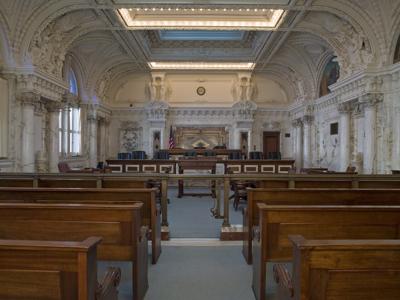



Courtroom One, James R. Browning Federal Courthouse, San Francisco, home of the U.S. Ninth Circuit Court of Appeals
SAN FRANCISCO — Courts can't delay making new filed court documents available to the public, a federal appeals panel has ruled.
In a case arising out of Idaho, online legal news publisher, Courthouse News Services, sued Sara Omundson, in her official capacity as Idaho Courts administrative director, challenging the state’s policy of shelving new civil complaint filings until a manual review results in accepting or rejecting the document. CNS said the procedure can prevent access to filed complaints for a few minutes to several days.
According to court records, in 2015 Idaho started using a Tyler Technologies electronic filing system called Odyssey. Under the state’s Rules for Electronic Filing and Service, when a clerk accepts a complaint it’s immediately made public. If a clerk rejects a complaint, it’s deemed to have never been filed.
CNS, which has pursued similar lawsuits nationwide for more than 10 years, said Idaho’s system means more than 40% of new complaints remain offline until at least the next business day, while 15% are delayed at least two calendar days, although the figures are disproportionate from one county to another.
U.S. District Judge David Nye granted CNS’ motion for summary judgment, finding the First Amendment gives the public the right to access judicial documents when the complaint is received, not when a clerk agrees it’s filed correctly.
Idaho challenged the ruling before the San Francisco-based U.S. Ninth Circuit Court of Appeals.
The Ninth Circuit hears appeals from federal courts in California, Idaho and seven other western U.S. states.
Judge Margaret McKeown wrote the panel’s opinion, filed Sept. 3; Judges Jennifer Sung and Sidney Fitzwater concurred.
Fitzwater is a district judge for the Northern District of Texas and sat on the panel by designation. McKeown also wrote a special concurrence, which Sung joined.
“We are not writing on a blank slate,” McKeown noted, pointing to similar litigation CNS has also brought against Ventura County, California.
The panel first said Judge Nye was correct to consider the case, rejecting Idaho’s position that abstention was proper to avoid federal interference in state courts.
“Requiring Idaho to implement a change to its statewide e-filing system would not engender any continuing federal-court oversight at all — Idaho need only effectuate a one-time switch to” a different approach, McKeown said. The panel explained Odyssey has an Auto Accept option — which “virtually all federal district courts follow” — making everything public upon submission. It also offers a Press Review Queue, for which Tyler charges $108,000 annually after a setup fee, under which everything is immediately public while retaining a clerk’s manual processing responsibility.
The panel noted its position is in conflict with a 2018 ruling from the U.S. Seventh Circuit Court of Appeals holding a federal judge in Chicago should’ve abstained rather than order Cook County Circuit Courts to change filing procedures. But McKeown noted “we expressly rejected” that decision when addressing the Ventura County matter and wouldn’t change positions because the Idaho dispute affects an entire state.
“Idaho draws a distinction between a plaintiff’s submission of a complaint to the state court’s e-filing system and the court clerk’s ultimate decision to deem that complaint filed after processing,” McKeown wrote. “The notion that a filed complaint is not a ‘judicial document’ defies common sense.”
The panel said its own earlier decisions, along with those from other circuits, established “whether a complaint is a judicial document depends on whether the document is filed” online or in person, not whether a clerk deems it was filed correctly.
“Under Idaho’s restrictive conception of the public-access right,” McKeown said, “pre-process delays would be constitutionally irrelevant, despite those delays routinely lasting as long as those we deemed ‘significant’ when striking down Ventura County’s analogous process-first policy.”
The panel noted CNS isn’t challenging Idaho’s policy of having clerk’s review complaints or its ability to correct errors in submissions, nor did Judge Nye issue such an order. While the state noted only its judges can address errors after a clerk accepts a complaint, McKeown said that’s an administrative rule the state “could easily modify” by giving such power to clerks. She further noted that “when court administrative rules and a constitutional right collide, the constitutional right prevails.”
McKeown also said Idaho could mark pre-reviewed documents as such and said any state “interest in protecting litigant and third-party confidentiality is not, properly construed, Idaho’s duty at all — it is the duty of filer, and not the clerk or the Idaho courts, to ensure that sensitive information is redacted or that the complaint is filed under seal.”
In the concurrence, McKeown clarified a position on 1984 U.S. Supreme Court precedent in Press-Enterprise v. Superior Court as “a form of strict scrutiny that applies to denials of access to court proceedings.”
Whereas First Amendment rights can be subject to government limitation on time, place and manner of speech or other expressive activity, McKeown explained: “Idaho’s process-first policy resembles a denial of access. … The at-issue conduct is CNS’ access to newly filed complaints. It is not clear how a TPM restriction would apply directly to the right of access, which is protected by the First Amendment in order to facilitate expressive activity, but is not itself inherently expressive.”
She continued to extol the value of being able to freely discuss governmental affairs and said the state should only be able to delay such access with policies that “can survive our most exacting scrutiny.”
Courthouse News Service is represented by Bryan Cave Leighton Paisner, of San Francisco, and Givens Pursley, of Boise, Idaho.
Omundson is represented by Duke Evett, of Boise.
The Reporters Committee for Freedom of the Press, based in Washington, D.C., along with 23 media organizations, filed a support brief.
