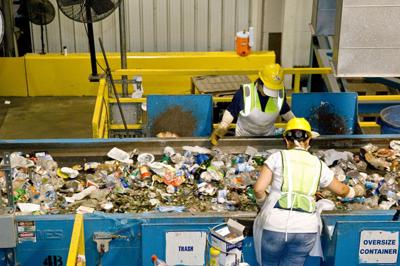


Recycling center
SACRAMENTO — Saying California is attempting to use its outsized economic heft to impose its "bespoke environmental preferences" on the entire U.S. without a vote, a coalition of 17 states have sued the Golden State to block the state's new law banning a host of disposable plastic products.
The lawsuit, led by Nebraska Attorney General Michael T. Hilgers, was filed June 22 in Sacramento federal court.
Hilgers, a Republican, was joined in the action by his counterparts from the states of Florida, Texas, West Virginia, Georgia, Missouri and other Republican-dominated states.
They are joined in the action by the National Association of Wholesaler-Distributors (NAW), a trade group representing the wholesale distribution industry, which the NAW describes as "the backbone of the supply chain" feeding the U.S. economy.
The lawsuit seeks to block California from continuing to enforce the industry mandates imposed by the state law known as the Plastic Pollution Prevention and Packaging Producer Responsibility Act, otherwise known as "the Plastics Act."
Signed into law by Gov. Gavin Newsom in 2022, the Plastics Act would nominally require that by 2032, all plastic packaging sold and used in California be recyclable or compostable; all plastic packaging be cut by 25% compared to 2022; and 65% of all single-use plastic packaging be recycled.
The law also imposed $5 billion in costs on plastics manufacturers, payable to the state, which state officials claimed would be used to help achieve the law's goals.
However, earlier this spring, the California Department of Resources Recycling and Recovery, also known as CalRecycle, moved ahead with permanent regulations, which would spell out how the Plastics Act would be enforced. The so-called "Extended Producer Resposibility" program under the law would take effect Jan. 1, 2027.
The Republican attorneys general and NAW, however, responded with their legal action.
In the lawsuit, they claim the California law doesn't just apply to California and won't just affect California. Rather, because California is by far the largest state economy in the U.S., the other states argue California is using that market leverage to force the entire plastics industry to change, harming manufacturers, distributors and consumers by raising prices everywhere, especially for essential products like food, medicine and other health care products.
And the other states argue that action amounts to an unconstitutional move by California to force the rest of the U.S. to comply with its new law, but without any ability to vote on new de facto national policies.
"In essence, the Act conditions access to California markets on revolutionary changes to the way manufacturers, distributors, and companies (large and small) design and package their products, as well as how plastic or plastic-containing packaging waste is disposed," the lawsuit says.
"Many of the Act’s unprecedented requirements reflect California’s bespoke environmental preferences — preferences irreconcilably at odds with those of many other States.
"Virtually every product packaged or shipped in plastic containers, as well as a significant number of other types of packaging materials that merely incorporate plastics, fall into the Act’s remarkable sweep. Either directly or indirectly, the Act purports to mandate a wholesale transformation of many products and related business models of innumerable businesses across the country.
"... The genius of our system of federalism is that it allows for differing views on and approaches to important policy questions. What it does not allow is for one State — no matter how populous or economically significant — to impose its policy preferences on all others."
The lawsuit also takes aim at California's decision to invest the authority to collect $500 million in annual industry fees to an "unelected ... unaccountable private organization," known as the Circular Action Alliance.
"Once again, California is trying to enact a policy that negatively impacts the rest of the country," Hilgers said in a release announcing the lawsuit. "If California goes unchecked, consumers will be forced to pay more for basic necessities."
Eric Hoplin, president and CEO of NAW, added: “California is not entitled to pronounce nationwide policies. Because the Act extends California’s regulatory reach far beyond its borders and brings within its sweep conduct wholly unconnected to California, the Act violates principles of federalism, the horizontal separation of powers, and due process.”
The lawsuit seeks a court order declaring California's law violates both the U.S. Constitution and California state constitution and blocking California from enforcing its law.