

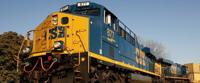


CSX train
ERIE – At least some of the blame for a fatal collision with a CSX train falls on the car’s driver, a federal judge has ruled while allowing a jury to decide if the railroad company is on the hook for the rest.
The estates of Timothy Powell, Jr. and Chaunee George won’t be able to pursue punitive damages against CSX, Pennsylvania federal judge Susan Paradise Baxter ruled last week. Though police said George caused the collision by failing to stop, the plaintiffs will be able to argue CSX is partly liable.
George and Powell died June 26, 2019, where CSX tracks cross Ellis Lane in Springfield Township in Erie County. Both were 18 years old.
“At a minimum, the foregoing expert reports submitted by Plaintiffs raise genuine issues of material fact regarding the comparative negligence of the parties that are left for a jury to decide,” Baxter wrote.
After being sued, CSX pointed the finger at George. Its motion for summary judgment said she failed to observe the “stop, look and listen rule” before driving over the crossing.
The conductor said the train’s engineer was blowing the horn when a blue car came “flying over the crossing.”
“She never looked or stop[ped] and we hit her straight on and dragged the car to the next crossing,” he said after the accident. The Pennsylvania State Police’s investigation determined George caused the collision, and crash data from the car showed she did not stop.
George slowed from 29 mph to 19 when going over the tracks. But plaintiffs attorneys have two experts who will testify that because of the wooded areas on both sides of the road, the railroad tracks are somewhat hidden and the sign indicating a railroad crossing is not clearly visible.
Warning signs were 750 feet from the crossing, which is five times farther than the distance recommended by the state Department of Transportation. The road was unpaved with potholes that would cause a driver to become distracted, one expert will say in arguing CSX failed to address these safety hazards.
CSX had sought absolution under state laws regarding contributory negligence, but Baxter said though George apparently caused the accident, a jury could find CSX is partly at fault too.
She did, however, toss claims for punitive damages. Attorneys attempted to bolster that argument with an expert who said CSX should have installed lights and gates at the crossing because the wooded areas kept drivers from detecting approaching trains.
But that claim was contradicted by another of the plaintiffs’ own experts, who said sight distance was not a concern and George would have seen the train if she’d turned her head to the left three seconds before crossing.
“Based on this record evidence, the perceived failure of Defendant CSX to maintain the vegetation at the Ellis Road Crossing cannot support an award of punitive damages in this case,” Baxter wrote.