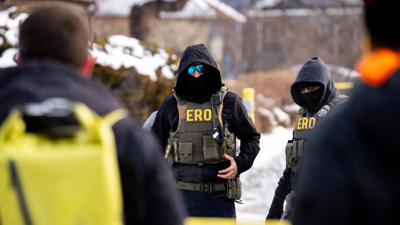



Enforcement and Removal Operations agents stand near a cordoned area in Minneapolis after an ICE agent fatally shot a motorist during a federal immigration enforcement operation.
PHILADELPHIA - The Trump administration has added to its wins against state and local governments that try to ban federal immigration enforcement officers from wearing masks during law enforcement operations.
Last week, U.S. District Judge Chad Kenney of the Eastern District of Pennsylvania issued a preliminary injunction preventing the City of Philadelphia from enforcing Bill 260060, an ordinance that would make it a crime for law enforcement officers, including federal officers, to wear face masks or conceal their badges or other identifying information.
Laws banning federal officers from wearing masks and requiring them to display identification are part of a broader movement by Democrat-controlled states and localities to impede and prevent Immigration and Customs Enforcement operations in the wake of fatal shootings by ICE agents in Minneapolis.
In addition to Philadelphia, California, Connecticut, New York, Oregon, Virginia and Washington have passed similar mask bans and identification requirements. A New Jersey law and executive order from New Jersey Gov. Mikie Sherrill prohibit federal officials from using nonpublic state-owned property – like office buildings, parking lots and parking garages – in connection with federal immigration enforcement activities.
The Trump administration has been fighting back, though, by suing to overturn and stop enforcement of these laws. With Judge Kenney’s injunction, Bill 260060 joins laws in California and Virginia that have been barred from taking effect.
In February, Judge Christina Snyder of the Central District of California enjoined enforcement of California’s No Secret Police Act, which would prohibit federal agents from wearing masks, but refused to halt California’s No Vigilantes Act, requiring federal agents to wear identification when conducting law enforcement activities. Enforcement of the No Vigilantes Act was later paused by the Ninth Circuit Court of Appeals while the United States appeals that decision.
On the same day that Judge Kenney issued his order enjoining Philadelphia’s Bill 260060, Senior Judge Robert Payne in the Eastern District of Virginia barred Virginia’s Mask/Identity Law from taking effect.
Connecticut’s mask ban and New Jersey’s sanctuary law are also being challenged by the administration. Briefing on the government’s motion to stop enforcement of the Connecticut law, which has already taken effect, will be completed by July 27.
In late June, the administration filed suit in federal court in Buffalo to stop enforcement of New York’s ban on mask-wearing by federal agents. On the same day, New York sued seeking a declaration that the law is constitutional and “a lawful exercise of New York’s sovereign authority.”
But even before the federal injunction stopped Philadelphia’s law from taking effect, Bill 260060 got off to a questionable start. Mayor Cherelle Parker refused to sign the law after City Solicitor Renee Garcia sent a letter stating that Bill 260060 had “significant legal problems, primarily concerning the authority of the City to regulate the conduct of federal officers when carrying out their duties under federal law.”
Under Philadelphia’s Home Rule Charter, the mayor cannot pocket veto a bill and so Bill 260060 became law on May 8 without the Parker’s signature and was set to take effect on July 7.
In its complaint seeking to invalidate the bill and asking for an injunction, the administration argued that “Philadelphia has no authority to regulate federal officers in this way, any more than it could regulate the color of their vests, forbid federal agents from carrying guns, or require them to give state- or local-law warnings before effectuating arrests.”
Judge Kenney agreed. “’As every schoolchild learns,’” Kenney wrote, quoting a 1991 U.S. Supreme Court ruling, “’our Constitution establishes a system of dual sovereignty between the States and the Federal Government…’ But when there is conflict between the two sovereign authorities, the Supremacy Clause ensures that federal law controls.”
In Judge Kenney’s view, there was no question about Philadelphia’s intention to interfere with and impede federal immigration enforcement. Bill 260060 was part of a larger “ICE Out” package of bills presented to Mayor Parker, he noted.
What’s more, Philadelphia District Attorney Larry Krasner made clear that he would use the law to target federal immigration officials. This included statements by Krasner that he intended to “to ‘arrest’ and ‘put handcuffs’ on federal agents who break the law” and that he had launched a “Fight Against Federal Overreach” coalition in an effort “‘to assist in prosecuting federal law enforcement officers who violate state laws’ and ‘to ensure that constitutional limits on federal power are actively enforced.’”
“It is therefore easy to ‘see the [bill] for what it really is,’” Kenney found. “In no uncertain terms, [Bill 260060] explicitly seeks to control how federal law enforcement officers perform their governmental duties and conduct operations.”
And the harms to federal officials and enforcement programs from enforcement of the bill are more than hypothetical, Judge Kenney found. In affidavits supporting its motion, the government described efforts to dox immigration agents on the liberal-leaning social media platform, BlueSky.
Ultimately, Judge Kenney concluded that accepting Philadelphia’s view that states and municipalities have the authority to direct federal law enforcement activities means those entities could pass their own laws that would devolve into a patchwork that would “defeat all ends of the government” and cause “national disruption.”
“When the Philadelphia City Council voted to pass [Bill 260060],” Kenney wrote, “it attempted to sidestep the Constitution’s clear mandate” that states have no power to control the federal government “and disregarded this fundamental principle of law that has informed American jurisprudence for over 200 years.”