
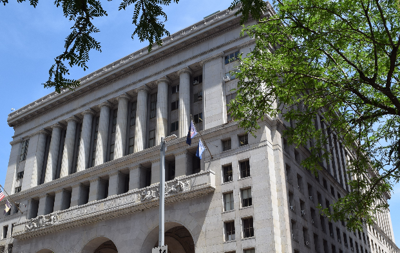



Allegheny County Courthouse
PITTSBURGH – Men claiming they were raped while juveniles at Pennsylvania detention centers would disagree that time heals all wounds, as it could be the very thing that disrupts their quest for justice.
Lawsuits target the Cornell Abraxas Group, which operates youth rehabilitation centers in South Mountain, Morgantown and Marienville. But according to many lawsuits, staff routinely sexually assaulted minors who were placed there by court order and intimidated them to prevent any reporting.
With control over progress reports, phone access and visitation privileges, among other things, employees could use the boys to fulfill deviant sexual urges, the cases claim. One plaintiff who says beatings were regular alleges a female staff member would watch detainees in the shower and forced him into receiving oral sex under threat of more physical abuse.
This was after two male staffers had tried to hold him down in the woman’s office when he had refused to pull his pants down, he says. But time isn’t kind to his lawsuit or any of the others filed against Abraxas – the plaintiff can’t actually remember the name of one of the men who dragged him out of a shower naked or how to spell the names of the other employees, offering only physical descriptions and phonetic spellings.
Add in the state law that was in effect at the time (some of the alleged assaults occurred close to 20 years ago) and the lack of medical documentation, and the cases present a challenge for lawyer D. Wesley Cornish of Cornerstone Legal Group. He’s filed four federal lawsuits this year and several more in Pittsburgh state court through the years.
“I think the biggest hurdle will be the amount of time that has passed,” Cornish told the Pennsylvania Record. “Often these individuals might not still be working at the facilities years later, and there’s no video tape of the incidents that happened.
“When there’s abuse, to hide the abuse, children aren’t taken to medical providers or an outside hospital or doctor.”
Time waits for no lawsuit
Bringing individual complaints poses procedural hurdles for plaintiffs to clear, like filing the lawsuits within the time allowed under Pennsylvania’s statute of limitations for personal injury and sexual abuse claims.
For many victims who were sexually abused as minors, claims against abusers fail because they are often brought well after the two-year limitations period has expired. This is true even when the two-year window does not start until the alleged victim turns 18 years old.
In 2019, Pennsylvania expanded its statute of limitations to allow victims of sexual abuse as minors to bring a claim until they turn 55. Individuals who are sexually abused between the ages of 18 and 24 have until their 30th birthday to bring a claim.
This extension of the limitations period, however, did not resuscitate claims that already were time-barred under the old statute, and so anyone who was sexually abused as a minor who turned 18 years old in 2017 could not recover damages for the alleged abuse unless they filed a claim by 2019, or two years after they turned 18.
Without help from legislators, many cases are doomed from the start. One plaintiff said he went to a nurse for a physical examination, only for the nurse to masturbate him to completion under the excuse of an STD test.
But this was in 2008-09. A federal judge found in 2024 that state law “does not extend” his time for filing and dismissed claims, without prejudice.
Last year, lawmakers introduced two bills aimed at providing a new two-year window for bringing sexual abuse cases that have been time-barred, but it’s been nearly a year since they’ve been considered.
HB 462 would revive for a new two-year period sexual abuse cases that currently are time-barred. It passed the House in June in a 122-80 vote but has sat idly in the Senate Judiciary Committee since.
It’s the same fate as HB 464, passed 138-64 by the House. It would amend the Pennsylvania Constitution to create the same two-year window but has been in the Senate State Government Committee since June.
"This bill is not about any one institution or individual, this bill is about survivors of childhood sexual abuse seeking justice against the perpetrators of those crimes,” sponsor Nate Davidson said last year. “They deserve to have their day in court, and the institution of the General Assembly would be well served to pass this long-overdue amendment clean and without delay.”
Time passes. Memories fade.
The amount of time that has passed since the alleged abuse doesn’t only show itself in dates on court documents but in the testimony plaintiffs present.
“It is further believed that Plaintiff was abused in additional ways and/or on additional occasions, but Plaintiff has emotionally suppressed partially and/or in whole these additional details and/or episodes of abuse,” cases say.
A lack of specifics gives Abraxas and co-defendant The GEO Group, which shared a business partnership with Abraxas from 2010-2021, another defense in court. Without names, dates and records, plaintiffs’ cases fail.
Earlier this year, Abraxas and GEO recognized the “serious” nature of the allegations but argued they were “unproven and unsubstantiated.” They attacked the complaint as bald, inflammatory and “devoid of verifiable facts.”
“(T)his Honorable Court has repeatedly held that plaintiffs bringing forth claims of sexual abuse must provide, at minimum, some facts about these individuals, and the associated actions or inactions at issue,” the defendants wrote.
A Pittsburgh state judge held in 2024 that plaintiffs could provide job titles or physical descriptions when they could not remember names. Cornish, the victims’ lawyer, hopes discovery will lead to some identities in his newest cases.
“We’re obviously going to have to take some discovery and see who was hired to see if Abraxas had followed all their policies,” he said. “It’s a common allegation that Abraxas doesn’t properly ensure employees are supervised after they commit abuse.”
He had tried to group clients together in a 2022 federal class action, but creating a class of alleged victims since 2000 was too ambitious, Judge Christy Criswell Wiegand found.
After two years of litigation, Wiegand denied the plaintiffs’ motion for class certification, ruling that the motion was “devoid of any legal argument or factual support for certification” and “stumble[d] on the threshold hurdle of ascertainability.”
“[B]y defining class membership based on violating a provision of statutory law, the Plaintiffs have inextricably intertwined identification of class members with liability determinations, such that the putative class members cannot be ascertained without extensive and individualized fact-finding mini-trials,” Judge Wiegand wrote.
The case was closed in April 2024.
Time is cruel
Institutional abuse is something that Pennsylvania courts have had to handle, like in the cases of the Penn State football program and the Catholic church. A grand jury report of clergy abuse started, “We, the members of this grand jury, need you to hear this” and identified credible allegations against more than 300 priests.
“As a consequence of the coverup, almost every instance of abuse we found is too old to be prosecuted,” it continued.
So, time healed the church’s wounds. For some of Cornish’s clients, who say their troubles as teens led them to Abraxas facilities but instead of rehabilitation they were forced to endure further trauma, that’s not the case.
“It’s had a pretty severe effect on all the plaintiffs,” he said. “If you look up the plaintiffs, they’ve had brushes with the criminal justice system.
“They were abused, they were forced to hide their abuse and if they disclosed it, they could’ve suffered severe consequences. Essentially, the plaintiff or student would be forced to stay at the facility longer or suffer some other discipline.
“They knew if they disclosed what really had happened, they would be punished for telling the truth.”
A message to the Attorney General’s Office asking whether the facilities are being investigated was not returned. Abraxas calls the allegations unsubstantiated and recently scored a federal contract to house juveniles who are undocumented immigrants.
“Trump administration jails migrant teens in facility known for child abuse,” the New York Times headline reads.
Cornell Abraxas operates several treatment, detention and residential facilities in Colorado, Illinois, Ohio and Pennsylvania and recorded revenues of over $65 million in 2023, which contributed significantly to its parent company’s total revenues of $102.7 million.
Abraxas Academy holds six licenses from the Pennsylvania Department of Human Services to provide secure care, residential services and transitional living to upward of 135 children and adolescents at the Morgantown facility.
According to a Department of Human Services report from 2013, there have been two allegations of sexual abuse by a staff member at Abraxas Academy against two residents. In addition to identifying other violations, the 2013 report states simply, “Staff Member B sexually abused Child #3 and #4.” There is no indication of exactly when the abuse took place, though the report notes that the “facility followed the appropriate reporting protocol upon receiving the allegation of suspected abuse” and staff member B was fired in April 2013.
Several other violations were noted, including use of restraints “known to cause pain to the child” and failures to put in place health and safety plans to address allergic reactions by two of the children in custody.
These violations were identified as part of a state inspection of the Abraxas Academy between July 22 and July 24, 2013. Notwithstanding these violations, Abraxas’ license “remain[ed] in good standing.”
In November 2025, the Department of Human Services notified Cornell Abraxas that it had revoked one of Abraxas Academy’s certificates of compliance at the Morgantown secure detention unit based on a finding of “gross incompetence, negligence, and misconduct in operating the facility; and failure to provide access.”
These findings related to allegations that a staff member had “shov[ed]” a child’s “face to the table briefly,” that a staff member had provided “contraband to residents,” and that staff had failed to report attempts to escape by residents.
Cornell Abraxas’ appeal of the revocation is pending decision by the DHS.