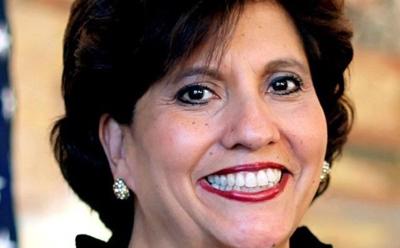


U.S. Ninth Circuit Judge Mary Murguia
SAN FRANCISCO - A landmark ruling blocking the state of California from enforcing laws and policies which a federal judge said trampled the rights rights of parents to not be kept in the dark by public school teachers and administrators if their children begin identifying as a different gender at school has, itself, been blocked by a federal appeals court.
In response, attorneys representing the parents and teachers who sued to secure the now-paused ruling have said they will seek immediate appeal, including to the U.S. Supreme Court.
On Jan. 5, a three-judge panel of the U.S. Ninth Circuit Court of Appeals granted the request from the state of California for an emergency stay of the ruling from U.S. District Judge Roger Benitez.
The stay was imposed in an unsigned order delivered by the panel including Ninth Circuit Chief Judge Mary Murguia and Circuit Judges Andrew D. Hurwitz and Salvador Mendoza Jr.
“California is trying to undo this victory for families and educators, but we will not let that happen. This is an issue of national importance and will likely need to be settled by the U.S. Supreme Court,” said attorney Paul M. Jonna, one of the lawyers representing the plaintiff parents and teachers, in a statement released following the appeals court's ruling.
“While the fight continues at the appellate level, we remain confident that our clients’ constitutional rights will ultimately be vindicated. Parents have a fundamental right, recognized by the Supreme Court for over a century, to direct their children’s upbringing. Teachers have a constitutional right to communicate honestly with parents without being forced to deceive them in violation of their faith. California cannot override these rights, and we are prepared to take this case as far as necessary—including all the way up to the Supreme Court—to protect the families and educators who are being harmed by these policies.”
All three of the judges on the Ninth Circuit panel were appointed by Democratic former presidents. Murguia and Hurwitz were appointed by former President Barack Obama, while Mendoza was appointed by former President Joe Biden.
The decision means the ruling delivered by Judge Benitez just before Christmas will not carry any legal weight, at least for now, and the state policies and laws at the heart of the case remain in effect.
In the Dec. 22 ruling, Benitez explicitly declared public schools cannot withhold from parents or otherwise mislead parents about their students' gender expression or status at school. He said any state law or local policies that interfere with parents' right to know violates their rights under the Fourteenth Amendment and First Amendment of the U.S. Constitution.
The judge also ruled the state can't prevent teachers and school staff from telling parents about their children's gender expressions or status, without similarly violating the teachers' and staff members' First Amendment rights.
In the ruling, Benitez blasted California officials for repeatedly asserting the guarantees of privacy rights for students under California's state constitution and state law outweighs the rights of parents under the U.S. Constitution to know medically, psychologically and religiously significant information about their children, as well as the parents’ rights to direct the religious upbringing of their children.
"The state bases its legal position on a derogation of the parents’ federal constitutional right to care for and raise their children and an unwarranted aggrandizing of a student’s state-created right to privacy. California’s education policymakers may be experts on primary and secondary education but they would not receive top grades as students of Constitutional Law," Benitez wrote.
The judge also repeatedly faulted state officials for crafting laws, policies and regulations which begin at the presumption that parents who learn that their children may be questioning their gender will respond with abuse and harm, so justifying policies which allow public schools to mislead, stonewall or outright lie to parents about their children's gender status and presentation.
Benitez imposed a statewide permanent injunction against the state of California and any public school districts that would seek to continue the policies. The ruling was on behalf of a class of all parents of public school students and public school teachers throughout California.
The state, however, appealed immediately, asserting the ruling would create chaos and uncertainty within the schools and harm transgender students.
Just before the New Year's holiday, the Ninth Circuit panel granted a temporary stay on the ruling, but without comment.
The panel followed up with its Jan. 5 order, indefinitely staying Benitez's injunction.
In the ruling, the judges blasted Benitez's ruling, calling it overly broad and too sweeping.
The Ninth Circuit, however, has upheld more sweeping injunctions on controversial topics, including a nationwide injunction blocking the Trump administration from seeking to limit birthright citizenship.
That ruling was struck down by the U.S. Supreme Court, which said such nationwide injunctions are generally improper. In that ruling, the Supreme Court further indicated sweeping injunctions could still be allowed in certain circumstances, including potentially in class action-style lawsuits.
However, in this case, the Ninth Circuit panel of Obama and Biden appointees said Benitez's ruling went too far and was not "narrowly tailored" enough to address the potential "harm" that the ruling could inflict on the state of California by blocking California's ruling Democratic supermajority from imposing its preferred state laws and policies.
The judges said they also said they believed Benitez's findings affirming the rights of parents and teachers to be superior to California state law to be constitutionally unsound, because they doubted teachers and parents could show they have been harmed by the state law and education policies.
The judges further said they believed Benitez's ruling was based on an incorrect reading of the facts in the case, as well. The judges sided entirely with the state, saying it is enough that state policies don't "categorically forbid" public school teachers from telling parents "information about students' gender identities ... without student consent."
The judges noted the policies, however, still leave such disclosure to the discretion of school officials, only if they determine "there is a compelling need to do so to protect the student's wellbeing" or to "avert a clear danger to the well-being of a child."
The Ninth Circuit judges claimed their reading of the policies leaves them "not clear ... which particular policies are problematic."
And the judges brushed aside Benitez's determination that the California laws and policies trample parents' First Amendment religious freedom rights, because the "challenged policies appear to apply only when a student makes the voluntary decision to share their gender nonconformity with the school."
Benitez's First Amendment religious freedom holding was based in the Supreme Court's 2025 decision in Mahmoud v Taylor, in which the high court determined a public school district infringed on the religious rights of parents by not allowing parents to opt their children out of school activities in which school officials explicitly promote and incorporate pro-LGBTQ content into curriculum, lessons or special school assemblies or events.
The appellate judges, however, said Benitez again read the Mahmoud v Taylor decision too broadly.
They asserted the ruling was a narrow one, solely focused on "coercive 'curricular requirements,'" and, thus, shouldn't be extended to state and school policies regarding the disclosure of student information to parents.
In his ruling, Benitez had found the California gender disclosure policies "impose a similar, if not greater, burden on free exercise” than the policies struck down by the Supreme Court in Mahmoud.
The appellate judges said they expected Benitez's ruling will ultimately be reversed, perhaps entirely.
Plaintiffs, however, said it is the appellate judges who will be reversed. They said they were "deeply disappointed" in the ruling, which they called "an extraordinary step" which "misapplied both the facts and the law."
They said they will seek review of the panel's decision from a larger en banc panel of 11 Ninth Circuit judges, as well as from the U.S. Supreme Court.