
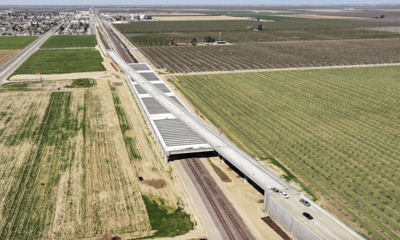


The Wasco Viaduct in Kern County is one of the major infrastructure components completed thus far on California’s Central Valley high speed rail line course. In all, just 60 miles of that 171 mile segment has been completed between Merced and Bakersfield, with costs ballooning from initial estimates of $30 billion, with a completion date of 2020, to more than $106 billion as of early 2026, with an estimated completion date now pushed back to 2033.
SACRAMENTO - California officials last month dismissed a lawsuit filed by the state’s High-Speed Rail Authority that challenged the federal government’s decision to cut $4 billion in grant funding for what the Trump administration sees as a wasteful “boondoggle.”
Attorneys with the state Attorney General’s Office filed the dismissal notice on Dec. 23 in the Eastern District of California. The plaintiff requested the legal action to be dismissed without prejudice, meaning it could be refiled in the future.
Last July, the Federal Railroad Administration (FRA) terminated the $4 billion from California’s all-electric railway project, which is designed to transport travelers around the state at more than 200 miles per hour. Federal Transportation Secretary Sean Duffy said the project was chock-full of “serious issues” with no guarantees of completion.
“The waste ends here,” Duffy said in a prepared statement. “... The American people are done investing in California’s failed experiment. Instead, my department will focus on making travel great again by investing in well-managed projects that can make projects like high-speed rail a reality.”
In a statement emailed to the Southern California Record, the authority said the federal government was no longer a reliable partner to advance the high-speed rail project.
“Combined with the administration’s persistent lack of good-faith engagement, this made clear that the federal government is unlikely to uphold its commitments to California,” the statement said. “As a result, the state has opted to move forward without the Trump administration. We regret that they will not share in California’s success.”
The authority has suggested that attracting private investors and “strategies to commercialize assets” would provide an accelerated path to complete the project.
“We also see this moment as a new opportunity,” the authority said in its statement. “Federal requirements have, at times, hindered project delivery by adding cost and delays without adding value – creating inefficiencies, constraining innovation and slowing construction.”
Proceeding without the federal government’s support will allow the authority to ensure a world-class rail transit system, according to the statement.
The authority notes that a large majority of the project funds comes from the state, with the federal government contributing only 18% of the funds. The voter-approved rail network will also receive $1 billion per year through 2045 as a result of Gov. Gavin Newsom’s signing of legislation last year authorizing a cap-and-invest program to reduce greenhouse gas emissions.
The authority expects the initial 171-mile Merced–to-Bakersfield segment of high-speed rail to begin passenger service by 2032 or 2033, but federal officials question the timetable.
The authority’s 2025 lawsuit against the Trump administration over the cancellation of funds argued that the FRA action was arbitrary, capricious, illegal and a threat to the economy of the Central Valley and the state as a whole. High-speed rail, according to the complaint, was designed to help address the problem of climate change and spur economic growth in the Central Valley and beyond.
President Trump asserted in error that it would be cheaper to take passengers between San Francisco and Los Angeles by limousine rather than through high-speed rail, the lawsuit said. In addition, Trump falsely stated that the high-speed rail project is “one hundred times over budget” when the total project budget stands at about $106 billion.