
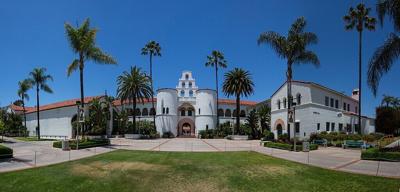


Harper Hall, San Diego State University
SAN DIEGO - A federal judge has granted preliminary approval to a settlement that would end a class action on behalf of more than 800 female athletes who accused San Diego State University of violating Title IX through an alleged systematic favoring of male athletes and their programs with respect to funding and other opportunities.
U.S. District Judge Todd Robinson issued an opinion Jan. 7 taking a significant step toward resolving litigation dating back to a February 2022 complaint from 15 members of the school's track and field and rowing teams. Their evidence included allegations of providing less financial aid to female athletes than males at a reduction of between 4.17% and 8.98% for more than a decade.
Robinson approved one class of all SDSU female athletes since the lawsuit was filed — that group would be eligible only for injunctive relief — and a second class of female athletes who participated in SDSU programs from 2018 to 2025, yet allegedly did not get all the possible athletic financial aid.
Under terms of the deal, SDSU will pay $300,000 for the second class, which currently has 826 identified members. A distribution formula is the responsibility of the class’ legal team, lawyers from the San Diego firm of Casey Gerry Francavilla Blatt and the Oakland firm Arthur Bryant Law, SDSU agreed to pay $1.3 million toward the plaintiffs’ legal expenses.
The injunctive relief includes SDSU’s agreement “to hire a mutually agreeable neutral third party to conduct a Gender Equity Review of its athletic department using the process consistent with the U.S. Department of Education’s Office for Civil Rights’ 1990 Title IX Investigator’s Manual,” according to Robinson.
SDSU will use those findings to create and implement a new plan for gender equity that will bring the school into compliance by the spring of 2027. The university will provide three annual summary updates, starting July 31, 2026, regarding implementation and will post the plan and reports on its varsity sports website.
Other relief includes a commitment to “providing equitable nutrition to a comparable number of male and female” athletes, Robinson said, giving coaches from all teams equal opportunities to fly to competitions further than a six-hour drive; allowing hotel stays in San Diego before home contests; repairing the women’s outdoor track in the current school year; replacing the women’s lacrosse field turf no later than the spring of 2028; assigning someone who isn’t a coach or player to stream home contests; and ensuring professional photography and publicity are equal to teams of each gender.
Robinson’s opinion indicates Class 2 members will get $172 per qualifying academic year, despite the third amended complaint calling for between $4,531 and $6,343 per year. He said the lack of information on the steep reduction in joint settlement motion “initially appeared problematic,” but he learned during a hearing that the initial values came from Equity in Athletics Disclosure Act figures and discovery provided “access to financial distribution data that reduced potential recovery.”
Robinson further noted the values in the complaint didn’t account for maximum financial aid limits, said SDSU insisted the athletes would be entitled only to equitable relief, and noted “there have been no similar financial aid Title IX lawsuits resulting in monetary damages for plaintiffs.”
Regarding the ratio of legal fees to cash available to class members, Robinson acknowledged the outsized ratio, but said the $1.3 million is “a significant reduction" from the traditional amount attorneys calculated — $3.2 million — while also not being out of line with other settlements in which plaintiffs recovered little or no money. He further said he analyzed the deal to ensure the lawyers weren’t accepting an unfair settlement in order to collect their own fees and noted the named plaintiffs who reached individual settlements got no additional financial award.
Potential class members have until March 17 to opt out of the deal and final approval documents are due by March 19. A final approval hearing is set for April 16.
Other attorneys working for the class include Bullock Law, of Des Moines, Iowa, and Haeggquist & Eck, of San Diego.
SDSU is represented by Miller, Canfield, Paddock and Stone, of Detroit, and the office of California Attorney General Rob Bonta.