
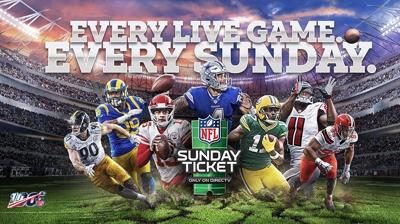


A former NFL Sunday Ticket logo
SAN FRANCISCO — The National Football League is back on the hook for a payout potentially worth billions of dollars to Sunday Ticket subscribers, after a federal appeals court said a lower court judge improperly tossed out a $4.7 billion jury verdict in an antitrust lawsuit accusing the league of using anticompetitive practices to overcharge for the league-wide TV package.
However, how much the NFL may ultimately need to pay will need to be determined at another trial, as the appeals court said the jury miscalculated.
On Oct. 30, a three-judge panel of the U.S. Ninth Circuit Court of Appeals reinstated a Los Angeles federal jury's finding that the NFL should be held liable for allegedly partnering with satellite television provider DirecTV to allegedly force football fans, sports bars, restaurants and others to pay more than they otherwise may have needed to to access every NFL game through the subscription package known as NFL Sunday Ticket.
In the ruling, the judges said they believed a Los Angeles federal judge wrongly overturned the jury's verdict by finding testimony from two experts hired by the plaintiffs to establish their claims against the NFL should be excluded.
Without that testimony, the judge found, the case against the NFL collapsed, along with the resulting verdict.
However, the appeals judges said the experts' testimony should have been considered valid, even if the other party or the judge can poke holes in it.
The Ninth Circuit decision was authored by Circuit Judge Anthony D. Johnstone. Ninth Circuit Judge Holly A. Thomas and U.S. District Judge Joan H. Lefkow concurred.
Lefkow, a federal judge based in Chicago, served on the panel by special designation.
"As a gatekeeper for expert testimony, a district court must exclude unfounded or unreliable opinions," Judge Johnstone wrote in the ruling. "But opinions are neither unfounded nor unreliable merely because they are impeachable. Such opinions are for the jury to weigh at trial. Once a jury does so, its verdict must stand unless it is clearly not supported by the evidence."
While the finding of liability against the NFL should be reinstated, the appeals panel said the jury used improper figures to slap a $4.7 billion payout order on the NFL. So, the judges ordered a new trial to determine the proper amount the NFL may owe to current and former subscribers.
It is not yet known when that trial may occur.
The dispute landed in federal court in 2015, when class actions were first brought in federal court accusing the NFL and DirecTV of allegedly violating federal antitrust laws.
DirecTV held the rights to Sunday Ticket from 1994-2022. At that time, the NFL sold the rights to Sunday Ticket to YouTubeTV for about $2 billion. YouTube is not a defendant in the litigation.
The lawsuits against the NFL and DirecTV were consolidated into one action in the Central District of California.
The lawsuits generally centered on accusations that the NFL used the Sunday Ticket package to monopolize control illegally over league broadcasts and to charge "supracompetitive" inflated rates for residential subscribers and business owners alike to secure access to TV broadcasts of games featuring teams from outside of their local media markets.
Plaintiffs have been represented in the consolidated action by class counsel, including attorneys from the firms of Susman Godfrey LLP, of Los Angeles, Seattle and New York; MoloLamken LLP, of Chicago and Washington, D.C.; and Hausfeld LLP, of New York, Washington, D.C., and San Francisco, among others.
The NFL and DirecTV failed for years to dismiss the action, and the matter went to trial. There, a jury relied largely on testimony from two economic expert witnesses, identified as economists Daniel Rascher and Douglas Zona, to find in favor of plaintiffs and order the NFL to pay $4.7 billion.
In his testimony, Rascher used a so-called "yardstick model" to claim TV broadcasts of college football games, which are spread across multiple networks, shows the NFL telecast market would be much more open and competitive, "without the NFL's anticompetitive conduct."
And Zona testified that his economic models indicated that, under the exclusive rights granted to DirecTV under Sunday Ticket, the NFL allegedly had overcharged residential customers by $2.8 billion and business owners, like sports bars and restaurants, by $670 million.
After the trial, the NFL asked the court to toss the jury's verdict, arguing the expert testimony was unreliable, at best.
After review, U.S. District Judge Philip S. Gutierrez agreed and overturned the jury's ruling.
The plaintiffs appealed, teeing up the Ninth Circuit's decision to give them another crack at paydirt.
They said Gutierrez was wrong to eject the expert testimony, despite its flaws.
The NFL, for instance, argued Rascher's testimony comparing NFL broadcasts to college football's fell far short of the goal line, as the NFL noted nearly 90% of all of its games are available on broadcast TV, and every game is available on TV in the markets of the teams competing in those games.
They said refusing to allow the league to generate revenue from out-of-market games would jeopardize their ability to continue to provide as many free local games as are now available and could force the league to adopt TV broadcasting strategies used by other professional sports leagues, which often require fans to subscribe to particular channels or purchase pricey cable-style TV packages to access their teams' games, even in the local market.
The appeals judges, however, said Gutierrez was wrong to reject Rascher's "yardstick model," in which "an expert compares the real world with the challenged anticompetitive conduct to a hypothetical but-for world without it."
"Reasonable jurors may debate whether college and professional football telecasts are sufficiently similar or how out-of-market NFL games would have become available in the absence of the NFL’s anticompetitive conduct," Johnstone wrote. "But those questions are for the jury to decide."
The appeals judges further said jurors should also be able to weigh the reliability and applicability of Zona's testimony concerning alleged overcharges.
However, the appeals judges said the jury still incorrectly calculated how much the league should pay, using a method that "was not based on a proper consideration of the evidence."
While the jury was instructed to "find an overcharge," jurors instead used "the difference between the residential list price and the lower estimated actual price paid by a group that included the Subscribers."
"That difference — the money the Subscribers may have saved because DirecTV sold Sunday Ticket to them below the list price — reflected a discount, not an overcharge. And it did not account for what commercial subscribers paid at all, which on average was an order of magnitude higher than the residential prices," Johnstone wrote.
Following the verdict, the NFL issued a statement saying they were “disappointed" by the decision.
In a statement published by several outlets, the NFL said: “We continue to believe that our media distribution strategy—which features 100% of NFL games broadcast on free over-the-air television in the markets of the participating teams and national distribution of our most popular games, supplemented by many additional choices including RedZone, Sunday Ticket and NFL Plus—is by far the most fan-friendly distribution model in all of sports and entertainment.”
Attorneys for the plaintiffs did not respond to requests for comment from Legal Newsline on Oct. 30.
The NFL and DirecTV are represented by attorneys from the firms of Clement & Murphy PLLC, of Alexandria, Virginia; Gibson Dunn & Crutcher, of Los Angeles and Washington, D.C.; Wilkinson Stekloff LLP, of Washington, D.C.; Milbank LLP, of Washington, D.C.; Covington & Burling LLP, of Washington, D.C.; and O'Melveny & Myers LLP, of Los Angeles, among others.
