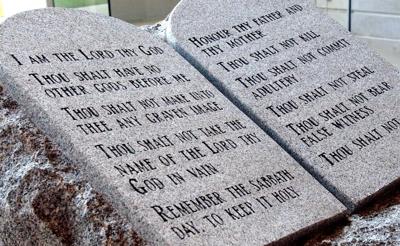


NEW ORLEANS – The U.S. Court of Appeals for the Fifth Circuit has upheld a Texas law requiring the display of the Ten Commandments in every public-school classroom across the state.
Representing numerous multifaith families, the challenge to Senate Bill 10 was brought by the ACLU in the case of Rabbi Nathan v. Alamo Heights Independent School District, which raised questions about religious freedom and the separation of church and state guaranteed by the First Amendment.
“We are extremely disappointed in today’s decision,” the ACLU said in a statement following Tuesday’s ruling. “The Court’s ruling goes against fundamental First Amendment principles and binding U.S. Supreme Court authority. The First Amendment safeguards the separation of church and state, and the freedom of families to choose how, when and if to provide their children with religious instruction.
“This decision tramples those rights. We anticipate asking the Supreme Court to reverse this decision and uphold the religious-freedom rights of children and parents.”
While the ACLU contends the decision was a loss of rights, Attorney General Ken Paxton, who defended S.B. 10 before the 5th Circuit, called the ruling a “victory” for “moral values.”
“This is a major victory for Texas and our moral values,” Paxton said. “My office was proud to defend S.B. 10 and successfully ensure that the Ten Commandments will be displayed in classrooms across Texas. The Ten Commandments have had a profound impact on our nation, and it’s important that students learn from them every single day.”
In its opinion, the 5th Circuit concluded S.B. 10 does not violate either the Establishment Clause or the Free Exercise Clause of the First Amendment.
Justices examined whether the Texas law resembled a founding-era religious establishment.
“S.B. 10 looks nothing like a historical religious establishment,” the opinion states. “It does not tell churches or synagogues or mosques what to believe or how to worship or whom to employ as priests, rabbis, or imams. It punishes no one who rejects the Ten Commandments, no matter the reason. It levies no taxes to support any clergy. It does not co-opt churches to perform civic functions.
“These are the kinds of things ‘establishments of religion’ did at the founding. S.B. 10 does none of them.
The ACLU and plaintiffs argued that S.B. 10, like historical establishments, is “coercive” because it pressures children to honor the Ten Commandments.
“Not so,” the opinion states. “S.B. 10 requires no religious exercise or observance. Students are neither catechized on the Commandments nor taught to adopt them. Nor are teachers commanded to proselytize students who ask about the displays or contradict students who disagree with them.”
The Fifth Circuit found that a district court erred in ruling that S.B. 10 violates the Establishment Clause, and that the plaintiffs failed to show how the law burdens their right to religious exercise, dismissing their Free Exercise claims.
“To Plaintiffs, merely exposing children to religious language is enough to make the displays engines of coercive indoctrination,” the opinion states. “We disagree.”
Fifth Circuit case No. 25-50695