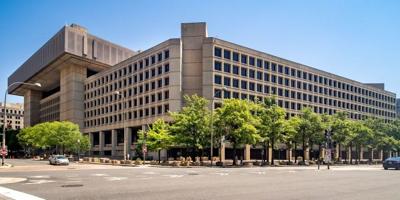


FBI headquarters
NEW ORLEANS – A federal appeals court has upheld a ruling holding the U.S. government liable for an FBI agent’s fatal shooting of a bound and blindfolded hostage during a Texas rescue operation.
But the 5th Circuit Court of Appeals ordered the trial court to reduce the damages award because it improperly added money for attorney fees.
The divided three-judge panel ruled October 21 that the trial judge had sufficient evidence to find that FBI Special Agent Gavin Lappe negligently shot Ulises Valladares without identifying his target and when neither Lappe nor another agent faced a threat.
The court directed the judge to restore the original $1.915 million damages award to Valladares’ son, Ulysses Valladares, and the boy’s mother, Justina Garcia. Attorney fees must come out of that award and cannot exceed 25%, the court said. The ruling reversed an amended judgment that increased damages to $2.39 million.
Writing for the majority, Judge Carl E. Stewart said the trial court’s findings were supported by eyewitness testimony and other evidence, and its decision to credit that testimony over the agents’ accounts deserved “great deference.” Judge Stephen Higginson joined Stewart. Judge James C. Ho dissented.
The kidnapping began January 24, 2018, when two intruders entered Valladares’ Houston home, bound him and his 12-year-old son with duct tape and sought information about Valladares’ brother, according to the opinion. The kidnappers took the father to another location. His son escaped his restraints and went to a neighbor’s house for help.
The FBI joined the search and deployed a SWAT team to the house where Valladares was being held. Special Agent Jeffrey Hawkins was assigned to break a window with a Halligan tool, then enter through the opening. Lappe provided cover while other agents approached the front of the house.
Hawkins dropped the tool inside while breaking the window and moved away. According to an account recounted in the opinion, Hawkins then saw a silhouette that appeared to be in a “shooting stance” and heard two shots. Lappe said, “I shot” and “he grabbed my gun.” The person shot was Valladares, who died shortly afterward.
But Sophia Heath, who had agreed to hold Valladares at her home and was in the room during the shooting, gave a different account. She testified that Valladares remained blindfolded with his hands bound throughout the incident. He stood from a couch beneath the window, turned toward the noise, pushed aside the curtains and was immediately shot, according to the majority opinion.
Heath testified that Valladares never leaned out the window, held a weapon or made threatening gestures. Neither Lappe nor Hawkins testified at the bench trial, although Hawkins’ deposition was admitted into evidence.
The majority said Valladares’ restraints supported Heath’s account over those of the agents.
“Indeed, it was presumably impossible for Ulises to see the window, the agents, or their weapons given that his vision was entirely obstructed by the blindfold,” Stewart wrote.
The family pursued the government under the Federal Tort Claims Act, which permits certain lawsuits against the United States for injuries caused by federal employees. The government argued that the trial court’s factual findings were unsupported and challenged its adverse credibility findings concerning the agents.
The dispute also involved the law’s discretionary function exception, which protects certain government decisions involving judgment or choice. The FBI’s deadly force policy permitted agents to shoot only when they reasonably believed someone posed an imminent danger of death or serious physical injury. The majority upheld the trial court’s determination that the exception did not shield the government in this case.
Ho argued that the majority gave too little weight to the speed and danger of the encounter. Valladares’ movement toward the curtain could have appeared threatening even though he was bound and blindfolded, Ho wrote.
“A figure standing on a couch, with hands held together, raised forward – if merely to push open a curtain – could easily resemble a person in a threatening shooting stance, especially during a high-stakes rescue mission,” he wrote.
Ho said Lappe had a reasonable belief he or Hawkins faced imminent danger and that the government should therefore be protected from suit.
“But it’s the kidnappers who should be punished – not the FBI agents who attempted to rescue the hostage in good faith,” he wrote.
The judgment under review imposed civil liability on the United States, not criminal punishment on the agents. An earlier constitutional claim against Lappe individually ended after a separate appeals panel ruled in 2021 that he was entitled to qualified immunity. That panel concluded that the allegations described an accidental shooting that did not constitute a Fourth Amendment seizure.
The trial court originally awarded Garcia $611,000 and Ulysses Valladares $1.304 million, along with a separate $475,000 attorney fee award. After the government objected to the separate fees, the judge increased the plaintiffs’ damages by exactly $475,000 and stated that attorney fees were limited to 25% of the judgment.
The appeals court said the increase lacked independent support in the record.
“The statute requires the attorney’s fees to be carved out of the total damages award, rather than issued in addition to it,” Stewart wrote.
The panel sent the case back with instructions to reissue the original damages award and apply the statutory fee limit. The plaintiffs had sought at least $5 million each in the trial court, but did not brief arguments supporting their cross-appeal, which the panel deemed abandoned.
U.S. Court of Appeals for the Fifth Circuit case number 25-20180