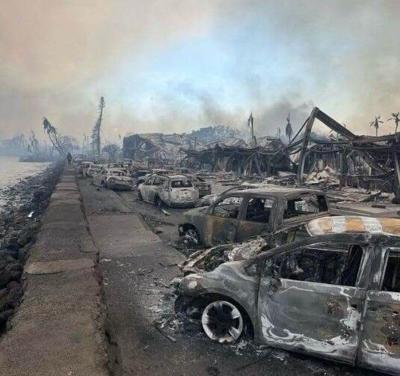



The aftermath of the Lahaina wildfire in 2023
HONOLULU - The Hawaii Supreme Court has ruled insurers that already paid claims to property owners and others as a result of the 2023 Maui wildfires cannot intervene in a settlement to recover that money back from those blamed in court for the catastrophe.
The insurers’ sole remedy, according to the court, is the lien-claims process provided by Hawaii statute to recover claims paid to policyholders that settle with defendants. The court’s Feb. 10 ruling was the latest development in several lawsuits that arose in the aftermath of wildfires that swept through Lahaina on Aug. 8, 2023, killing more than 100 people.
In the wake of the Lahaina fires, numerous lawsuits were filed against, among others, Hawaiian Electric Company, Kamehameha Schools, the State of Hawaii and the County of Maui.
Individual claims were filed in the Hawaii Circuit Court of the Second Circuit by residents affected by the wildfires, three parallel class actions were brought in the First and Second circuits on behalf of injured persons that had not yet filed individual claims, and several insurers brought subrogation claims in the First Circuit to recover damages from the defendants.
The three class actions were removed to federal court and then refiled as a consolidated class action before Judge Peter Cahill of the Second Circuit. As of December 2025, about 12,000 people have reportedly joined the class action.
While the cases were proceeding, the parties negotiated a proposed global settlement in August 2024.
That was just the beginning of the procedural twists and turns.
On Aug. 19, 2024, Judge Cahill issued an order asserting “exclusive jurisdiction, authority, and legal duty to review and resolve any and all subrogation claims or liens arising out of claims for payments” in the event of a global settlement.
Then, in September 2024, Judge Cahill “reserved” to the Hawaii Supreme Court questions concerning the rights of the insurers to recover directly from the defendants.
This was no small matter as, according to one report, by February 2025 insurers had paid out $2.6 billion in claims and were expected to pay another $800 million to policyholders.
On Nov. 1, 2024, while the reserved questions were pending before the Hawaii Supreme Court, the class and individual plaintiffs entered into separate settlements with the defendants totaling $4.037 billion. The class settlement was conditioned on either a written release by all insurers of all claims against the defendants or a ruling by the Hawaii Supreme Court on the reserved questions limiting the insurers’ right of recovery to liens against policyholders and barring them from recovering directly from defendants.
The class settlement agreement asserted that the condition would be met by Judge Cahill’s Aug. 19 order once that order became final.
On March 17, 2025, the Hawaii Supreme Court issued its ruling on Judge Cahill’s reserved questions and held that “the lien provided for under HRS § 663-10(a) is the exclusive remedy for a property and casualty insurer to recover claims paid for damages caused by a third-party tortfeasor in the context of a tort settlement between an insured and the tortfeasor.”
Following the Hawaii Supreme Court’s ruling, on March 24, 2025, class plaintiffs sought preliminary class certification, approval of the class settlement agreement – totaling $135 million in settlement funds – and appointment of class counsel.
That led the insurers, on April 8, 2025, to move to intervene in the settlement proceedings, which was denied by Judge Cahill.
Briefing before the Supreme Court concluded a year ago, and now the justices have held that the insurers could not intervene under Hawaii Rule of Civil Procedure 24.
The decision turned largely on whether the insurers had a protectable interest in subrogation rights that “would be impaired by the settlement’s release of their claims against” the defendants.
The court found that no such interest existed even though some class members may not file claims to receive settlement funds.
Granting insurers “equitable subrogation rights” and “intervention-worthy interests” based on “a narrow subset of class members who choose not to file claims against the settlement,” the Court reasoned, would allow insurers to intervene in “every mass tort class action,” would “scuttle class action settlements unless defendants obtain releases of insurers’ claims,” and would “discourage[] comprehensive settlement.”
According to the court, the statutory scheme created by the Hawaii legislature “’limit[ed] reimbursement and subrogation for all insurance companies’ to the comprehensive procedure prescribed” by statute and “prevents insurers from blocking tort settlements because their lien interests are affected.”
Ultimately, “[i]nsurers have no greater rights than their insureds… Where the insureds’ claims are resolved via settlement, so too are the insurers’ derivative action. Insurers cannot subrogate when their insureds have settled.”