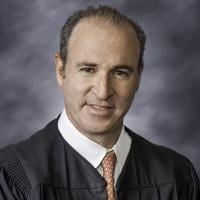


Few
COLUMBIA, S.C. – The chief justice of the South Carolina Supreme Court has stepped down the day before he would have faced a vote to keep his job, declaring he does not have the support of lawmakers to stay on the bench.
Justice John Cannon Few made the announcement today on X after hinting at his fate last week during oral arguments regarding the state’s controversial asbestos court. He commented at one point that he would soon be able to return to litigating cases after a committee approved three candidates to challenge for his seat.
“It has become clear to me over recent weeks that I do not – and will not – have the votes to be reelected to the Supreme Court of South Carolina,” Few posted.
“It is customary in judicial elections for the candidate who cannot win to withdraw from the race.”
In South Carolina, candidates for judgeships are approved or denied by the Judicial Merit Selection Commission, which is made up of three members each of the House of Representatives and Senate, a bonus pick of a private citizen for both and four selections by the governor. One of those picks from the governor was attorney Peter Protopapas, whose business in the asbestos court was the subject of last week’s hearing.
Candidates approved go before the legislature, which votes. There are plenty of lawmakers who double as lawyers at firms with personal-injury cases that can ultimately end up before the very judges they selected.
Few faced two current judges and the former Speaker of the House, Jay Lucas, who will have to step down in three years when he reaches the mandatory retirement age if his former colleagues select him to take Few’s spot.
Lucas was a judge 30 years ago before his election to the House of Representatives, where he served for 24 years. From 2014-22, he was House speaker – one of the most powerful posts in the state – and he worked with all three current JMSC members from the House: Leon Stavrinakis, Micah Caskey and Jay Jordan.
Other candidates are Court of Appeals judge Blake Hewitt, a former plaintiff lawyer with asbestos experience, and administrative law judge Ralph Anderson III.
In the Republican primary in 2024, voters (who could have been from any party, the state has open primaries), were asked if the state should adopt reforms to improve transparency and reduce conflicts of interest in how judges are picked.
More than 91% said yes. Months later, small changes were made: The governor can pick one-third of the JMSC and it can approve up to six candidates for a spot on the bench, up from three.
Further measures have been proposed but not adopted. One idea that has floated around is eliminating lawyer-legislators from the JMSC.
Few said he was proud of his 26 years as a judge and would return to private practice.
“There will be no soft landing for me, as I plan to return to the active practice of law with the same energy and enthusiasm that has defined my career as a judge and justice,” he wrote.