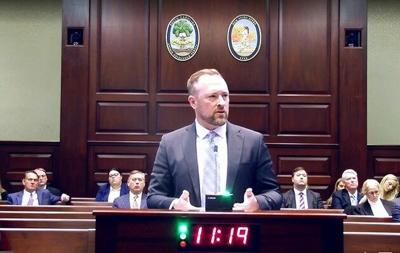


Todd Carroll of Womble Bond Dickinson argues for Altrad at Wednesday’s South Carolina Supreme Court hearing
COLUMBIA, S.C. - One thing was clear after a lengthy hearing before the South Carolina Supreme Court on Wednesday over whether a foreign company can be held liable for U.S. asbestos claims: It’s all about the insurance.
Sidestepping complex questions about international jurisdiction and South Carolina receivership law, the justices zeroed in on what plaintiff lawyers are experts at, which is tapping corporate insurance policies to pay claims.
The justices were asked to decide whether Judge Jean H. Toal, herself a former chief justice of the state Supreme Court, had the power to appoint a receiver to hunt for insurance held by Altrad Group, a French company, and its Cape Intermediate Holdings unit based on the island of Jersey that once mined asbestos in South Africa.
Altrad argues Judge Toal violated South Carolina and international law by appointing Peter Protopapas, a local personal injury attorney, as receiver to hunt out assets held by Cape and related companies. At one point Justice John Cannon Few erupted at Altrad attorney Todd Carroll.
“Wouldn’t the receiver be entitled to try and figure out if Cape is insured?” the judge asked. “All I hear about is all this technicality stuff.”
The “technicality stuff” included Altrad’s argument Judge Toal doesn’t have jurisdiction over it and that she is ignoring a landmark decision by a U.K. court of appeals that denies Cape has any liability for U.S. asbestos claims. Altrad also argued Judge Toal’s appointment orders are riddled with errors, starting with the fact Cape isn’t even a defendant in the case being argued and South Carolina law, with rare exceptions, doesn’t allow receivers to be appointed before any judgment has been entered.
The case before the Supreme Court involves plaintiffs named Tibbs, yet the receiver was actually appointed in a case involving a plaintiff named Park.
Judge Toal has repeatedly appointed Protopapas receiver over companies that once sold asbestos, most of them long defunct, with a commission to keep a third of any insurance money he recovers. Protopapas puts the rest of the money – more than $50 million so far -- in secretive trusts, to be dispensed to lawyers and asbestos plaintiffs as he sees fit, with no public disclosure.
Judge Toal took the process a step further when she appointed Protopapas receiver over Cape, which is owned by a solvent French firm with thousands of employees. Protopapas then sued Altrad and other companies, including mining giants Anglo American and DeBeers, in Cape’s name, claiming they engaged in a conspiracy to hide assets from U.S. asbestos claimants.
DeBeers and Anglo American settled with Protopapas last year and he deposited an undisclosed amount of money in yet another trust, which presumably is being used to pay attorneys John T. Lay and Protopapas as they pursue Altrad and Cape.
Altrad’s lawyer attempted in vain to direct the justices to what it argues are basic errors in how Protopapas was appointed. Those include a state law requiring the plaintiff to identify, in advance, the property they want the receiver to protect and to afford the defendant the opportunity to post a bond to cover the disputed amount.
Judge Toal doesn’t require either in her orders, instead giving Protopapas authority to collect money on behalf of present and future plaintiffs without identifying any assets in advance.
Protopapas “wants to take every asset he can find of (Cape) and bring them all to South Carolina, and then set up a process where plaintiffs can come to him and he can give them whatever he wants,” Carroll said. “It sounds bizarre, but that is what is going on.”
Chief Justice Kittredge was unimpressed, saying: “I hear these good arguments, I read good arguments, and I open the brief and all I see is a Sergeant Shultz defense: I know nothing, I see nothing, I will not cooperate.”
Plaintiff attorney Theile McVey came in for some tough questioning as well. The justices repeatedly asked why she doesn’t press for a trial and judgment against Cape that she can then try to collect.
“I’m sitting here trying to figure out why in the world are you messing with this?” Justice Few asked.
Insurance, McVey answered. If Cape refused to show up in court and the plaintiffs won a default judgement, any insurance contracts would likely be voided because the defendant failed to cooperate with its insurers. Lay, speaking later for Protopapas, said the same thing.
“We cannot get a judgment,” he said. “If we get a judgment, a large portion of the assets goes away.”
By the end of the hearing the justices and lawyers seemed to agree that whatever Judge Toal authorized Protopapas to do, it did not include seizing assets outside the country or doing much more than trying to find insurance to pay claims in South Carolina courts. Justice Few offered a potential solution, which would be to alter the receivership to allow Protopapas to find insurance policies first, and only if those exist to continue the search for hard assets.
Altrad’s lawyer demurred, reiterating the company’s argument that Judge Toal has no jurisdiction over it in the first place. Justice Few erupted, citing evidence Cape mined much of the most-deadly asbestos sold in the U.S
“With that starting point, it’s hard for me to imagine a trial judge in South Carolina should not be cut loose to try and figure this out,” the judge said. “It’s time for this case to get litigated in South Carolina.”
Last year, Justice Few joined a ruling that pushed back at the receivership arrangement at issue in the Altrad case. The court affirmed Protopapas’ receivership over one company but said “it is an extraordinary remedy reserved for the most extraordinary cases. It is not to be used in the typical default case.”
Justice Few must compete for his seat this year against three other candidates in a judicial selection process controlled by lawyers and legislators. Newly appointed to the Judicial Merit Selection Committee, which will decide if Few stays on the court: Protopapas, the main figure in the Supreme Court hearing.