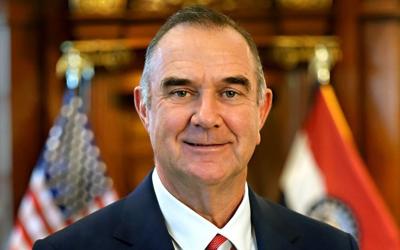



Missouri Gov. Mike Kehoe
JEFFERSON CITY — Americans for Prosperity Missouri has thrown its support behind Gov. Mike Kehoe’s plan to phase out the state income tax after his State of the State Address, calling it a crucial step toward delivering tax relief to Missouri families and boosting economic competitiveness.
In a statement released following the address, Gary Hollis, AFP-MO’s state director, said the group is “thrilled the governor pushed for phasing out the state income tax” and commended the GOP leadership in the House and Senate for taking steps “to provide real relief to Missourians.”
Hollis added that eliminating the income tax would return money to “hard working Missouri families” and help attract businesses to the state, echoing conservative economic priorities.
Kehoe has made reducing and eventually eliminating the income tax a central economic goal of his administration.
A recent report indicates that Kehoe continues to emphasize this issue as a top priority going into the 2026 legislative session, noting his desire to work with lawmakers on a “responsible plan” to phase out the tax over time, rather than making abrupt cuts that would undermine essential state services, according to MissouriNet.
In his State of the State address, Kehoe directed state officials to work on “a sustainable and comprehensive plan to eliminate the individual income tax once and for all,” stating that Missourians can “spend their money a whole lot better than government,” KCUR reported.
Advocates such as AFP-MO argue that lowering tax burdens will help Missouri better compete with other states that have little to no income tax, pointing to examples such as Texas and Florida that tout years of economic growth without a personal income tax.
But the proposal has sparked debate over Missouri’s budget and fiscal priorities.
The state’s personal income tax accounts for a significant share of general revenue, which is estimated to be around 60%, which funds critical services including education, healthcare and infrastructure, First Alert 4 reported.
Economists and budget experts caution that phasing out such a large revenue source would require offsetting revenue streams, such as broadening sales taxes to include services, raising other levies or cutting spending.
According to an economist at the University of Missouri–St. Louis, scrapping the income tax could cost the state approximately $8 billion a year, potentially leading to higher sales taxes or reductions in public services if revenue isn’t replaced.
AFP-MO’s support places the organization within a broader national context of conservative groups pushing for lower or eliminated income tax systems in state policy.
Publications analyzing state-level tax reforms note that several states have either moved to flatter tax structures or eliminated income taxes altogether, often with backing from Koch-associated advocacy groups and other conservative networks, The American Prospect noted.
Missouri’s recent legislation also included a historic move when Kehoe signed House Bill 594, making Missouri the first state to fully exempt individual capital gains from state income tax beginning in 2025—a step proponents say lays the groundwork for broader tax reform.
Supporters argue that such tax cuts put more money into the hands of workers and small business owners and can make the state more attractive to investors and companies considering relocation.
AFP-MO’s Hollis reiterated this sentiment in his statement, applauding legislative leaders for their efforts to deliver “real relief” and characterizing the income tax phase-out as vital to the state’s economic health.
Opponents, however, warn that the loss of revenue poses risks to Missouri’s ability to fund essential public services.
Some advocates for low-income families and education funding groups have expressed concern that steep cuts to the income tax without clear replacement plans could result in diminished investments in schools, social services, and infrastructure.
As lawmakers begin the 2026 session, the income tax debate is expected to be a central point of contention in Jefferson City.
With strong advocacy and a firm commitment from the governor, AFP-MO says Missouri stands at a crossroads between reshaping its tax code and balancing the fiscal realities of state governance.