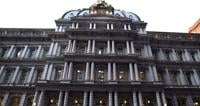
Missouri Court of Appeals for the Western District in Kansas City
KANSAS CITY — The Missouri Court of Appeals, Western District, has affirmed a Labor and Industrial Relations Commission decision finding that the city of Grandview was not responsible for the cost of a police officer’s total knee replacement following a 2016 on-duty injury.
In a decision filed Sept. 8, the court upheld the commission’s finding that Gabriel Gilbert suffered a 17.5% permanent partial disability to his right knee as a result of the July 2016 injury, rather than the 30% disability previously awarded by an administrative law judge.
The court also upheld the denial of reimbursement for Gilbert’s knee replacement surgery, past medical expenses and future medical treatment associated with the replacement.
Gilbert, who has been employed as a Grandview police officer since 2002, injured his right knee while chasing a suspect on foot on July 31, 2016. He filed a workers’ compensation claim following the injury.
The 2016 injury was not Gilbert’s first work-related knee injury. He had previously suffered compensable injuries to the same knee in 2012 and 2013.
Prior to arthroscopic surgery for the 2013 injury, Gilbert’s physician, identified in the court opinion as Dr. AS, advised him that he would likely need a knee replacement within the following 10 years.
After the 2016 injury, Gilbert underwent a series of treatments, including arthroscopic partial medial meniscectomy surgery in January 2017.
He also had his knee aspirated and received a steroid injection. In June 2017, his treating physician determined that he had reached maximum medical improvement and released him to return to full duty.
Although Gilbert continued to experience pain and popping in his knee, his physician concluded that those symptoms were caused by degenerative changes unrelated to the 2016 injury.
In a subsequent rating report, the physician assessed Gilbert with a 4% permanent partial disability resulting from the July 2016 injury and stated that any future medical care would be related to underlying degenerative changes rather than the meniscus tear.
Gilbert continued seeking treatment for his knee and eventually underwent a total right knee replacement in July 2022 through his health insurance.
The physician who performed the surgery diagnosed him with degenerative joint disease and osteoarthritis of the right knee.
An administrative law judge later found that the City of Grandview should reimburse Gilbert for $72,159.13 in past medical expenses and $5,193.19 in out-of-pocket expenses, including the cost of the knee replacement surgery.
The ALJ also ordered the city to provide future medical treatment associated with the replacement and found Gilbert had suffered a 30% permanent partial disability.
The city appealed that decision to the Labor and Industrial Relations Commission, which reversed the ALJ’s ruling in significant part.
The commission concluded that Gilbert had not proven that his total knee replacement was necessary to cure or relieve the effects of his July 2016 workplace injury.
It relied on the opinions of Gilbert’s treating physician and the surgeon who performed the knee replacement, both of whom concluded that the surgery was necessary because of degenerative conditions rather than the 2016 injury.
Gilbert appealed the commission’s decision to the Missouri Court of Appeals.
The appeals court found that substantial and competent evidence supported the commission’s decision.
The court noted that Gilbert’s treating physician had treated his knee for several years and performed three arthroscopic surgeries, while another physician whose opinion supported Gilbert’s claim examined him only once more than seven years after the 2016 injury and had not treated or operated on his knee.
The court also addressed the commission’s use of an “additional significant evidence” standard involving modification of a temporary workers’ compensation award.
The appeals court concluded that Missouri’s Workers’ Compensation Law does not require additional significant evidence before a temporary award can be modified and said previous cases establishing such a requirement should no longer be followed on that point.
However, the court determined that the commission’s decision should still be affirmed because substantial evidence supported its alternative finding that Gilbert failed to prove his knee replacement was reasonably required to treat his 2016 workplace injury.
Finally, the court upheld the commission’s finding that Gilbert suffered a 17.5% permanent partial disability to his right knee.
The court found that percentage was within the range established by the medical evidence and that substantial competent evidence supported the commission’s determination.
“The decision of the Labor and Industrial Relations Commission is affirmed,” Judge Alok Ahuja wrote in the opinion, with all judges concurring.
Missouri Court of Appeals, Western District case number: WD88375