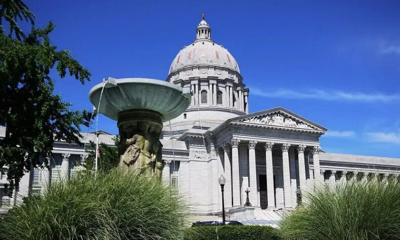



Missouri State Capitol in Jefferson City
ST. LOUIS — Freedom Principle MO is publicly supporting a set of proposed constitutional amendments that would phase out Missouri’s individual income tax, limit government revenue growth and expand taxpayer protections, according to a statement released by the group’s president.
The proposals, House Joint Resolutions 173 and 174, along with House Joint Resolution 169, would require voter approval and could appear on the statewide ballot as early as November 2026.
If approved, the measures would amend the state constitution to restructure Missouri’s tax system and impose new constraints on state and local fiscal policy.
HJR 173 and 174 outline a framework allowing the Missouri General Assembly to gradually reduce and ultimately eliminate the state’s individual income tax through a series of revenue-based triggers.
The plan is designed to phase out the tax over time, with a target date around 2032 if economic conditions meet specified benchmarks.
The proposal also includes mechanisms intended to provide relief from personal property taxes and other property-related financial obligations.
Complementing that effort, HJR 169 would expand existing constitutional limits on government growth. According to the statement, the measure would impose stricter caps on revenue, spending, and public debt at both state and local levels.
It would also broaden requirements for voter approval of tax increases and new government borrowing, mandate refunds of excess revenue with interest, and require the creation of emergency reserves.
Additionally, the proposal would prohibit new state real property taxes and local income taxes while maintaining the framework of the state’s existing Hancock Amendment.
The organization described the resolutions as a “balanced package,” arguing that the combined measures would reduce tax burdens while ensuring long-term fiscal discipline.
The group stated that eliminating the income tax would make Missouri more economically competitive and allow residents and businesses to retain more of their earnings, while HJR 169 would serve as a safeguard against unchecked government expansion.
The statement emphasized that no changes would take effect without voter approval, noting that constitutional amendments in Missouri must be approved through a statewide ballot measure.
The group said this requirement ensures that “the first and final say” rests with voters.
Freedom Principle MO also framed the proposals as part of a broader effort to modernize Missouri’s tax system in response to economic trends in other states.
The statement cited states that, without individual income taxes, including Tennessee, Texas and Florida, as examples of jurisdictions experiencing economic growth and population increases.
It also referenced actions by several other states that have pursued income tax reductions or reforms in recent years.
Under the proposed framework, income tax reductions would be tied to revenue growth, with automatic rate decreases triggered when state revenues meet specified thresholds.
The plan also allows for targeted expansions of sales and use taxes to offset potential revenue losses, while including provisions intended to protect funding for essential services such as public education.
The organization said the proposal avoids abrupt fiscal changes by implementing gradual reductions and incorporating safeguards designed to maintain budget stability.
It also noted that the plan includes a limited, three-year exemption from certain voter-approval requirements under the Hancock Amendment, applying only to legislation directly related to eliminating the income tax and providing associated local tax relief.
Other tax increases would remain subject to existing constitutional restrictions.
According to the statement, the group’s members have identified eliminating the income tax, reducing personal property taxes and limiting government spending as legislative priorities for 2026.
The organization said it worked with lawmakers to refine the current versions of the resolutions and plans to continue advocating for additional fiscal constraints, including potential caps on government spending beyond those included in the proposals.
If approved by voters, the measures would require ongoing legislative involvement to implement the changes and ensure that taxpayer protections and fiscal controls are maintained.
Freedom Principle MO President Byron Keelin said the organization views the proposed amendments as a path toward reducing tax burdens, increasing economic competitiveness and strengthening constitutional limits on government finances.
The group is urging both the Missouri Senate and voters to approve the measures in 2026.