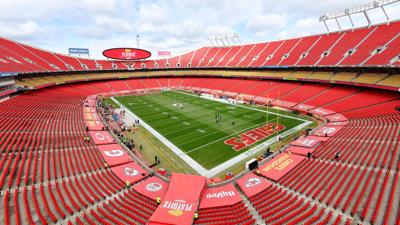



GEHA Field at Arrowhead Stadium
JEFFERSON CITY, Mo. – The Missouri Supreme Court has rejected a challenge to a law authorizing stadium subsidies and several tax credit programs, ruling that two state lawmakers and a taxpayer had failed to establish their right to sue.
The 5-2 November 10 decision left Senate Bill 3 in place without resolving whether it violates the Missouri Constitution. The court affirmed a Cole County judge’s dismissal of the lawsuit for lack of standing, the legal requirement that plaintiffs show a sufficient interest in a dispute to bring it before a court.
State Sen. Michael Moon, state Rep. Bryant Wolfin and Maries County resident Ron Calzone sued in July 2025 to block the law, which lawmakers passed during a special legislative session called that May.
The legislation included the Show-Me Sports Investment Act, supporting large athletic and entertainment facilities, along with tax credits for certain sporting events, homestead disaster damage and property taxes. The challengers alleged it improperly granted public money to private parties and violated constitutional restrictions on special laws and the legislative process, including requirements governing a bill’s subject, title and original purpose.
Writing for the majority, Judge Robin Ransom said the challengers had not alleged the direct expenditure of tax revenue necessary to support their taxpayer-standing claims.
They relied in part on a fiscal analysis estimating that the Department of Revenue would spend $10,000 to create a disaster tax credit form and potentially need additional employees and up to $175,000 in computer programming. But the majority said those estimates depended on assumptions and contingencies. Legislative fiscal analysts also had indicated the department could absorb the cost of changing tax credit forms.
“Projections are not equivalent to the requirement that a sum be paid out,” Ransom wrote.
The court also rejected the argument that the law’s stadium financing provisions established taxpayer standing. Any spending remained subject to legislative appropriations, an application for a facility project and approval by state officials, the majority said.
Those intervening steps meant the law’s authorization of spending did not itself qualify as a direct expenditure under the court’s precedents.
The challengers separately argued that refundable sporting-event tax credits could require the state to issue checks before the end of a tax period. The majority said that process also required several intervening steps, including review of an application, completion of the sporting event, submission of documentation and issuance of a tax credit certificate.
The court declined to overturn its precedent that issuing tax credits does not constitute a direct expenditure of tax revenue. It also rejected as speculative the argument that tax breaks for some would force other taxpayers to make up the difference.
The challengers sought to bolster their case on appeal by pointing to a disaster relief tax form the Revenue Department had created and county elections held in April 2026. The majority declined to consider those matters because they had not been presented to the trial court in the petition under review.
Judge Paul C. Wilson dissented, joined by Judge Mary R. Russell. Wilson argued that the appeal should have been dismissed because the trial court had not entered a final, appealable judgment. He said the dismissal was without prejudice, meaning the challengers could pursue another action.
Even if the Supreme Court could hear the appeal, Wilson wrote, the allegations about expected state spending were sufficient to survive a motion to dismiss. He said the challengers should at least have been allowed to update their petition to allege expenditures that occurred after they filed suit.
“Giving Challengers’ allegation the broadest intendment, the circuit court should have taken the state’s own prediction of expenses as sufficient,” Wilson wrote, adding that the plaintiffs would still have to prove those expenditures later in the case.
The majority also rejected Calzone’s argument that he was personally harmed because Maries County did not meet the law’s population criteria requiring a vote on property tax credits. The court said he had not properly raised that theory below or alleged that he met the law’s eligibility requirements for receiving the credit.
Moon and Wolfin, who both voted against the bill, also had argued that alleged constitutional defects diminished the effectiveness of their legislative votes. The court did not decide that argument because the challengers abandoned it after acknowledging an error in how they presented it in their appellate brief.
Supreme Court of Missouri case number SC1015344