
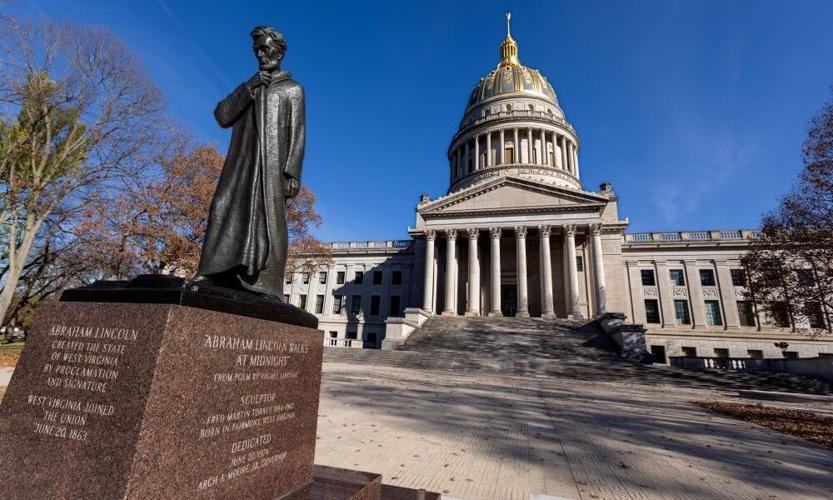




“Abraham Lincoln Walks At Midnight” outside the West Virginia State Capitol.
CHARLESTON – No meaningful legal reform took place during the 2026 legislative session, but a few bills, if they become law, will have an impact on West Virginia judges and Supreme Court justices.
Senate Bill 29 would increase the annual salaries of magistrates, circuit court judges, family court judges, Intermediate Court of Appeals judges and Supreme Court of Appeals justices.
Salaries would raise for county magistrates by $6,750 and other judges including circuit judges, family court judges, Intermediate Court of Appeals judges and Supreme Court justices by $10,000 over two years. The bill also would create a contribution holiday for the state’s contribution to the judicial retirement program if the program is 125 percent funded.
Also, SB643 would end the Supreme Court of Appeals Campaign Financing Pilot Program effective June 30. The public financing system was voluntary for state Supreme Court candidates, and it was created to try to clean up the optics of big money in judicial races.
Candidates who chose to participate gave up most traditional fundraising and instead ran their campaigns primarily on public funds from a dedicated state fund. The goal was to reduce the influence and appearance of influence of large donors and special interests in judicial elections in which impartiality is especially sensitive.
The program was first authorized as a “pilot” for the 2012 Supreme Court cycle, then later made permanent. Former Justice Allen Loughry was the first candidate to use it in 2012. He received close to $400,000 in public funds for his campaign.
Other candidates opted in during the 2016 cycle (including former Justice Brent Benjamin and current Justice Bill Wooton), though Beth Walker, who was not a public‑financing participant, ultimately won. After 2016, no Supreme Court candidates used the program, and there is just under $23,000 dollars left in the fund.

Thomas
With no legal reforms enacted, West Virginia Citizens Against Lawsuit Abuse called the 60-day session that ended March 14 a “wasted opportunity” by the state Senate.
“While the House of Delegates focused on an economic development package aimed at job creation, the Senate spent its time making life more expensive for West Virginia families,” WV CALA Executive Director Greg Thomas said. “From attempting to hike the ‘tort tax’ through expanded liability to voting for politically motivated mandates that drive up electric bills, the Senate’s priorities were clearly putting special interests first and taxpayers last. They even went so far as to do the bidding of out-of-state groups by banning food products and driving up grocery costs.
“West Virginians deserve a Senate that works for them, and we look forward to seeing a dramatic improvement in that body following this year’s primary election.”

Huffman
Americans For Prosperity-West Virginia Director Jason Huffman said key components of its legislative agenda were secured, including income tax cuts and the expansion of the Hope Scholarship school choice program.
“The group and our activists across the state are celebrating these common-sense policy victories that Governor Patrick Morrisey, Senate leaders and principled Delegates were able to shepherd through the legislative process despite attempts from some House of Delegates leaders to derail them,” Huffman said.
“The 5% reduction to the income tax means $125 million will be returned to hardworking West Virginia families. And because of the expansion of the Hope Scholarship to every school-aged child in West Virginia, no family is without the opportunity to find the right education for their child’s unique needs regardless of income or ZIP code.”
Huffman was critical of House leadership.
“It remains incredibly disappointing to see top House leaders attack core conservative principles like school choice or to watch them work to water down what should have been a 10% income tax cut to only 5%, nakedly putting corporate welfare over tax relief for working families,” he said. “West Virginia faces too many socioeconomic headwinds to have much needed progress towards proven policy solutions stymied by the failed tax-and-spend, big government schemes of the past.
“Time will tell how deeply these poor policy choices will inform the decisions Republican primary voters will make in an increasingly competitive electoral environment.”
Overall, legislators passed 303 bills (152 Senate, 151 House) of the more than 2,700 introduced during the 60‑day session. Here are the big-picture takeaways from the 2026 regular session, which wrapped up Saturday:
Tax and budget
5% across-the-board personal income tax rate cut, retroactive to January 1, projected to return about 125 million to taxpayers and roughly 230 million in annual tax relief when combined with other state–federal code alignment changes.
Lawmakers removed a proposed increase in vape and e‑cigarette taxes from the income tax bill before final passage.
Workforce, education, and government reforms
New workforce initiatives including micro‑credentialing programs aimed at skilled trades, manufacturing and “emerging industries,” backed by the administration as a way to address labor shortages and upskilling.
Measures to modernize state personnel systems and improve government efficiency advanced as part of the governor’s package (details to be fleshed out in specific bills and rules).
A bill establishing the West Virginia Collaboratory (HB 4002) to support research and innovation, and another creating the Recharge West Virginia Program (HB 4004) focused on economic and community revitalization.
Energy and infrastructure policy
Passage of a major energy-policy bill (HB 5381) directing the Office of Energy to craft a comprehensive statewide energy development and grid‑stabilization plan, with explicit emphasis on coal, natural gas, nuclear, hydropower, hydrogen, and geothermal.
The final version stripped out the “West Virginia First Energy Act” language and removed references to wind and solar, reflecting a deliberate shift toward traditional and dispatchable resources.
Morrisey framed these moves as part of a “50 by 50” energy strategy, including the state’s first formal energy security plan.
Children, families, and what failed
Some child welfare and child care changes passed, but a high‑profile bill designed to protect public school children whose parents are under child welfare investigation died in the last hours.
Advocates noted there was no major legislative movement on affordable housing, public transit or other structural barriers to employment, despite those being identified as key needs.


