





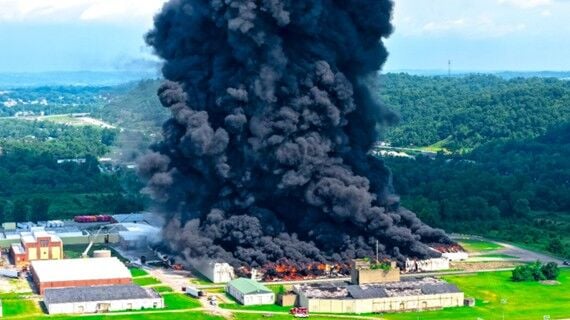
The fire at the People’s Cartage warehouse in Parkersburg began July 4 and reignited July 5, according to the class action lawsuit filed July 7.
CHARLESTON -- Residents near a Parkersburg warehouse that caught fire this weekend have filed a class action claiming they’ve been affected by the fire and thick black smoke.
The plaintiffs accuse the facility’s owner and parent company of years of safety lapses and reckless conduct that put neighbors’ health and property at risk.

diTrapano
“This was not simply an unavoidable industrial accident, but the result of a series of decisions and missteps allegedly made despite known fire risks, prior incidents and prior regulatory action,” attorney L. Dante diTrapano told The West Virginia Record. “Those allegations warrant a full accounting of what occurred and why this community was placed in harm’s way.”
James Leonard Anthony and Doris Jean Anthony, who live on Pennsylvania Avenue near the Peoples Cartage warehouse, are the named plaintiffs in the complaint filed July 7 against Peoples Cartage and parent company Total Distribution Inc. They seek damages for personal injuries and property losses caused by the fire that sent massive plumes of toxic black smoke over nearby neighborhoods.
They claim the companies ignored an “elevated risk of fire” tied to highly combustible plastic pellets stored at the Camden Avenue site and to repeated hazardous‑waste fires and violations at a sister facility, allowing a reignited blaze to burn for days while residents were ordered to shelter in place.

Forbes
“People throughout the community were told to shelter in place because of what they were breathing,” attorney W. Jesse Forbes said. “Families were forced to fear the very air around them, worry about the safety of their children and elderly loved ones and question whether their persons and property had been contaminated.
“All of this began over the Fourth of July weekend, when families should have been safely celebrating with one another – not confined to their homes fearing for themselves and those they love.” As alleged in this Complaint, when
The proposed class of “lawful residents, business operators and property owners or possessors” in the area covered by the shelter‑in‑place order and in the broader zone affected by smoke, ash and soot from the fire.
The complaint invokes the Class Action Fairness Act and says the class likely includes more than 100 members with total claims exceeding $5 million, exclusive of interest and costs. It seeks certification under Rule 23, appointment of the Anthonys as class representatives and several Charleston law firms as class counsel.
According to the filing, Total Distribution acquired Peoples Cartage’s Camden Avenue warehouse and a sister facility at the Airport Industrial Park near the Mid‑Ohio Valley Regional Airport in 2024. The companies also operate facilities in Vienna, Nitro, Huntington and Kenova, the complaint states.
The complaint says the fire first broke out around 10:40 a.m. July 4 in one of the storage boxes containing plastic pellets at Peoples Cartage’s Camden Avenue warehouse campus. The pellets, a raw material for plastic manufacturing, were stored in cardboard boxes roughly four feet by four feet and stacked as much as 16 feet deep in the warehouse, according to the complaint.
The facility’s sprinkler system and local firefighters were believed to have contained the initial fire, the filing says, but Peoples Cartage and Total Distribution later shut off the sprinkler system because water was soaking other boxes and managers feared the wet, stacked boxes would collapse and endanger workers. The companies instead instituted a “fire watch” while the system was offline and began replacing activated sprinkler heads, the complaint alleges.
At about 5:30 a.m. July 5, before the sprinkler system was restored, employees or agents started removing and opening boxes damaged in the previous day’s fire, the complaint states. One box reignited when its contents were exposed to air, and the fire then spread rapidly, engulfing the facility in flames and sending up “massive plumes of thick black smoke.”
The plaintiffs say Peoples Cartage personnel had “ample notice” the stored chemical compounds were “extraordinarily volatile and combustible” and that any smoke, ash and soot from burning plastics could pose “a grave risk of acute injury or lasting harm” to nearby residents and businesses.
Despite that, the complaint states, the facility was operated “without any adequate fire safety or containment system in place” when the second fire erupted.
The reignited fire triggered a prolonged, multi‑agency response, according to the complaint. The suit says the municipal water system was drained during early firefighting efforts, forcing crews to truck in water using roughly 30 tanker trucks.
An industrial firefighting service from Pittsburgh later installed a supplemental line from the Little Kanawha River, pumping about 9,000 gallons of water per minute onto the fire and collapsed structure, with responders expecting several days of excavation and dousing of material stacked up to 16 feet deep.
Because of ongoing smoke and air‑quality concerns, the West Virginia Department of Environmental Protection deployed five‑gas meters and requested help from U.S. EPA to monitor particulate matter and volatile organic compounds. A shelter‑in‑place order for residents near the Camden Avenue facility was issued July 4 and remained in effect until about 2 p.m. July 7.
The Anthonys claim they and other class members suffered interference with the use and enjoyment of their homes and businesses, contamination that will require cleanup, compliance costs linked to the shelter‑in‑place order, respiratory and other health effects and potential long‑term health impacts.
Beyond the Camden Avenue incident, the complaint outlines a detailed history of fires and hazardous‑waste violations at the Airport Industrial Park facility, which Peoples Cartage now operates.
The filing notes that fires involving calcium hypochlorite – a granular chlorine compound used in pools and water disinfection – occurred there in July 2020 when the site was owned by REO Processing West Virginia, leading to a WVDEP consent order.
After Total Distribution acquired the site in 2024, state inspectors documented multiple subsequent fires and violations, including failure “to operate to minimize the possibility of a fire, explosion, or any unplanned sudden or non‑sudden release of hazardous waste constituents to the environment” and disposal of hazardous waste without a permit.
A December 2025 consent order issued to Peoples Cartage by WVDEP’s Division of Water and Waste Management assessed a $46,380 civil administrative penalty and required upgrades such as poured concrete storage structures and thermal scanning to detect dangerous heat. In a Plan of Corrective Action letter that same year, Peoples Cartage Senior Director of Safety, Quality and Regulatory Compliance Joseph DeVirgilio told regulators the company had revised its waste‑management plan, retrained staff and wired new waste‑storage areas with fire alarms tied to monitored systems.
Even as those corrective measures were underway, a March 2026 compliance inspection and subsequent notice of violation found Peoples Cartage had failed to prepare a proper hazardous‑waste manifest, failed to notify regulators of its actual generator category after shipping large‑quantity hazardous waste and failed to report two hazardous wastes on its biennial report.
Inspectors also documented moisture collecting on floors where calcium hypochlorite was stored, noting the chemical can produce highly toxic chlorine gas when it comes into contact with water.
The complaint argues that this “documented, repeated history of fires, violations for not having proper fire‑preventative mechanisms in place, hazardous waste violations, and safety complaints” at the affiliated site put Peoples Cartage and Total Distribution on actual and constructive notice of recurring, foreseeable fire risks across their operations. Plaintiffs say the companies failed to “adequately assess, audit, or correct fire risks at the Camden Avenue facility” before this weekend’s fire.

Majestro
“The allegations in this complaint present serious questions about corporate decision-making and whether known fire risks were appropriately addressed before this incident occurred,” attorney Anthony Majestro said. “Companies that store hazardous and combustible materials in our communities have a responsibility to implement adequate safety measures to protect the public. …
“Despite those responsibilities and despite a documented history of prior fires, regulatory violations and safety concerns at an affiliated facility, defendants failed to take the steps necessary to prevent this devastating fire and its widespread impact on the surrounding community.”
The plaintiffs accuse the defendant companies of negligence, private nuisance, trespass, strict liability and reckless conduct. They seek compensatory damages for diminution in property value, cleanup costs, business losses and personal injuries as well as punitive damages, pre‑ and post‑judgment interests, court costs, attorney fees and other relief.
“West Virginians should never have to worry that the air around their homes has become unsafe because of decisions made inside a commercial warehouse or by an out-of-state corporation storing dangerous and combustible materials in our state,” diTrapano said. “This civil justice action seeks to uncover the facts, provide accountability, and help ensure that no other community experiences what Parkersburg endured over the Fourth of July weekend.”
They are being represented by Forbes, Jennifer N. Taylor and Michael D. Heidenreich of Forbes Law Offices; diTrapano, Alex McLaughlin and David Carriger of Calwell Luce diTrapano, Majestro and Graham B. Platz of Powell & Majestro; and Bernard E. Layne III, Jonathan R. Mani and Damon Ellis of Mani Ellis & Layne.
U.S. District Court for the Southern District of West Virginia case number 2:26-cv-447