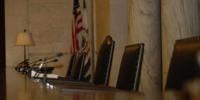


The chambers of the West Virginia Supreme Court of Appeals
CHARLESTON – The West Virginia Supreme Court has upheld a ruling in favor of the City of Charleston over its demolition of a building that housed a Chinese restaurant building.
The November 5 opinion leaves intact a $58,539.54 judgment against the property’s owners for demolition costs, plus costs and interest.
The justices unanimously affirmed an Intermediate Court of Appeals decision rejecting a challenge by New China Restaurant and Philip Dy Chin. The owners argued that disputed facts about the city’s actions should have prevented a lower court from deciding the case without a trial.
The dispute began Februrary 17, 2020, when several hundred bricks fell from the two-story building owned by Chin. City inspectors determined that the structure could partially or completely collapse without corrective work, according to the opinion.
An engineer hired by the owners inspected the building two days later and reached a similar conclusion. The engineer found that immediate, extensive repairs were necessary to protect the public and prevent further structural collapse, and that the repairs would cost more than the building was worth.
On February 21, the city gave the owners until February 24 to complete the corrective work recommended by their engineer. The notice warned that if the work was not completed and an immediate public safety threat remained, “the city will be forced to demolish the building at your ultimate expense.”
The owners hired a mason to remove fallen and loose bricks but took no further corrective action by the deadline, the court said. They sought a temporary restraining order and preliminary injunction February 25 to stop demolition. A Kanawha County circuit judge denied that request, citing both inspections’ findings that the building posed an immediate public threat. The owners did not appeal that ruling.
The city demolished the building shortly afterward and placed a demolition lien on the property.
The owners sued in February 2021, seeking damages over the demolition. The city counterclaimed to recover the unpaid demolition charges. In March 2023, the circuit court granted summary judgment to the city on both the owners’ claims and the city’s counterclaim, finding that Charleston had complied with applicable state and municipal requirements.
On appeal, the owners contended that a city official told their lawyer on the morning of February 24 that removing the bricks was sufficient to temporarily stop demolition. They said the city reversed course that evening and announced that demolition would begin the next day.
The Supreme Court agreed with the ICA, saying the owners had not explained how that alleged exchange established a factual dispute material to a specific legal claim.
“Petitioners’ skeletal argument failed to address how the foregoing created an issue of material fact that could potentially entitle petitioners to relief on a specific cause of action,” the court wrote.
The justices also rejected the owners’ argument that the circuit court had improperly treated its earlier refusal to stop demolition as barring their subsequent claims. The intermediate court found nothing in the summary judgment order suggesting that the circuit court had given the earlier ruling that effect, and the Supreme Court agreed with its analysis.
“Upon consideration of the record and briefs, we conclude that there is no reversible error based on the two assignments of error presented to this Court,” the justices wrote in the memorandum decision.
West Virginia Supreme Court of Appeals case number 24-403 (Intermediate Court of Appeals case number 23-ICA-175)