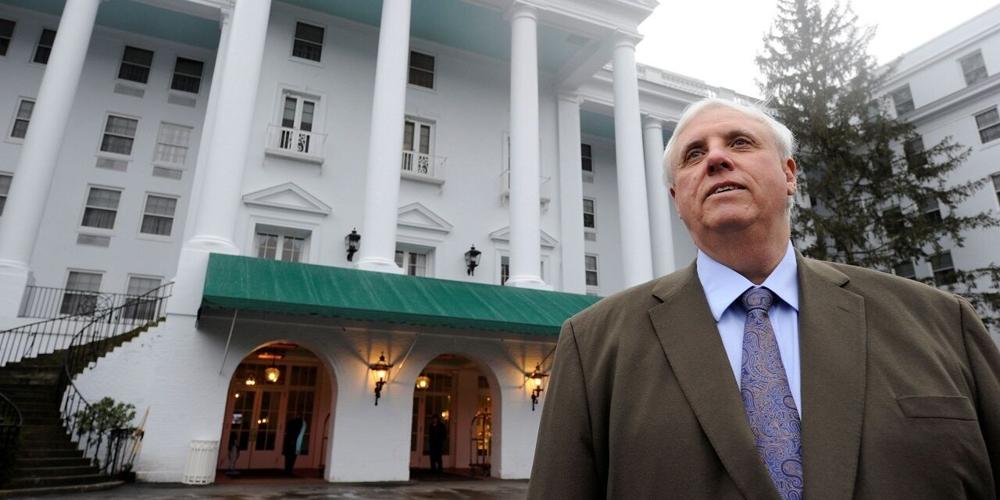




Jim Justice outside The Greenbrier
CHARLESTON – The chairman of the West Virginia Democratic Party formally has asked the IRS to review more than $8 million in recently reported federal payroll-tax liens against The Greenbrier’s ownership group and determine whether businesses associated with U.S. Senator Jim Justice and his family are receiving preferential treatment.
In a letter dated August 19, Mike Pushkin asked the IRS Criminal Investigation department to independently examine the circumstances surrounding The Greenbrier tax liabilities, including whether federal income taxes, Social Security and Medicare taxes were withheld from employees’ paychecks but not timely remitted to the U.S. Treasury.

WV Legislature photo
“This is fundamentally a question of equal treatment under the law,” Pushkin said. “West Virginia business owners have been investigated, prosecuted and even sent to federal prison for failing to turn over hundreds of thousands of dollars in taxes withheld from their employees.
“When more than $8 million in payroll-tax liens are filed against businesses controlled by the family of a sitting United States senator, West Virginians have every right to ask whether the same standards are being applied.”
Pushkin says ordinary West Virginia business owners have faced federal prosecution and imprisonment for similar tax offenses involving far smaller amounts.
According to publicly reported IRS filings, federal tax liens totaling more than $8 million were recently filed against The Greenbrier’s ownership group for payroll-tax obligations. Those were about $4.92 million for the tax period ending December 31, 2025, and another $3.08 million for the period ending March 31, 2026. The reported obligations include federal income taxes, Social Security and Medicare taxes withheld from workers’ paychecks, along with employer obligations.
The latest liens follow a history of tax problems involving Justice family businesses. In 2021, IRS records showed approximately $1.5 million in federal liens against The Greenbrier Hotel Corporation for previously unpaid payroll taxes dating to 2018. Those liens subsequently were released after payment. In 2025, the West Virginia Tax Division filed about $1.36 million in state tax liens against The Greenbrier Hotel and Sporting Club involving sales taxes.
Pushkin said a tax lien alone does not prove a crime and that neither the amount owed nor the existence of repeated liens establishes that anyone acted willfully.
“That is exactly why we are asking for an investigation,” Pushkin said. “We are not asking the IRS to assume anyone is guilty. We are asking the IRS to determine the facts and make sure the law is being enforced without regard to wealth, political power or family connections.”
Last week, the Justice family and Kennedy Lewis Investment Management announced the completion of a new joint venture they say will “enhance the long-term vision for The Greenbrier and provide the capital and expertise to strengthen and preserve America's Resort for its guests, both long-standing and new.”
Pushkin’s letter contrasts the Justice businesses’ tax liabilities with several cases in which West Virginia business owners were criminally prosecuted for failing to remit employment taxes.
Pushkin says the issue is particularly sensitive because Moore Capito serves as U.S. Attorney for the Southern District of West Virginia.
“That uncertainty is precisely why an independent review by IRS Criminal Investigation is appropriate,” Pushkin said. “The public should not have to wonder whether there is one system of justice for a politically connected billionaire family and another for a small-business owner in Charleston, Montgomery or Hurricane.”
Pushkin’s letter makes no allegation that Capito has interfered with or declined any investigation and acknowledges that neither the Democratic Party nor the public has access to confidential IRS or Justice Department information concerning whether an investigation is already underway.
Pushkin’s letter asks IRS Criminal Investigation to review the current liabilities and the history of previous employment-tax delinquencies involving Justice family businesses; identify who was legally responsible for collecting and remitting employee taxes; determine whether any failure was willful; consider whether the facts warrant investigation under federal criminal tax laws; and determine whether the same investigative standards used in comparable West Virginia cases have been applied.
“Money taken out of a worker’s paycheck for Social Security, Medicare and federal income taxes isn’t simply another unpaid bill,” Pushkin said. “That money belongs to the worker and is supposed to be sent to the government on that worker’s behalf. West Virginians who play by the rules deserve to know those rules apply equally to everyone — including the rich and politically powerful.”