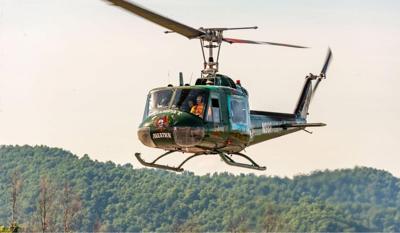


The Huey helicopter that crashed in Logan County in 2022.
CHARLESTON – The state Intermediate Court of Appeals of West Virginia has upheld summary judgment for Appalachian Power in a wrongful death regarding a 2022 Logan County helicopter crash.
The June 11 memorandum decision stems from a June 22, 2022, sightseeing flight during MARPAT Aviation’s “Huey Reunion” event at the Logan County Airport, where members of the public could purchase 30‑minute rides in a Vietnam-era UH‑1B helicopter. The event was part of the City of Logan’s Freedom Festival.
During one flight, the helicopter’s engine failed. As the aircraft descended, it struck inactive, unmarked Appalachian Power lines 231 feet above a nearby road and then crashed onto the roadway, killing everyone on board, including passenger Kevin M. Warren.
In the ruling, the ICA affirmed a 2025 Logan Circuit Court ruling and removes APCo from remaining state‑court litigation.
Warren’s widow, Tessa Warren, sued APCo in September 2023, claiming the utility was negligent in failing to mark or remove the de‑energized lines that the helicopter hit. Her complaint asserted APCo breached common‑law duties to maintain its lines, violated Federal Aviation Administration guidance on marking and failed to comply with the National Electric Safety Code and its own internal practices.
After discovery, APCo moved for summary judgment in April 2025. The company said the Federal Aviation Act and related FAA regulations preempt the standard of care in aviation‑safety negligence suits, and it said its lines met all applicable federal requirements.
The company emphasized that the lines had been decommissioned in 1996 and that, because they predated both the FAA and its predecessor statute, they were not an “obstruction to air navigation” under federal law.
APCo also relied on a prior federal court ruling that already had granted the utility summary judgment in a companion federal case arising from another passenger’s death in the same crash, holding that the FAA regulations defined the duty of care.
In response, Warren did not directly contest the preemption theory or argue the lines qualified as an obstruction under the regulation, instead asserting the case involved broader landowner duties to people traversing the land and pointing to common‑law obligations, the NESC and APCo’s best practices.
At a May 2025 hearing, APCo reiterated FAA rules controlled the duty of care and said the crash was not foreseeable as a matter of state negligence law. Warren’s counsel argued foreseeability and state‑law duties but acknowledged she had “abandoned preemption.”
On June 18, 2025, a Logan Circuit Court judge granted summary judgment to APCo, saying FAA regulations preempt the field of aviation safety, the power lines were not an obstruction and Warren had waived any contrary preemption arguments by not meaningfully responding to that portion of the motion. The court further found no common‑law duty because the helicopter crash was not reasonably foreseeable.
Reviewing the case de novo, the ICA framed preemption as dispositive and declined to reach most of Warren’s five assignments of error.
The ICA ruled, under West Virginia law, a nonmoving party must specifically respond to a properly supported summary‑judgment argument, and it said failure to do so can waive the issue on appeal.
Citing state Supreme Court memorandum decisions, the court said a conclusory, broad response is not enough to preserve more focused arguments.
The court concluded Warren “did not respond adequately” to APCo’s argument regarding the standard of care. It also said the undisputed facts showed the lines were not an obstruction.
Even if the issue had been preserved, the ICA said Warren failed to show error in the circuit court’s preemption analysis. Surveying federal appellate decisions, the ICA said most circuits have held Congress intended to occupy the field of aviation safety and FAA regulations establish the applicable standards of care while still allowing state tort claims to proceed when plaintiffs allege breaches of those federal standards.
Because Warren never argued the lines met the obstruction thresholds and the record evidence showed they did not, the court held she could not demonstrate a breach of duty. The ICA also rejected her attempt to rely on state common‑law duties, the NESC or utility best practices as “meritless and contrary to the basic concept of preemption” where FAA regulations control the standard of care.
In a concurring opinion, Judge Ryan White criticized the majority’s broad discussion of field preemption, saying the case could be resolved purely on state‑law foreseeability grounds. He said the lines had been inactive for decades, and the accident occurred only because of an engine failure forcing an emergency descent. He said that chain of events that was “too remote and too speculative” to impose a duty on APCo under West Virginia negligence law.
White cautioned against reading FAA silence below certain height thresholds as evidence Congress intended to displace all state duties involving lower structures. He said the existence of detailed regulations governing some obstructions does not necessarily show that federal law has occupied the entire field of potential hazards, particularly where state‑law duties would not interfere with federal control over navigable airspace. Nevertheless, he agreed that no reasonable jury could find this accident reasonably foreseeable to the utility and therefore concurred in affirming the judgment.
West Virginia Intermediate Court of Appeals case number 25-ICA-289 (Logan Circuit Court case number 23-C-122)