
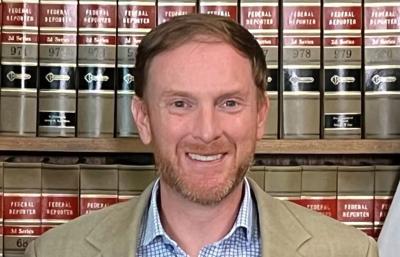



West Virginia Attorney General J.B. McCuskey
CHARLESTON – West Virginia Attorney General J.B. McCuskey is leading a coalition of 21 states to push back on the ability of activist groups to sue and halt federal permitting projects before states can review them.
McCuskey’s office filed an amicus brief with the U.S. Supreme Court asking it to reverse a federal appeals court ruling allowing that right and restore states’ permitting authority.
The brief was filed in support of the Air Force in U.S. Department of the Air Force v. Prutehi Guahan. The Air Force has been disposing of WWII-era munitions at a base in Guam for decades and needs a permit under a federal environmental law – the Resource Conservation and Recovery Act (RCRA) – to do so legally. Congress has delegated authority over that permitting process to states, territories and tribal nations.
But, when the Air Force applied to renew its permit in 2021, an activist group sued before Guam EPA had even reviewed the application – and the Ninth Circuit agreed with the group. West Virginia and other states are asking the Supreme Court to reverse that decision.
“Extreme environmentalist activists are trying to weaponize laws and add unnecessary layers to an established and workable permit process,” McCuskey said. “If they are allowed to succeed, they will be able to delay or block any project – including housing, energy or military – they want at any stage – even before the appropriate agencies have had the chance to look at it.
“This will cost taxpayers millions of dollars in project delays and cancellations, as well as litigation costs with little, if any, environmental benefit. This is an abuse of the process. Not only that, but it would also strip states of their congressionally mandated permitting authority.
“Where does it stop? We must take a stand now to end this extreme overreach.”
The coalition argues that because the Air Force simply applied for a permit and nothing has been approved yet, it is too early to sue. Usually courts can only review “final” government decisions, not preliminary steps.
West Virginia argues the Ninth Circuit's ruling threatens a principle called cooperative federalism – the system where Congress lets states run environmental permitting programs within federal guidelines. If activists can sue in federal court before a state even finishes reviewing a permit application, it effectively sidelines the states and shifts all the power to federal judges. States lose their meaningful role, and their decisions become irrelevant.
The coalition also says a second environmental review is redundant and harmful because the RCRA already demands extensive environmental analysis. The Air Force is required to evaluate potential risks to human health, identify hazardous waste, allow public comment and meet strict conditions before being granted a permit.
Forcing the Air Force to complete the additional National Environmental Policy Act review is essentially asking the agency to complete the same detailed information twice. Courts recognize a “functional equivalence” rule – if one law already addresses the environmental aspects, a second process is not necessary.
“Every state in this country has permitting programs that depend on being allowed to do their jobs,” McCuskey said. “If activist groups can run to federal court before a state agency has even looked at an application, then the federal courts become the decision-makers, and states are left on the sidelines.
“Let the Guam EPA do its job first. If someone wants to challenge the final permit decision, they can do that later, but not before the process even has a chance to work.”
Joining McCuskey’s brief are the AGs from Alabama, Alaska, Arkansas, Florida, Georgia, Idaho, Indiana, Iowa, Kentucky, Louisiana, Montana, Nebraska, North Dakota, Ohio, South Carolina, South Dakota, Tennessee, Texas, Utah and Wyoming.

