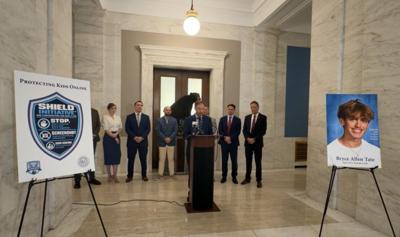


West Virginia Attorney General J.B. McCuskey speaks during a November 5 press conference outside his office at the state Capitol.
CHARLESTON – West Virginia Attorney General J.B. McCuskey has sued Snapchat alleging it misled families about protections for children while concealing risks of sexual exploitation, compulsive use and unsafe advice from its artificial intelligence chatbot.
The consumer protection lawsuit, filed November 5 in Kanawha Circuit Court against Snap Inc., cites the deaths of two West Virginia children who were targeted through Snapchat. It alleges the company’s public safety assurances conflicted with internal records documenting gaps in abuse detection, reporting and parental oversight.
The filing came one day before the first anniversary of the death of Bryce Tate, a 15-year-old Nitro High School honors student who died by suicide November 6, 2025, after being targeted in a sextortion scheme that began on Snapchat.
At a news conference Thursday, McCuskey joined Bryce’s family to announce funding for a statewide education campaign aimed at helping children, parents and educators recognize and respond to online exploitation.
“After learning of Bryce’s life and his tragic death, I knew if this could happen to him – it could happen to anyone,” McCuskey said. “We needed to act.
“This sextortion plot began on Snapchat – and we will hold the company accountable for this tragedy and the harms posed to all other kids in West Virginia.”
The lawsuit alleges violations of the West Virginia Consumer Credit and Protection Act. It seeks civil penalties of up to $5,000 per violation upon a finding of repeated and willful violations, restitution, the surrender of profits obtained through unlawful practices and court-ordered safety changes.
According to the complaint, someone posing as a 17-year-old girl contacted Bryce while he was exercising after school. The person claimed to know him and supplied enough accurate information to make the approach appear credible.
After obtaining intimate images, the person demanded $500 and threatened to release them. Bryce offered the $30 he had, the complaint says. Citing his father’s account, it says the person sent about 120 messages in roughly 20 minutes and imposed a deadline for releasing the images. Bryce died within three hours of the initial contact, according to the filing.
His family reported seeing no warning signs and learned about the exploitation only after investigators examined his cellphone, the complaint says.
“Bryce was our only child, and we carry the pain of losing him every day,” his father, Adam Tate, said. “We can’t bring him home, but we can help other children know they are never alone and that no threat is worth their life.”
The complaint also recounts the death of Cimarron Thomas, a 12-year-old West Virginia girl contacted through Snapchat in May 2018 by Alexander McCartney, who lived in Northern Ireland.
Using a girl’s profile, McCartney obtained sexual material and threatened to expose it unless Cimarron complied with his demands, according to the complaint. He later contacted her through another profile and renewed the threats. She died by suicide. McCartney pleaded guilty to manslaughter and numerous other offenses and received a life sentence with a minimum term of 20 years, the filing says.
The state’s case centers on allegations that Snap marketed Snapchat as safe and appropriate for teenagers while withholding information families needed to evaluate its risks.
A June 2022 internal review acknowledged that grooming was prominent on the platform and that predators felt confident because Snapchat had “not gone looking for them,” according to the complaint. It also cites records describing the company’s Trust & Safety team as “down to the bone” and lacking full around-the-clock coverage, despite congressional testimony that the team worked “24/7.”
The lawsuit alleges that reports of abuse frequently failed to produce a review. An internal document from April 2021 showed that 86.3% of sexual content detected proactively by Snapchat’s systems expired before review. Another internal record, from 2022, acknowledged that 96.7% of account reports did not lead to review, according to the complaint.
The state also argues that disappearing messages could leave parents and investigators without evidence of grooming, threats or coercion, even when a recipient had saved the images used to blackmail a child.
“Snapchat promised safety,” the complaint says. “Those promises did not protect Bryce.”
The filing challenges features designed to encourage repeated use, including Snapstreaks, which count consecutive days of exchanges between users, activity-based Snapscores and endlessly scrolling video feeds. It alleges the company maintained and monetized those features despite knowing they could create stress and encourage compulsive use.
The complaint also alleges Snap deliberately restricted its Family Center parental oversight tool. During its development, CEO Evan Spiegel directed that the feature provide “visibility but not control,” according to internal communications quoted in the filing. Other records indicated the company made the tool difficult to find out of concern that wider adoption could reduce teenagers’ engagement, the state alleges.
A substantial portion of the complaint focuses on My AI, the chatbot Snap made broadly available April 19, 2023, including to children. The state alleges the company released it without sufficient safety testing after initially offering it to paying Snapchat+ subscribers, including teenagers.
The filing cites testing reported by The Washington Post in March 2023 in which the chatbot gave a purported 15-year-old suggestions for concealing the smell of alcohol and marijuana. In another test described in that report, it offered suggestions for making a sexual encounter “romantic” after a user identified herself as 12 and described plans involving a 31-year-old man, according to the complaint.
The complaint acknowledges Snap responded to the reporting by describing My AI as experimental and warning users not to rely on its advice. But the state argues those cautions conflicted with the company’s promotion of the chatbot as a “personal sidekick,” its placement alongside conversations with human friends and options allowing users to personalize its name and avatar.
The lawsuit also challenges the company’s disclosures about location information. When users grant Snapchat access to their device location, My AI can receive that information even if they activate Ghost Mode, which hides their location from friends on Snap Map, according to the complaint.
The state further alleges that Snap gave users a misleading impression about the privacy of chatbot conversations while sending communications to OpenAI to generate responses and certain conversation content and other information to Microsoft Advertising to select advertisements.
Among the requested remedies are effective age verification, age-appropriate safeguards, stronger parental controls, crisis-response protocols, child-predator detection measures, clearer risk disclosures and independent monitoring.
At Thursday’s news conference, McCuskey and the Tate family announced funding for the Shield Initiative, an education and prevention campaign developed by the Bryce Tate Memorial Foundation.
The campaign’s central message is: “Stop. Screenshot. Show Someone.”
It aims to teach students to stop engaging with someone threatening them, preserve evidence and tell a trusted adult immediately. Organizers say the campaign will emphasize that children targeted by exploitation are victims who deserve help and will not be in trouble for seeking it.
McCuskey said the effort will use consumer education money secured through actions against other social media and technology companies. His office and the foundation are producing an educational video that will be available online for public use. The announcement did not specify a funding amount.
“We’re grateful to Attorney General McCuskey and his team for helping us put that message into schools and homes,” Adam Tate said. “We want Bryce to be remembered as a hero whose story helps protect other families.”
Kanawha Circuit Court case number 26-C-1339