
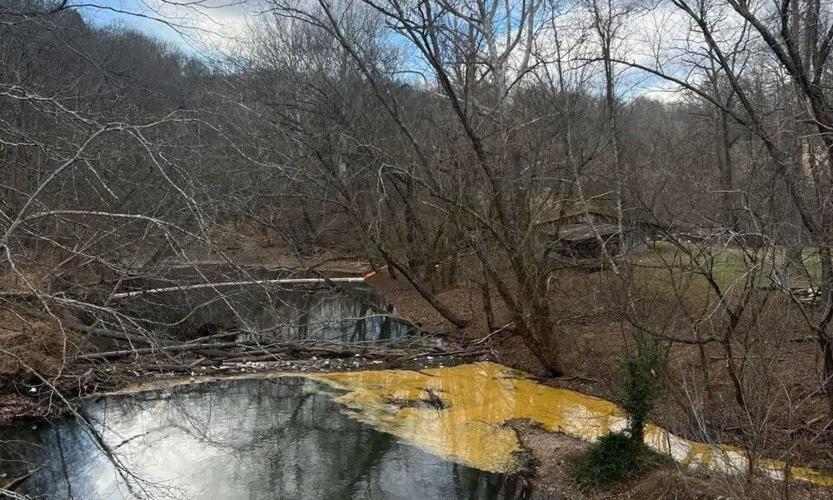







This photo showing contamination in Twelvepole Creek.
WAYNE – A second class action lawsuit has been filed regarding the three-week water crisis in the Town of Wayne.
The lawsuit, filed February 10 in Wayne Circuit Court, names 16 individual plaintiffs and lists Appalachian Power Company, American Electric Power and the Town of Wayne as defendants.
The complaint says the plaintiffs seek to recover damages for lost use of water and related harms following the contamination and/or threatened contamination of the Town of Wayne water supply and the shutdown and/or restriction of water service, arising from the oil spill/release into Twelvepole Creek and connected creeks and situated waterways beginning on or about January 13–16.

Jared Hicks
“We wanted to go ahead and get ours filed because these citizens are extremely unhappy,” Jared Hicks, one of the attorneys filing the second class action, told The West Virginia Record. “We know our clients are still leery of using the water, and I don’t blame them. Just because it passes as regulatory doesn’t mean it’s safe.
“One of our clients already has been admitted to ICU. Other clients are reporting extreme skin rashes. And it all started at very beginning, before customers were notified of the problem.”
About 2,400 homes in and around the town have been without water service for three week weeks because of alleged vandalism at a substation that led to the leak of nearly 5,000 gallons of oil into Twelvepole Creek.
Wayne water customers were under a Do Not Consume order from January 16 to February 6. The state Department of Environmental Protection says vandalism at an AEP substation caused 4,900 gallons of transformer oil to leak into Twelvepole, which runs through Wayne before draining into the Ohio River. The state Department of Health says hydrocarbons were found in the Wayne water system.
Wayne Mayor Danny Grace lifted the Do Not Consume order February 6, saying the water is safe to drink.
According to the complaint, the East Lynn substation was vandalized or unlawfully accessed January 13. A deputy responded to the report and saw evidence of unauthorized entry and damage, including damaged fencing and indications of attempted theft of metal and/or copper. The deputy and others who responded also saw fluid leaking from the substation area, according to the complaint. It says the state Department of Environmental Protection was made aware of the leak that day.
The plaintiffs and other community members say they documented contaminated water conditions and/or oily sheens in and around local waterways that feed into the town’s water supply.
The complaint says AEP and ApCo knew the location of the substation posed a “substantial risk” of contaminating waterways and knew the unguarded, unsecured substation was at risk of vandalism, trespass and theft.
The complaint also says the town also knew its water system was vulnerable to contamination because of the substation location. And, the plaintiffs say the town’s water system is subject to failures, leaks, breaks and maintenance conditions that could delay or complicate mitigation and restoration of water service following contamination.
The plaintiffs say the Do Not Consume order caused “immediate disruption of daily living and business operations.”
After the state DEP confirmed thousands of gallons of what was believed to be a non-PCB fluid/mineral oil were released at the substation, the town began the process of flushing the water system.
“Plaintiffs and the putative class have been unable to use the water service they pay the town to provide for ordinary domestic and business purposes,” the complaint states. “Plaintiffs have been forced to obtain alternative sources of water for personal and household purposes, often at their own expense, including purchasing bottled water, traveling to obtain water and/or expending additional costs and time.”
The plaintiffs say they have suffered and continue to suffer economic loss, loss of use of property, annoyance, inconvenience, stress and disruption.
They accuse the town of breach of contract, and they accuse AEP and ApCo of negligence, public nuisance and strict liability. They also seek injunctive relief to keep the town from imposing or seeking a rate increase on customers to pay for the damages and losses.
They seek compensatory damages for the loss of the use and enjoyment of property, diminution of value and damage to property, out-of-pocket expenses for replacement water and related supplies, economic losses, annoyance, inconvenience, disruption of daily life, loss of time and other damages. They also seek damages if potential exposure-related damages are proven.
In addition, they also seek damages if potential exposure-related damages are proven. They also seek punitive damages, pre- and post-judgment interests, court costs, attorney fees and other relief.
The complaint says the class would be all residents and businesses in the Town of Wayne served by the town’s water and sewer service. The complaint seeks class certification and for the attorneys to be appointed class counsel.

Ken Hicks
The plaintiffs are being represented by Kenneth Hicks and Jared Hicks of Hicks Law Office in Huntington. The case has been assigned to Circuit Judge James Young.
The named plaintiffs are David Ramey, Belinda Ramey, Charles Ramey, Dallas Stephens, Andrea Vaughan, Harry Sowards, Jerry Maynard, Evan Wilson, Terri Hudson, Kenneth Thompson, Samantha Noble, Victoria McCormick, Jason Stephens, Barbara Spurlock, Wade Adkins, Jill Thompson and Kaylee Wilson.
A February 9 town council meeting was heavily attended. Jared Hicks said he was there, and he said residents are still upset and leery.
“After attending that meeting, it showed us they want it resolved,” he told The Record. “They want action. The most important thing is getting justice for Wayne County.
“And, we’re still getting calls every day. We’re continuously signing up clients. We’re still putting our case together. The real work starts now.”
Last week, another class action was filed regarding the water crisis. It was filed in Kanawha County.
Wayne Circuit Court case number 26-C-13