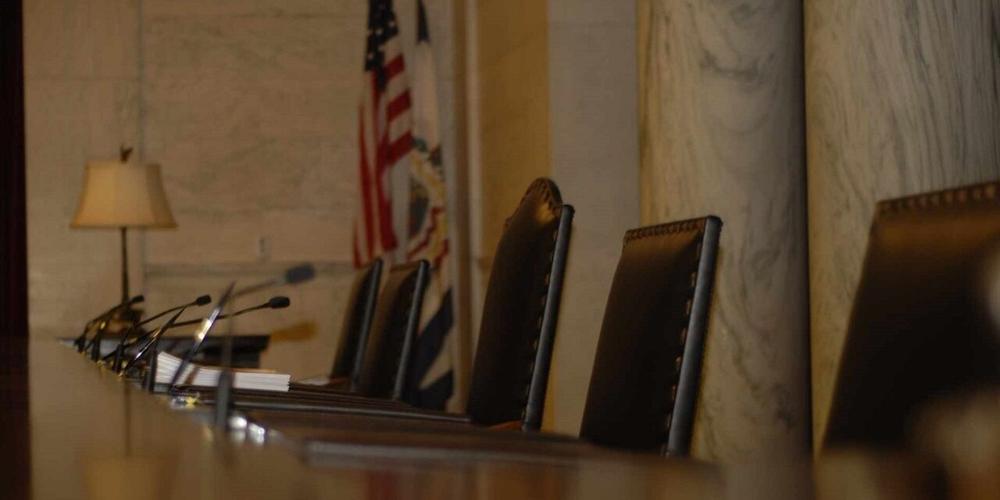




The chambers of the West Virginia Supreme Court of Appeals
CHARLESTON – The state Supreme Court has suspended the law license of a Buckhannon attorney for two years after finding he committed 41 violations of the state’s Rules of Professional Conduct in five client matters ranging from will contests to property and criminal cases.

Bailey
In a June 5 opinion, the court agreed with the Lawyer Disciplinary Board’s Hearing Panel Subcommittee that Brian Bailey’s conduct warranted “a strong and serious sanction,” but it declined to follow the panel’s recommendation to annul his license. Instead, the court imposed a two-year suspension, restitution, and other conditions.
“Mr. Bailey committed forty-one rule violations, including failure to communicate, inaction, lack of diligence, depositing unearned retainer fees directly into his operating account, and failing to respond to the ODC,” Justice Gerald Titus wrote for the court, concluding that a two-year suspension “will appropriately punish Mr. Bailey for his misconduct, deter other members of the Bar, and restore public confidence in the ethical standards of the legal profession.”
The case arose from five disciplinary complaints filed between 2022 and 2023. The Office of Lawyer Disciplinary Counsel (ODC) brought formal charges in June 2024. Bailey, admitted to the bar in 2005 and serving as a solo practitioner and mental hygiene commissioner in Lewis and Upshur counties, stipulated to most of the factual allegations before the HPS.
The court adopted the panel’s findings that Bailey violated duties of candor, loyalty, diligence, competence and communication owed to several clients, and that his misconduct extended to his handling of client funds and his responses to disciplinary authorities.
In a will contest filed for client Tesla Lewis, Bailey failed to conduct discovery, did not move for default against non-answering defendants, and left almost all communication to his nonlawyer assistant, who incorrectly told Lewis that discovery responses had been filed. When the defendants moved for summary judgment, Bailey neither told Lewis about the motion nor notified her of the hearing. He appeared alone, could not explain her absence, and the circuit court granted summary judgment and dismissed her claims for lack of evidence and discovery. Bailey then failed to promptly inform Lewis of the dismissal, forcing her to hire new counsel to pursue an appeal that ultimately failed.
In another matter, Clifford Ellis overpaid Bailey by $2,250 on a $3,000 flat fee for a land dispute because Bailey failed to maintain proper fee records. Bailey deposited Ellis’s payments into his operating account rather than his IOLTA, failed to refund the overpayment, and repeatedly left Ellis to deal with critical events on his own – including two mediations and a contempt proceeding. Bailey did not appear at a renewed contempt hearing, telling the court’s law clerk he did not want to say anything on the record after Ellis filed a disciplinary complaint. Ellis executed a court-ordered deed without Bailey’s assistance.
Other clients, including criminal defendant Robert Moats and civil client Robert Stobart, testified Bailey failed to communicate, did not file requested motions and ignored written requests for their case files.
In Moats’s case, Bailey delegated review of the State’s discovery to his assistant and never filed a motion for reconsideration of sentence as the client requested. Both clients’ payments were deposited into Bailey’s operating account without corresponding records showing what fees had been earned.
Across the five complaints, the HPS found Bailey repeatedly failed to respond to ODC inquiries, ignored his discovery obligations in the disciplinary case itself and abdicated core responsibilities to his nonlawyer assistant, who became the primary point of contact for clients and even reviewed discovery with them.
The court concluded Bailey acted “knowingly” rather than negligently, citing the breadth and persistence of his conduct, including his consistent failure to use his IOLTA account, track client payments, respond to discovery, and communicate with clients and the ODC. The court emphasized that repeated failures over many years could not be characterized as mere oversight.
The HPS identified numerous aggravating factors: Bailey’s prior disciplinary offenses, a dishonest or selfish motive, a pattern of misconduct, multiple offenses within one proceeding, lack of remorse, vulnerability of at least one client and Bailey’s substantial experience in practice. It found no mitigating factors, and the court agreed. Bailey had been barred from introducing mitigating evidence at the panel hearing after failing to respond to the ODC’s motion to exclude such proof, and the justices said he could not raise that challenge for the first time on appeal.
On the handling of client funds, the court drew a distinction between fee mishandling and outright misappropriation, stressing that disbarment is generally required for conversion of client settlement funds in the absence of compelling extenuating circumstances. The court characterized Bailey’s practice of depositing unearned fees into his operating account as mishandling, not misappropriation, supporting a sanction less than annulment of his license.
Chief Justice Haley Bunn filed a separate opinion concurring with the majority’s legal analysis on fee mishandling but dissenting from the length of the suspension. She argued the two-year suspension does not adequately reflect the seriousness of Bailey’s abandonment of clients, misrepresentations to a court, and the actual harm that followed.
Bunn would have imposed a one-year suspension for Bailey’s mishandling of client funds and an additional two years for his other violations, for a total of at least three years.
“The misconduct associated with Mr. Bailey’s handling of each client’s case is evocative of the derisive criticism the legal profession endlessly combats,” Bunn wrote.
In addition to suspending Bailey’s license for two years, the court ordered him to pay $2,250 in restitution to Ellis, petition for reinstatement, complete 12 hours of continuing legal education devoted solely to office management and ethics before seeking reinstatement as well as reimburse the costs of the disciplinary proceeding.
West Virginia Supreme Court of Appeals case number 24-363