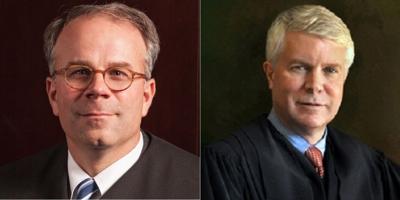


U.S. Seventh Circuit Court of Appeals judges, from left, Michael Scudder and David Hamilton
CHICAGO — A federal appeals court will allow the American Academy of Pediatrics to slip away from their doomed bid to use Chicago's Democrat-dominated federal courts to block Florida's Republican state attorney general from using Florida state courts to sue the AAP for allegedly violating a Florida state law by allegedly misleading the public about the safety of child gender transitions, rather than risk a potential landmark appellate ruling against them.
On Sept. 14, the U.S. Seventh Circuit Court of Appeals said it would allow the AAP to exit the litigation it filed in Chicago against Florida Attorney General James Uthmeier, so long as U.S. District Judge Matthew F. Kennelly vacates his controversial injuntion that had landed the case before the appeals court.
However, a group of judges on the Seventh Circuit Court chided their colleagues for allowing the AAP to walk away without first delivering a message for lower courts concerning the "extraordinary" order issued by Kennelly and its potential to lay the groundwork for future constitutionally questionable orders that run roughshod over the ability of state prosecutors and state courts to handle enforcement actions under that state's laws.
In a dissent, Seventh Circuit Judge Michael Scudder, joined by three other judges, said Kennelly's "injunction worked a grievous blow to a cornerstone principle of our constitutional design —federalism — and all but cast a vote of no confidence in state courts."
"We have clear authority to say this and have bypassed an important opportunity to do so, all at a time when the federal judiciary’s enforcement of neutral structural constitutional principles remains as important as ever," Scudder wrote.
"... I worry that forgoing this opportunity will prove constitutionally expensive another time," he added.
The ruling comes as perhaps the final step in the Chicago stage of the legal battle between AAP and Florida Attorney General James Uthmeier.
The legal fight began in December 2025 in Florida state court when Uthmeier sued the AAP in St. Lucie County. The complaint also named two other organizations as defendants. Those included the World Professional Association for Transgender Health and the Endocrine Society.
In that lawsuit, Uthmeier accused the organizations of violating the Florida Deceptive and Unfair Trade Practices Act and the state's Racketeer Influence and (RICO) Act.
The Florida lawsuit accused the groups of deceiving the public by allegedly knowingly lying about "credible evidence" backing their recommendations supporting the use of puberty blocking drugs, cross-sex hormones and gender transition surgeries for children, and promoting the practices using alleged falsities.
The AAP has refused to retract its statements and recommendations, despite government pressure and Uthmeier's lawsuit.
Instead, the AAP, which is based in Chicago's suburbs, sued Uthmeier in Chicago federal court, asserting Uthmeier's lawsuit is an unconstitutional attempt to suppress their speech concerning the controversy surrounding child gender transitions.
Uthmeier sought to dismiss the AAP's lawsuit, saying the action marked an unprecedented and constitutionally questionable attempt to use a federal court in one state to block a state attorney general from attempting to enforce his state's laws in that state's courts.
However, Kennelly sided with the AAP, saying he believed an injunction was proper because the effect of Florida's lawsuit would be felt by the AAP, an organization in Illinois.
Kennelly agreed with the AAP that the Florida action was a "bad faith" violation of the group's First Amendment rights.
That view was supported in a 2-1 decision from a three-judge panel of the U.S. Seventh Circuit Court of Appeals.
In that ruling, Seventh Circuit judges David Hamilton and Candace Jackson-Akiwumi noted federal courts are commanded by the U.S. Supreme Court to almost always avoid getting involved in state court disputes. But supporting Kennelly, they said Uthmeier's "bad faith" meant Chicago federal judges were not out of bounds to block Florida state officials from using Florida state courts to enforce Florida state law.
The ruling, however, drew a sharp rebuke from Scudder, the third member of the panel, who called the majority opinion "a grievous blow to federalism" that would have lasting and "grave" repercussions, if allowed to stand.
Federalism is the central principle of the U.S. constitutional system, which balances the powers of the central federal government against those of the 50 sovereign U.S. states, permitting states to make and enforce their own unique laws.
The panel, however, did not have the last word.
Uthmeier appealed to the full Seventh Circuit.
There, Scudder's position appeared to hold sway, as the full court not only voided the three-judge panel's ruling, and not only blocked Kennelly's injunction, but also invoked rarely used powers to refuse to allow neither Kennelly nor the three-judge panel to rehear the case at all.
Rather, a majority of the full complement of 11 judges ordered the case to remain before them, in a so-called initial en banc proceeding.
In the meantime, Uthmeier continued to pursue his claims against the AAP and their co-defendants in Florida court. And a St. Lucie County judge refused an initial attempt by the defendant groups to toss the case, finding Uthmeier's case "targets unprotected conduct and false and misleading commercial speech," which is afforded lesser protection under the First Amendment.
Faced with the prospect of defending against both the revived Florida state court action and a potentially landmark defeat at the Seventh Circuit, the AAP instead chose to withdraw from the action in Chicago federal court, asking Kennelly to dismiss their lawsuit and the related injunction.
Kennelly granted that request, though he did so "without prejudice," meaning he did not foreclose the AAP from trying again.
With the dismissal in hand, the AAP asked the Seventh Circuit to also release the case, saying there was no longer an active legal dispute and the case is moot.
For his part, Uthmeier urged the Seventh Circuit to still rule in the matter, saying the dismissal amounted to an attempt by Kennelly and the AAP to "sweep this matter under the rug," rather than face scrutiny over the legal action and the injunction, which Uthmeier said was "inexcusably wrong."
Uthmeier further argued a decisive ruling was needed from the Seventh Circuit to prevent Kennelly or other judges from repeating the gambit in the future against actions mounted by state attorneys general with whom they differ politically.
The political nature of the matter was reinforced by a filing from a group of Democratic state attorneys general, including California Attorney General Rob Bonta and Illinois Attorney General Kwame Raoul, who urged the Seventh Circuit to allow a federal judge to limit the authority of Florida's Republican attorney general to enforce his state's law.
However, rather than rule in the matter, the full Seventh Circuit agreed the case was moot, and have ordered an end to the case, provided Kennelly follow through on his order and vacate his injunction.
In a concurring opinion perhaps explaining the majority's position, Seventh Circuit Judge Joshua Kolar acknowledged the court could have said more on the matter. But the judges chose not to, as they believed Kennelly's dismissal had mooted the case and there as no longer a "live controversy" to decide.
Without such a "live controversy," Kolar said, he would "hesitate to come to any conclusion" on the weighty constitutional questions involved in balancing when federal judges can use a so-called "bad faith exception" to the general rule that prohibits federal judges from intervening in state court cases, to instead step in and shut down state legal actions in the name of protecting constitutional rights.
The "bad faith exception" can be cited when a judge, after a serious inquiry, determines the evidence shows a prosecutor acted with "malice" in bringing a potentially politically motivated case that tramples First Amendment or other constitutional rights.
While the appeals court declined to rule in the case, judges on the court used the decision to get in some parting shots over which party had actually violated the Constitution.
Hamilton and Jackson-Akiwumi asserted the fault lies with Uthmeier, for allegedly seeking to violate the First Amendment rights of the AAP and their co-defendants. Hamilton and Jackson-Akiwumi, appointees of Democratic former presidents Barack Obama and Joe Biden, respectively, maintained their belief that the AAP's recommendations to doctors and guidance to the public about child gender transitions was merely protected constitutional speech, even if it may have proven to be without scientific evidence.
So, they maintained their belief that Kennelly had chosen to protect constitutional rights when he cited the so-called "bad faith exception" to attempt to shut down Uthmeier's action.
"The exception is ... a critical feature—a constitutional safety valve, if you will—in the federalism balance...," Hamilton wrote.
Scudder, joined by judges Michael Brennan, Amy J. St. Eve and Thomas Kirsch, however, asserted Kennelly's injunction amounted to unconstitutional judicial overreach that all but declared Florida's state courts couldn't be trusted to handle the dispute, trampling the principles of federalism.
"Time will tell whether the Academy (AAP) prevails on its defense or falls short," Scudder wrote. "All we can observe today is that, if the Academy does not prevail at the trial court level, it can seek further review in the Florida appellate courts, even the Florida Supreme Court.
"The U.S. Constitution presumes parity and comity between the federal and state courts. As Justice Brennan explained more than 50 years ago for a unanimous Supreme Court, 'a pending state proceeding, in all but unusual cases, would provide the federal plaintiff with the necessary vehicle for vindicating his constitutional rights.'”
Scudder, Brennan, St. Eve and Kirsch were all appointed by President Donald Trump during his first term in office.