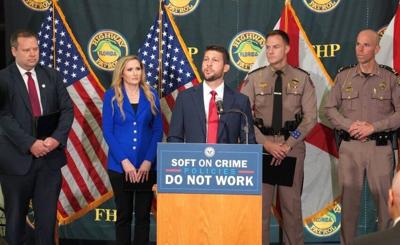



Florida Attorney General James Uthmeier speaks at a press conference.
CHICAGO — In a seeming rebuke to a controversial decision handed down and supported by a group of Obama- and Biden-appointed judges, the rest of the judges on Chicago's federal appeals court have struck down that ruling that would have allowed Chicago judges to block Florida's Republican state attorney general from using Florida state courts to enforce a Florida state law against a national pediatrics organization for allegedly misleading the public about the safety of child gender transitions.
On July 8, the U.S. Seventh Circuit Court of Appeals granted the petition of Florida Attorney General James Uthmeier to rehear the dispute over the attempt by the American Academy of Pediatrics to use Chicago federal courts to block Uthmeier from enforcing Florida's law against them.
In that order, the Seventh Circuit also agreed to strike down an injunction entered against Uthmeier by U.S. District Judge Matthew F. Kennelly, an appointee of former President Bill Clinton, an injunction that had been upheld in a 2-1 decision by a divided three-judge panel.
The majority in that June 22 decision had included Seventh Circuit judges David F. Hamilton and Candace Jackson-Akiwumi, appointees of former Democratic presidents Barack Obama and Joe Biden, respectively.
But the full Seventh Circuit court went further still, taking the unusual step of not returning the case to that panel for further hearings. Instead, the full court ordered the case would be heard entirely by a full complement of 11 judges in a so-called initial en banc proceeding.
The majority on the court did not explain their reasoning for such an extraordinary step, which bypasses the usual route, as designed by Congress, of allowing a three-judge panel to finish with the case before proceeding to an en banc hearing on the merits of the case.
However, the decision to take up the matter initially en banc drew dissent from four of the five Biden-appointed judges on the Seventh Circuit.
That dissent was authored by Judge James Z. Lee, and was joined by judges Jackson-Akiwumi, Nancy Maldonado and Doris Pryor.
Hamilton did not join with Lee's specific dissent. But Hamilton did join the four in dissenting from the court's overall order to vacate Kennelly's injunction and void the original June 22 opinion Hamilton and Jackson-Akiwumi had authored.
The June 22 appeals court decision had rejected Uthmeier's attempt at the time to vacate Kennelly's injunction.
In that ruling, Hamilton and Akiwumi said they agreed with Kennelly's findings that Uthmeier's case against the American Academy of Pediatrics was based on an improper desire to use a legal action grounded in Florida state law to essentially punish the AAP for supporting child gender transitions.
While federal courts almost always are commanded by a U.S. Supreme Court precedent to abstain from getting involved in state court disputes, Hamilton and Jackson-Akiwumi said they could make an exception in this case, agreeing with Kennelly that Uthmeier's legal action could be blocked because it was filed in "bad faith."
That ruling, however, drew a sharp rebuke at the time from the third member of the panel, Seventh Circuit Judge Michael Y. Scudder.
Scudder was appointed to the court during the first term of President Donald Trump.
In that June 22 dissent, Scudder called the majority opinion "a grievous blow to federalism."
Federalism is the central principle of the U.S. constitutional system, which balances the powers of the central federal government against those of the 50 sovereign U.S. states, permitting states to make and enforce their own unique laws.
Scudder said Kennelly should have abstained from stepping into the case altogether and warned of powerful, lasting repercussions, should Kennelly and the AAP ultimately prevail in this case.
"Make no mistake about the legal magnitude of what is at stake here," Scudder wrote on June 22. "A federal court in Illinois has enjoined a state’s chief legal officer from proceeding in state court, all because it doubts the merits of his state law claims.
"The implications are grave. "
The legal fight began in December 2025 in Florida's 19th Judicial Circuit Court in St. Lucie County, when Uthmeier sued the AAP, along with two other medical organizations, the he World Professional Association for Transgender Health and the Endocrine Society.
In that lawsuit, Uthmeier accused the organizations of violating the Florida Deceptive and Unfair Trade Practices Act and the state's Racketeer Influence and (RICO) Act.
The Florida lawsuit accused the groups of deceiving the public by allegedly knowingly lying about "credible evidence" backing their recommendations supporting the use of puberty blocking drugs, cross-sex hormones and gender transition surgeries for children.
In his filings, Uthmeier has particularly assailed the AAP for issuing a "policy statement" that concluded that "puberty blockers are 'reversible' and that gender-affirming care results in minors having fewer mental health concerns." Uthmeier asserts those claims are not backed by scientific evidence and the policy statement was allegedly drafted and advanced by one person, a doctor who was not considered a medical authority, but was still undergoing his residency at the time and was launching a practice that "consisted largely of prescribing puberty blockers and cross-sex hormones to minors."
The AAP has refused to retract the policy statement, despite government pressure and Uthmeier's lawsuit.
Instead, the AAP, which is based in Chicago's suburbs, sued Uthmeier in Chicago federal court, asserting Uthmeier's lawsuit is an unconstitutional attempt to suppress their speech concerning the controversy surrounding child gender transitions.
Uthmeier sought to dismiss the AAP's lawsuit, saying the action marked an unprecedented extra-jurisdictional attempt to use a federal court in one state to block a state attorney general from attempting to enforce his state's laws in that state's courts.
Kennelly, however, sided with the AAP, saying he believed an injunction is warranted because the effect of Florida's lawsuit would be felt by the AAP, an organization in Illinois.
Kennelly said the convincing argument is that the relief Uthmeier seeks — an injunction to prevent the group from publishing anything supporting its position or collaborating with the other defendants — isn’t limited to what the group does in Florida.
Kennelly agreed with the AAP that the Florida action was a "bad faith" violation of the group's First Amendment rights.
Uthmeier appealed to the Seventh Circuit, but met with a similar result from Hamilton and Jackson-Akiwumi.
However, now under the new ruling, Uthmeier will have his appeal heard by the full Seventh Circuit, instead, after the Seventh Circuit invoked a rarely used court rule, known as Rule 40(g), to assign initial jurisdiction to an en banc panel.
In dissent to that decision, Lee and his fellow Biden appointees said they worried about the "impact" this unusual move "will have on future proceedings and the court as a whole."
Lee said the dissent should not be taken as an opinion on the overall merits of either the AAP's or Uthmeier's case.
"Perhaps this is one of the exceedingly rare cases that Rule 40(g) envisions and will prove to be the extraordinary exception and not the rule. I certainly hope so and respectfully dissent," Lee wrote.
In a related order, the Seventh Circuit directed the parties to complete briefing in the case before the Seventh Circuit by Aug. 26.