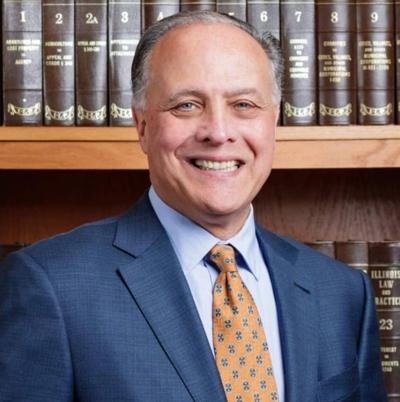


Burr Ridge Mayor Gary Grasso
CHICAGO — An Illinois state appeals court will allow the mayor of Burr Ridge to resume his defamation lawsuit accusing a political consultant who worked for his political rival for allegedly falsely accusing him of not paying the full amount owed on his property taxes.
Gary Grasso was mayor of west suburban Burr Ridge from 2005 through 2012, then sought re-election in 2019. During that campaign, according to Grasso’s lawsuit, candidate Zachary Mottl and his campaign team sent mailers to voters implying Grasso shorted his property tax payments by $36,000 because of an improper homestead exemption.
Grasso ultimately won reelection, and currently serves as mayor of Burr Ridge, with a term expiring in 2029.
In his July 2019 lawsuit, Grasso targeted Mottl, who also was a village trustee, along with fellow trustee David Williams and co-defendants the Zax PAC committee, COR Strategies and that company’s president, political strategist Collin Corbett.
Grasso is a former candidate for Congress. He lost in the Republican primary for Illinois’ 6th Congressional District in 2022.
Corbett is currently running an independent campaign for Illinois governor.
Although a settlement removed Mottl, Willimas and Zax PAC as defendants, Grasso continued his litigation against Corbett and COR. After DuPage County Circuit Court Judge David Schwartz granted summary judgment in favor of Corbett, Grasso challenged the ruling before the Illinois Third District Appellate Court.
Justice Matthew Bertani wrote the panel’s opinion, filed July 13; Justices Linda Davenport and John Anderson concurred. Anderson wrote a special concurrence.
Grasso’s appeal focused specifically on assertions in three mailers that accused him of tax fraud, claims that cited the Cook County Assessor’s Office and “DuPage County Records” as sources. Bertani said the claim originated from a third-party research firm COR retained with a report showing Grasso claimed a $6,000 DuPage County homestead exemption, while also claiming a similar exemption in Cook.
“The $36,000 figure suggested plaintiff defrauded the government for a period of six years,” Bertani wrote. “However, the research report only supported a two-year overlap in homestead exemptions.”
As a public official, Grasso would have to allege not just a defamatory statement — here the implication he committed criminal tax fraud — but also underlying malice. The panel cited the 1964 U.S. Supreme Court opinion, New York Times v. Sullivan, establishing the need to show a statement was made “with knowledge that it was false or with reckless disregard of whether it was false or not.”
Absent overt evidence that anyone knowingly published a false statement, the panel continued, the case hinges on the notion of reckless disregard for accuracy and whether a reasonable jury might agree with Grasso.
Corbett said he and his firm relied on research from America Rising, then examined public records to corroborate the report. But the panel’s review found only information that could lead to the conclusion the improper exemptions on the Burr Ridge residence totaled $12,000.
“Corbett was unable to recall how defendants converted that information into a claim of fraud in the sum of $36,000,” Bertani wrote. “The research report in no way supports the notion that plaintiff received an improper exemption beyond the years 2016 and 2017. Corbett was unable to explain the ‘math’ defendants used to formulate the $36,000 figure, let alone the alleged ‘more than $36,000’ accusation in” two of the three mailers.
The panel said the defendants didn’t put “blind faith in a known source without further investigation,” but did their own checking, effectively making Corbett and his firm the original source of the statement Grasso challenged. While Corbett’s deposition included routine assertions he couldn’t “speak to our thinking at that time,” the panel said a court should still determine whether it was a good faith publication, which means summary judgment was improper.
That alone led to the panel reversing and remanding the ruling back to DuPage County Circuit Court. But Justice Anderson opted to “elaborate on the problem that exists when a party seeks summary judgment based on their own subjective knowledge and intent, and that party is the only one who has that information," adding "(and I use ‘information’ loosely).”
When a party seeks summary judgment, Anderson said, judges should take undisputed evidence as fact. But Grasso couldn’t have submitted a declaration asserting what Corbett knew at the time, and accepting Corbett’s statement as fact would establish a framework that insulates private knowledge from judicial scrutiny.
“Credibility lies at the heart of this case,” Anderson wrote. “Defendants ask us to accept Corbett’s statement not because it is corroborated by independent evidence but because he says it is true. … Corbett’s deposition testimony is not a neutral recitation of historical facts. It is a self-serving declaration concerning the very mental state that determines liability. Corbett effectively asks the court to conclude that he lacked knowledge of falsity because he says he lacked knowledge of falsity. Such circular reasoning leaves no meaningful role for cross-examination or credibility assessment.”
While allowing that most testimony is self-serving, and acknowledging that not every factual question needs to reach a trial, Anderson also noted “the law’s traditional preference for live testimony reflects the recognition that truth is often revealed not merely by what a witness says but by how the witness responds when challenged.”
Grasso is represented by Vinkler Law Offices, of Burr Ridge, and Grasso Law, of Hinsdale.
Corbett and COR Strategies are represented by Keith Brin, of Highland Park.