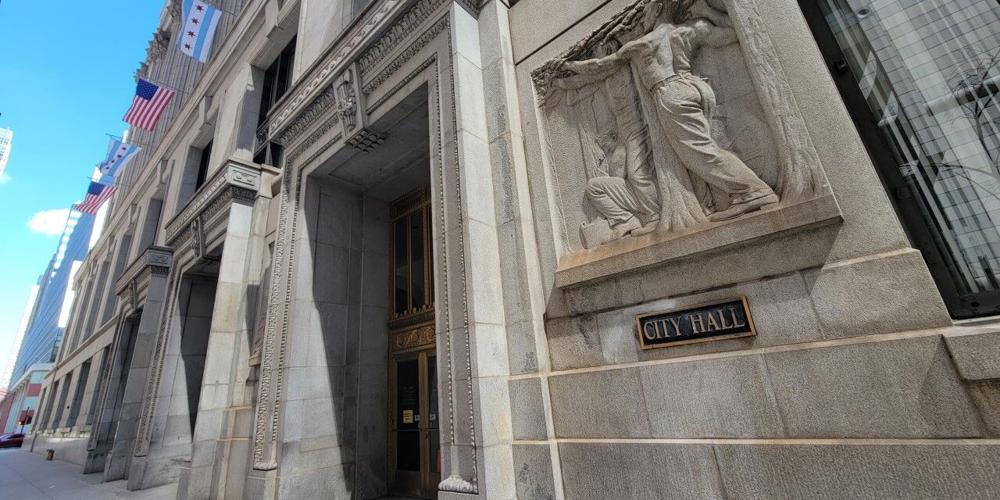





Chicago City Hall
CHICAGO - A federal appeals panel says Chicago’s policy of towing and disposing of vehicles doesn’t reach the level of unconstitutional taking without compensation, even if the value of the cars that are seized may greatly exceed the allegedly unpaid ticket debt.
Ryan O’Donnell and Michael Goree sued the city and United Road Towing alleging violation of their Fifth Amendment rights as a result of the graduated forfeiture process through which unpaid tickets can result in losing ownership of vehicles.
The men were represented in the potential class action lawsuit by attorneys Jacie C. Zolna and Benjamin R. Swetland, of the firm of Myron M. Cherry & Associates, of Chicago.
According to court records, the city ultimately sold O’Donnell’s vehicle to URT for scrap value and it relinquished Goree’s to the lienholder. Both men say they should’ve been paid after the disposal or the proceeds should’ve offset their unpaid ticket debt.
After U.S. District Judge Andrea Wood dismissed the complaint for failure to state a claim, the men took the putative class action to the U.S. Seventh Circuit Court of Appeals. Judge Thomas Kirsch wrote the panel’s opinion, filed Dec. 22; Judges Michael Scudder and Doris Pryor concurred.
According to Kirsch, the system begins with a ticket: vehicle owners can pay in full, agree to an installment plan or contest the violation. If they don’t pay or if they lose the challenge, the city sends a notice that the liability determination is final. Once a vehicle owner gets at least three such notices, or two that have been unresolved for at least a year, the city makes all vehicles registered to that owner eligible to be immobilized.
When the city sends a notice of impending immobilization, it gives the owner 21 days to pay in full or request a hearing. When that window expires, the owner then has 24 hours to pay, start an installment plan, take part in a relief program or request more compliance time. Failure to do so means the city can tow and impound those vehicles.
Once the city impounds a car, it sends another notice granting 21 days to pay and reclaim the vehicle, request an extension or demand an administrative hearing on the validity of the impound or immobilization. Once the city determines a vehicle is unclaimed, it can sell or otherwise dispose of the property.

U.S. Seventh Circuit Judge Thomas Kirsch
Because the men challenge the applicable city code section as facially unconstitutional, Kirsch said, they can only survive dismissal by showing that enacting the law itself constituted an illegal taking. He referenced another 2025 Seventh Circuit opinion, Hadley v. South Bend, which also “arose from a state’s exercise of its police power rather than eminent domain.”
As with South Bend, the Chicago graduated forfeiture process is an example of municipal authority to determine proper public safety measures, in this instance enforcement of city traffic code.
“The purpose of the forfeiture scheme is to target individuals who — by refusing to pay — have hitherto evaded punishment for their traffic and parking infractions,” Kirsch wrote. “Instead of continuing to issue unanswered tickets, the city institutes a different form of punishment: hindering offenders’ ability to drive by immobilizing, impounding and potentially even disposing of their vehicles. Without this graduated forfeiture scheme, vehicle owners who repeatedly violate the traffic code could evade punishment. The threat of impoundment and disposal forces them to internalize the consequences of their behavior and, accordingly, deters those violations in the first place.”
The panel rejected the framing of the process as a debt collection mechanism rather than application of law enforcement. Unlike bankruptcy actions, Kirsch explained, the towing program raises money and improves traffic law compliance. Further, while the panel did acknowledge “some forfeitures may result from an inability to pay, that’s not necessarily true in every case” and arguments that depend on specific situations to be valid aren’t applicable to their facial challenge to the enactment of the city code.
“Their arguments that the underlying offenses may be minimal, or that the vehicle owner may not be the offending driver, fail for the same reason,” Kirsch continued. “Allowing owners to recover their cars after paying is consistent with (the code’s) punitive purpose. Once owners pay their ticket debt, they’ve internalized the cost of their infractions and there’s no need for the city to continue to hold their vehicles. Second, the sweeping nature of (the code’s) reach also serves a punitive purpose: if the city doesn’t place every vehicle registered to an owner on the immobilization list, those with multiple vehicles can continue to drive, thwarting (the code’s) intended effect.”
The men also invoked a 2023 U.S. Supreme Court opinion, Tyler v. Hennepin County, which invalidated property tax sale systems that didn’t compensate the original owners for any equity amassed at the time the government claimed and resold their properties. The principle that the government “may not take more from a taxpayer than she owes,” Kirsch wrote, isn’t applicable when a government is applying law under police power.
With the main question resolved, the panel said, the remaining claims fail. There is no underlying constitutional violation supporting a claim against URT, nor is there a viable state law unjust enrichment claim, the judges said.