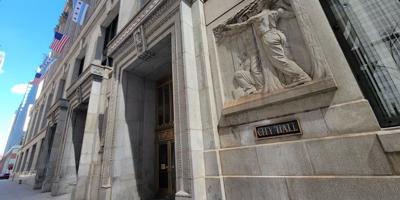


Chicago City Hall
CHICAGO — A trade group representing social media companies and other big tech companies is suing to challenge Chicago's so-called social media user tax, saying the tax — which Illinois' governor also has called to replicate statewide — amounts to unconstitutional taxation and unconstitutional discrimination against social media publishers.
The lawsuit was filed March 12 in Cook County Circuit Court.
“The government cannot single out publishers for disfavored tax treatment. But that is exactly what Chicago’s social media tax does. This tax penalizes a subset of online publishers for no other reason than they are popular," said Paul Taske, co-director of the NetChoice Litigation Center, in a statement announcing the legal action.
The lawsuit takes aim at Chicago's so-called Social Media Amusement Tax. The tax was imposed by the city at the beginning of 2026, after it was approved by the City Council in December 2025. Mayor Brandon Johnson chose neither to veto nor sign the ordinance, meaning it automatically took effect.
Under the ordinance, the city would impose a tax of 50 cents per user, after the first 100,000 users, as measured by user location data tracked by the social media companies, calculated monthly.
Supporters of the measure said they expect the tax will result in $31 million in new city revenue each year, which the city has claimed will be used to support community mental health services.
Illiois Gov. JB Pritzker has signaled his support for such a tax, calling in his February address to the Illinois General Assembly for a similar "fee" statewide, which his office indicated could raise up to $200 million per year for the state.
In its filing, NetChoice has signaled its intent to use the courts to shut down any move toward such taxes in the future, as they seek orders declaring such social media user fees not only to be bad policy, but also unconstitutional and illegal.
They called the tax a "targeted strike against America's most popular online publications."
The new fight marks the latest clash between Chicago City Hall and the tech and online entertainment industries over the city's use of its powers to tax so-called "amusements" to extract big money from platforms and their users.
In 2019, for instance, the city prevailed over an effort by Apple, Netflix and others to defeat the city's 9% tax on streaming services.
As in the past fight, NetChoice has lobbed allegations that the social media user tax violates the Internet Tax Freedom Act (IFTA), a federal law that prohibits state and local governments from imposing certain taxes which discriminate against online commerce.
In this case, NetChoice asserts the city tax illegally singles out social media companies and platforms, while exempting other online publishers.
But NetChoice further asserts the tax ordinance amounts to an illegal tax aimed at online speech and publishing, which NetChoice asserts violates the First Amendment.
They note the tax specifically exempts what the ordinance calls "bonafide" news sites, yet "does not provide any criteria—neutral or otherwise—to distinguish 'bona fide news' websites from other news websites."
"Because the Tax applies only to 'social media business[es],' it necessarily singles out websites that engage in expressive activity and facilitate a 'staggering' amount of fully protected speech across 'billions of posts,'" NetChoice said in its lawsuit.
They said this amounts to unconstitutional discrimination against social media publishers, and unconstitutional decisions by the city defining "bonafide" news reporting.
Further, NetChoice asserts the tax is unconstitutional because it cannot be properly apportioned, and may ultimately result in the companies being taxed multiple times for the same users.
Because the tax is calculated based on user location tracking data, it cannot accurately calculate how many users actually live in the city of Chicago. And NetChoice noted that social media companies do not collect the home addresses of people using their platforms.
Social media companies "may obtain IP addresses or locations via wireless signals that indicate a phone or a computer’s location while a covered website is being used, but social media businesses have no way of knowing if that user is a resident of Chicago.
"Moreover, IP addresses are ill-suited to determining where precisely a user is located—or whether the user is a 'resident' of Chicago," NetChoice wrote.
And users moving about to different locations and engaging in content on the social media platforms in different geographical locations could result in their IP addresses being counted multiple times. Should other local governments enact similar taxes, it could result in the companies being taxed in multiple locations for the same users.
NetChoice is seeking a court order declaring the tax illegal and unconstitutional.
They are represented by attorney Timothy J. McCaffrey, of the firm of Everlands Sutherland, of Chicago.
In a statement announcing the lawsuit, NetChoice said consumers will ultimately bear the price of such taxes, in the form of reduced services and increased costs for advertising and other online services.
“Beyond the legal problems, this tax is short-sighted," NetChoice's Taske said. "Ultimately, Chicago residents and their businesses should expect to see the cost of advertising dramatically increase. That means increased costs for Chicago businesses doing all they can to survive—local restaurants, auto dealers, artists and more will be the hardest hit under this proposal.
"This is a lose-lose for Chicagoans’ free speech, businesses and residents alike.”