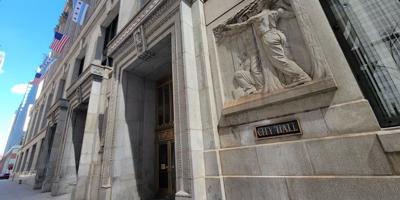



Chicago City Hall
CHICAGO — A state appeals panel has revived a class action accusing the city of Chicago of illegally issuing citations for distracted driving, saying a Cook County judge wrongly cut the case short, asserting "seven years" of litigation was enough, despite the case's complex legal and constitutional questions.
In August 2017, shortly after reaching a $39 million settlement to end a class action over red-light camera tickets, Myron Cherry & Associates attorneys Myron M. Cherry, Jacie Zolna, Benjamin Swetland and Jessica Chavin filed the lawsuit in Cook County Circuit Court on behalf of several named plaintiffs ticketed between 2012 and 2014 for using a cellphone while driving.
In August 2021, Cook County Circuit Court Judge Pamela Meyerson granted summary judgment to the city, finding the plaintiffs didn’t have the right to challenge the city’s use of its Department of Administrative Hearns to administratively adjudicate the citations. They challenged that outcome before the Illinois First District Appellate Court, which reversed the ruling and remanded for further proceedings.
At that point, Judge Meyerson granted a class certification motion. In 2024, the Illinois Supreme Court ruling in Cammacho v. City of Joliet established the Illinois Municipal Code provision at question in the distracted driving complaint didn’t bar administrative departments from handling such situations. The plaintiffs changed their legal theory of jurisdiction to invoke the Chicago Municipal Code, but Meyerson again granted summary judgment in January 2025 because the new theory wasn’t in the original complaint and she wouldn’t allow an amended complaint.
The plaintiffs again asked the First District Appellate Court to review the matter.
Justice Jesse Reyes wrote the panel’s opinion, filed Feb. 18; Justices LeRoy Martin and Bertina Lampkin concurred.
Reyes said the panel agreed with Judge Meyerson regarding whether the “amended complaint alleged a jurisdictional claim based on” a city ordinance, writing the only reference to the Chicago Municipal Code was in the context of allegations about the structure of state laws as regards whether ordinance violation challenges belong in circuit court or a municipal administrative proceeding.
The panel further rejected the argument that city code itself deprived DOAH of the right to adjudicate the distracted driving citations, finding “no reasonable reading of the amended complaint” to support the position. It also said the importance of the city code wasn’t “a live issue” when Meyerson issued the summary judgment ruling and further agreed the amended complaint isn’t an issue of new facts supporting an original legal theory but trying to advance claims by changing which law the city allegedly violated.
However, the panel ultimately agreed Meyerson should’ve granted leave to amend the complaint. Reyes said her ruling “appears to have focused on” the lawsuit taking more than seven years to work its way through the system but didn’t explain how allowing another amendment would prejudice the city or explain the conclusion the “plaintiffs knew about and could have pleaded their alternative theory from the start.”
The panel said “the passage of time is slightly misleading” with respect to both parties substantially shifting arguments over that time and noted “it was only in August 2023, when the city filed its cross-motion for summary judgment following remand, that the parties substantively addressed the question of whether the state statute preempted the city’s home rule authority.”
Further, when that happened, both parties acknowledged appellate court precedent answered the question, but the Cammmacho ruling reversed that history. The plaintiffs tried the same day “to shift their focus to the municipal ordinance” and asked to formally amend the complaint within a month.
“It is not clear that plaintiffs’ argument would be futile, especially given the supreme court’s decision in Cammacho,” Reyes wrote. “At a minimum, plaintiffs have nonfrivolous arguments concerning the interpretation of the Chicago Municipal Code in light of the supreme court’s treatment of the Joliet ordinances. While we express no opinion as to the ultimate likelihood of success on remand, we find that, under the circumstances of the case before us, plaintiffs should have been permitted to amend their complaint to include their ordinance-based jurisdictional argument.”
The panel refused to grant the plaintiffs’ request for summary judgment “on the basis that the city’s home rule power to administratively adjudicate reportable traffic offenses is impliedly preempted,” disallowing an attempt to raise an argument for the first time on appeal. It also would not revisit an earlier ruling that the DOAH had explicit authority to adjudicate violations occurring before 2014, saying nothing in Cammacho contradicted the initial ruling, especially since “our prior decision had been filed approximately 19 months prior to the Supreme Court’s ecision in Cammacho, and that the city of Joliet’s petition for leave to appeal and its supporting brief before the Supreme Court both cited our decision, meaning that the Supreme Court would have been well aware of our earlier decision.”
The city is represented by its corporate counsel.