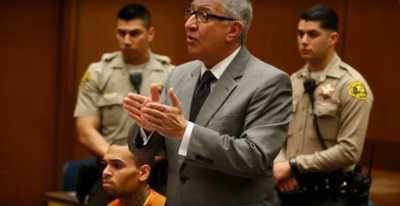


Attorney Mark Geragos
CHICAGO - An Illinois state appeals court has blocked celebrity lawyer Mark Geragos and his Beverly Hills law firm from reviving a lawsuit against two Nigerian brothers accused of helping actor Jussie Smollett stage a hoax racist and anti-gay attack, over claims the brothers and their lawyers had sought to win publicity by wrongly suing Geragos, who had represented Smollett, for allegedly smearing the brothers' reputations.
The ruling could potentially bring an end to another in a series of legal battles waged amid a long-running legal crossfire involving many of the people and personalities engulfed in the Smollett hoax scandal.
In the ruling delivered Jan. 16, a three-justice panel of the Illinois First District Appellate Court refused Geragos' attempt to undo a Cook County judge's dismissal of his lawsuit accusing brothers Olabinjo and Abimbola Osundairo and their legal team of malicious prosecution.
In the ruling, the justices noted Geragos could not claim that Smollett dumped the Geragos firm because of a defamation lawsuit filed against Geragos by the Osundairo brothers.
Rather, they said, the record indicates Geragos chose to cease representing Smollett, personally, even as his firm continued to do so. And that, the justices said, is enough to uphold Sherlock's determination that Geragos couldn't back up his claims for so-called "special damages."
"Geragos could have continued to represent Smollett and say what he wanted on his podcast regarding his client’s innocence. No one moved to disqualify him. Geragos’ remedy here was to seek sanctions in federal court, not bring a malicious prosecution suit," the justices said.
The decision was authored by Justice Sharon Oden Johnson; justices Mary L. Mikva and Sanjay Tailor concurred.
The decision was issued as an unpublished order entered under Supreme Court Rule 23, which may limit its use as precedent.
Geragos, his firm, and the Osundairo brothers and their lawyers have squared off in court against each other since some of the earliest weeks following the revelation that Smollett and the brothers allegedly faked the attack.
The Osundairo brothers were thrust into the public spotlight amid the fallout from former Cook County State's Attorney Kim Foxx's sudden and controversial decision to not prosecute Smollett for lying to police investigating his claims of being assaulted by white Trump supporters on on a cold January night on the streets of Chicago's Streeterville neighborhood in 2019.
Smollett had claimed his assailants had shouted at him that "This is MAGA country!" - referring to Trump's "Make America Great Again" campaign slogan - and had hung a noose around his neck, poured bleach on him and struck him.
Smollett asserted he was attacked for being black and gay.
Unquestioning sympathy and outrage was poured out throughout the country, particularly among Democrats, who sought to blame Trump for the alleged attack on the actor, which was blamed on alleged racism and homophobia.
After days of such outcry, however, police and prosecutors instead accused the actor, notable for his role on the "Empire" television series, of faking the attack with the aid of two Nigerian brothers he knew.
While a Cook County judge agreed to allow Smollett to walk under a supposed deal with Foxx's office, a different judge ordered a special prosecution of Smollett, which resulted in a jury convicting the actor of the alleged crime.
Central to the case against Smollett were claims the Osundairo brothers had admitted to helping Smollett carry out the alleged hoax.
Smollett's conviction, however, was ultimately tossed by the Illinois Supreme Court, which declared the state must honor the deal proffered by Foxx, regardless of its questionable nature.
Initially, Smollett had hired the Geragos firm, including attorneys Geragos and Tina Glandian, to represent him.
Geragos and his southern California firm, headquartered in Beverly Hills, are high profile attorneys, regularly representing celebrities in legal trouble.
After Foxx dropped the Smollett prosecution in the spring of 2019, Geragos and Glandian offered comments to the press, asserting Smollett's claims were true and the brothers had attacked him on the streets of Chicago's Streeterville neighborhood that night in January 2019.
Glandian also allegedly told reporters that the brothers had engaged in gay sex acts with Smollett.
The Osundairo brothers then sued in Chicago federal court, claiming Geragos, Glandian and their firm should be held accountable for allegedly defaming them, destroying the brothers’ reputation, costing them career opportunities and even endangering their lives and the lives of their families in Nigeria.
A federal court ultimately tossed the claims against Geragos and his firm. Initially, the claims against Glandian were allowed to continue. But a federal judge ultimately also granted summary judgment to Glandian in December 2024.
After the brothers' lawsuit was dismissed against Geragos and the firm, Geragos responded by suing the brothers and their lawyers in Cook County Circuit Court, claiming their campaign against him, allegedly even after the lawsuit was dismissed, amounted to malicious prosecution in a bid to keep their names in the public eye.
Lawyers identified as defendants in the action include attorneys Gloria Schmidt Rodriguez and Jorge Rodriguez, and their firm, the Gloria Law Group, of Waukegan; attorney Gregory Kulis, and his firm Kulis Law, of Chicago; and attorney James Tunick, and his firm, the Law Offices of James D. Tunick, of Chicago.
In June 2023, Cook County Judge Patrick J. Sherlock tossed Geragos' lawsuit.
In that ruling, Sherlock "pointed out that Geragos did not allege that Smollett would have hired him but for the filing of the federal defamation lawsuit, nor could he because his firm, through Glandian, continued to represent Smollett throughout his criminal prosecution."
The judge also ruled Geragos couldn't establish his malice claims against the Osundairo brothers' lawyers.
A few months later, the judge further rejected Geragos' request to vacate the judgment and restart the case. In that ruling, Sherlock brushed aside Geragos' claims that new evidence he had discovered would support his claims for special damages and malice.
Sherlock determined the new evidence still did not support Geragos' legal claims against the defendants.
On appeal, the justices agreed Sherlock did not abuse his discretion in both tossing the lawsuit and refusing to allow Geragos to amend his complaint and try to resurrect his lawsuit.