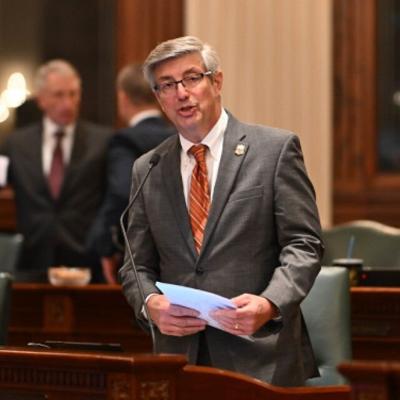



Illinois State Rep. Dan Ugaste, R-Geneva
SPRINGFIELD - Amid a growing push nationwide for new laws to regulate the booming business of third-party lawsuit investing, a state lawmaker has introduced legislation in Springfield in a bid to bring greater transparency to the practice in Illinois, as well.
“Other states are acting, and it’s time Illinois does as well,” Ugaste said in a statement announcing the legislation. “If you are going to profit from lawsuits filed in Illinois, you shouldn’t be allowed to hide in the shadows.”
On Feb. 9, State Rep. Dan Ugaste (R-Geneva) filed HB5244 in the Illinois State House of Representatives.
Ugaste's legislation, as well as new laws being introduced in other states and in the U.S. Congress, has been spurred by mounting concerns over the use of courts in Illinois and elsewhere in the U.S. legal system to generate profits for investors who are not parties to lawsuits or their attorneys.
Rather, the so-called third-party litigation financiers instead lend money, typically to plaintiffs, to pay attorneys and other costs needed to press legal claims, often against companies or other plaintiffs perceived as deep-pocketed.
In recent years, third-party litigation financing has underwritten tens of thousands or even hundreds of thousands of lawsuits against major pharmaceutical companies, tech firms, food producers, and many others.
However, recent court actions have revealed that this financing brings with it the potential for influence and interference in the course of litigation merely to maximize returns and profits for investors - sometimes even to the point of outright seizing control of cases and thwarting settlements to force defendants to keep litigating until they agree to pay what investors believe the case is worth, over the objections of the plaintiffs whose legal claims the investors were financing.
This was seen most recently in federal court proceedings in Chicago, when litigation financing giant Burford Capital persuaded an appeals court to let them nix a $50 million settlement. That deal between poultry producer Pilgrim's Pride and food distributor Sysco Corp. would have ended just one part of a long-running and multi-faceted court fight over claims food producers have violated federal antitrust laws by artificially boosting prices of chicken and other meats.
In the appellate ruling, one of the judges on the Seventh Circuit Court of Appeals called the case a "cautionary tale" about the largely unchecked rise of third-party lawsuit investing. In that decision, Seventh Circuit Judge Nancy Maldonado agreed Burford had the law on its side in the case, but she blasted the company for dragging out a settlement to end the litigation solely to boost its profits, in the process "having turned the courtroom into a trading floor."
In addition for the potential of undue interference with court proceedings that do not involve lawsuit investing in any way beyond its interest in generating profits for investors, the practice has also come under criticism by others for its potential use by foreign interests to assail American companies, gum up American courts, and harm the U.S. economy.
Under the measure proposed by Ugaste, third-party lawsuit funding would not be banned. Rather, it would come under regulations requiring greater disclosure and transparency to block foreign funding and allow courts and defendants to know who they are dealing with.
Further, the new legislation would provide consumer protections against lawsuit lenders, while limiting the amount investors could recover to make sure plaintiffs receive the lion's share of the recovery.
The legislation "creates basic rules to ensure outside funders aren’t steering cases, pressuring settlements, or turning the courts into a business opportunity,” Ugaste said.
Legal reform advocates in Illinois supported the measure. The Illinois Coalition for Legal Reform, for instance, noted similar legislation has been introduced in other states, including Iowa and Missouri, while such measures have been enacted into law in Wisconsin and Indiana.
Congress is also considering similar measures on a national level.
“Commercial third-party litigation funding has grown quickly, but Illinois law has not kept pace,” said Katie Reilly, Executive Director of the ICLR. “This legislation brings needed transparency and commonsense guardrails to ensure that lawsuits filed in Illinois are driven by facts and justice — not investors seeking profit.”
The fate of the legislation is far from certain in the Democrat-dominated Illinois General Assembly.
Trial lawyers whose lawsuits, which are worth billions of dollars annually, are routinely boosted by such third-party investments, donate millions of dollars each election cycle to Illinois Democrats, parlaying their campaign financing into strong support in Springfield.
Substantive Republican legislation also rarely advances in Springfield. Illinois House Speaker Emanuel "Chris" Welch, for instance, famously refuses to allow legislation to be called for a vote unless he knows the bill will receive at least 60 Democratic votes in the 118-member state House.
But Ugaste asserts the legislation is only about "transparency and fairness."
"If someone is funding a lawsuit and expecting to profit from it, the public and the courts deserve to know who they are and what role they’re playing,” Ugaste said.