
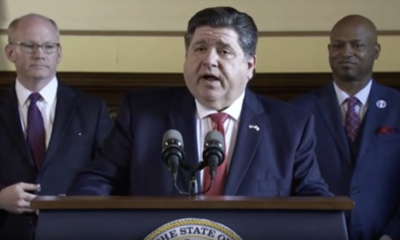



Illinois Gov. JB Pritzker, flanked by Illinois Senate President Don Harmon, left, and House Speaker Emanuel "Chris" Welch, right
CHICAGO — Illinois will need to defend in court a controversial and constitutionally questionable new law hurriedly rammed through Springfield by Democrats, imposing steep per user "fees" on internet site operators that the the state deems "social media" and digital ads to create a new revenue source to fuel the state's ever growing budget.
On Sept. 11, NetChoice, a trade group representing social media companies and other big tech companies, followed through on a threat the group issued to Illinois lawmakers and Gov. JB Pritzker months ago, asking judges to block the new taxes in parallel lawsuits filed in Cook County Circuit Court.
"Illinois’ new internet taxes firmly establish the state’s opposition to online speech, innovation, and its own business community,” said attorney Paul Taske, who serves as director of the NetChoice Litigation Center.
“The Supreme Court has made abundantly clear that legislators cannot target a subset of media for disfavored taxation, but that’s precisely what these taxes do. Not only are they flatly unconstitutional under the First Amendment, but they blatantly disregard Congress’s clear judgment under (federal law) that digital services cannot be subject to discriminatory taxation.”
Specifically, the lawsuits assert the new Illinois taxes violate both the First Amendment and the federal Permanent Internet Tax Freedom Act (PITFA) by singling out "digital services" for the disfavored tax treatment.
The lawsuits come about three months since Illinois Democratic lawmakers, with the vocal support of Pritzker, chose to impose the new taxes and fees as part of Illinois' new $56 billion budget.
Pritzker and other supporters say the measures will force "social media" operators to pay the state to make up for the alleged societal damage they say is caused by their platforms.
Styled as a "fee," the measure would impose what observers say is really a tax to extract potentially hundreds of millions of dollars, or more, every year from a host of companies engaged in the creation of platforms hosting interactive or user-generated content.
Specifically, the new "fees" will be charged against any online platform operator that the state believes has more than 100,000 users in Illinois. It would scale up progressively based on how many "Illinois users" a platform may have.
The fees would be charged at rates of:
100,000 to 499,999 users: 10 cents per user/month;
500,000 to 999,999 users: $40,000 base fee per month, plus 25 cents per user, per month, for each user over 500,000; and
Over 1 million users: $165,000 base fee per month, plus 50 cents per user, per month, for each user over 1 million.
The fee would be collected by the Illinois Secretary of State's office, rather than the Illinois Department of Revenue.
The law specifically forbids companies hit by the fees from attempting to raise prices or implement charges to make "Illinois users" pay the new "fees."
Supporters assert the measure will generate at least $200 million annually for the Illinois state government. Supporters, including Pritzker, assert the money will be used to fund programs to deal with mental health issues, allegedly exacerbated by social media, as well as to fund schools and other state budget priorities.
However, a variety of groups, including lobbyists and legal advocates for tech companies and internet freedom, as well free speech advocates, tax reform advocates, and others, have lined up to blast the measure, asserting it is deeply flawed and likely tramples constitutional protections.
Tax analysts, for instance, have noted the law doesn't actually define what a "user" is for the purpose of "fee" calculations.
Critics have further noted the law's potentially sweeping effect, threatening to loop in companies most people may not associate as being subject to the tax. While supporters of such taxes have pointed to large social media companies, like Meta, Google and other operators of prominent social media sites, critics have noted the measure could also impose a potentially crushing tax on lesser sites like AllTrails, a platform on which users can share route maps and other information about their favorite hiking trails.
And platform operators swept up into the Illinois digital tax regime could face compounding "astronomical" penalties if the state claims they didn't pay enough, with penalties starting at an amount equal to 100% of the unpaid fee and penalties for every month the state doesn't believe the business has paid enough.
Other critics have argued the taxes are unconstitutional levies targeted at publishers, with some likening the tax to a modern version of the British Stamp Tax Act that helped to trigger the American Revolution in 1775.
For its part, Netchoice in its lawsuits claim the taxes are unconstitutional taxes on digital speech and illegally single out digital commerce and publishing for unconstitutional tax treatment.
Netchoice has noted the Illinois tax and fee regime is similar to a digital advertising tax in Maryland that courts have already struck down.
And Netchoice has noted the Illinois tax and fee measure is very like the city of Chicago's ordinance levying similar "user fees" against social media platforms. Netchoice is also suing the city of Chicago over that measure.
And in its new lawsuits against the state, Netchoice is leveling many of the same arguments that have already been deployed in court against Chicago's fees.
Netchoice argues, for instance, the Illinois social media tax would be impossible to constitutionally collect, as the law includes no mechanism for determining who should be taxed and when. For instance, they noted, if both Illinois and Indiana impose the same taxes, social media companies could be taxed twice for the same single "user," should the "user" live in Illinois, but access their social media content while in Indiana.
And the uncertain nature of the tax and its consequences for online commerce will lead to higher costs and lost opportunity for Illinois residents, Netchoice said, as "some services may choose to limit or exit the Illinois market altogether – cutting residents off from vital communication, educational, and community-organizing tools they rely on daily."
"This tax raises the cost of doing business, costs that are likely to be passed on to Illinois consumers, and harms entrepreneurs' ability to grow," Netchoice said.
The state has not yet responded to the lawsuits in court.