
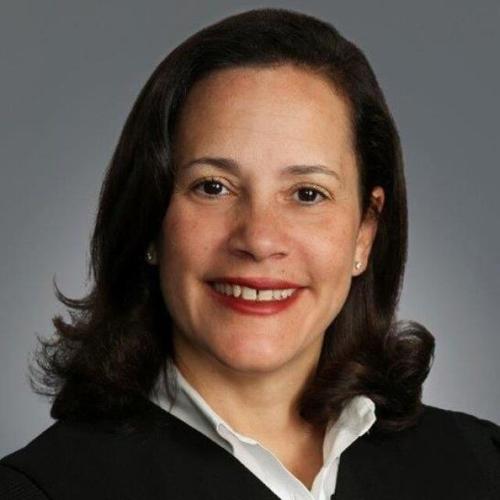




U.S. District Judge Sara Ellis
CHICAGO - After a federal appeals court signaled it would rebuke her decision restraining ICE from using force against those interfering with immigration enforcement operations in Illinois, a Chicago federal judge has agreed to pull the plug on the lawsuit brought by anti-ICE activists and journalists at the heart of the case.
However, U.S. District Judge Sara Ellis appears to have replaced the prior case with a new one, after keeping the prior case alive just long enough to allow her to also claim the authority to preside over a new, more sweeping lawsuit brought by Illinois Democrats who are seeking to win a court order essentially shutting down ICE's current operations statewide.
On Jan. 22, Ellis granted the request of the activist plaintiffs to formally dismiss their lawsuit challenging the use of force by federal agents from Immigration and Customs Enforcement (ICE) and Border Patrol against protestors and others the agents accused of rioting and interfering with agents' efforts to enforce immigration law in Chicago and other Illinois communities.
The activists and journalists who filed the lawsuit accused ICE and Border Patrol of an unconstitutional "pattern of extreme brutality" against the so-called "rapid response networks" of activists and others who would follow and harry immigration officers, as well as protestors and journalists gathered outside the ICE processing facility in suburban Broadview or at the sites of ICE raids and arrests.
They asserted the tactics were used as a bid to "silence press and civilians."
Federal agents asserted the control measures were necessitated by aggressive and hostile actions from activists, protestors and members of so-called "rapid response teams" who routinely follow ICE patrols and have been documented to attempt to interfere with arrests.
In a decision that generated headlines around the country, Ellis famously issued a preliminary injunction blocking ICE and Border Patrol agents associated with the now-ended "Operation Midway Blitz" and other immigration enforcement operations from using physical force or riot control weapons or even from "issuing a crowd dispersal order" requiring so-called protestors "to leave a public place that they lawfully have a right to be."
The order prohibited federal agents from "using hands-on physical force such as pulling or shoving to the ground, tackling, or body slamming" anyone "who is not causing an immediate threat of physical harm to others..."
The order also granted those claiming to be journalists the right to remain in an area undisturbed, even after an otherwise lawful dispersal order was given.
In her ruling, Ellis conceded activists and "protestors" had engaged in violent acts against ICE agents. But she said she believed federal agents' response "shocked the conscience" in acting against people who Ellis described as merely neighbors “who have shown up for each other.”
As she delivered the ruling from the bench, Ellis famously read from the Carl Sandburg poem, "Chicago," emphasizing the line: “And having answered so I turn once more to those who sneer at this my city, and I give them back the sneer."
However, Ellis' order was quickly blocked by the U.S. Seventh Circuit Court of Appeals. In that order, a panel of judges said they were troubled by Ellis' apparent judicial overreach. They said Ellis went too far in entering an order that attempted to control virtually "all law enforcement officers in the Executive Branch," including the President of the United States himself.
Following that decision, the anti-ICE activist plaintiffs opted to drop the case altogether, rather than risk a possible precedent-setting decision that could frustrate future efforts to sue ICE. They then asked Judge Ellis to dismiss the lawsuit.
Ellis, however, indicated she was in no hurry to do so, saying she was still troubled by ICE's continued tactics against activists seeking to thwart immigration enforcement elsewhere, and particularly in Minneapolis, particularly citing the death of Renee Good, an anti-ICE activist who was shot and killed by a federal agent when she attempted to hurriedly flee potential arrest and struck the agent with her car in the process.
In the meantime, Illinois Attorney General Kwame Raoul, with the support of Gov. JB Pritzker, and joined by the city of Chicago, filed a separate lawsuit seeking to restrain virtually all immigration enforcement operations in Illinois.

Illinois Attorney General Kwame Raoul
The lawsuit, filed on Jan. 12, essentially seeks court orders that would hamstring the ability of Immigration and Customs Enforcement (ICE) to carry out immigration raids and patrols within the state, and orders prohibiting U.S. Border Patrol from operating within Illinois and supporting ICE in Illinois at all.
The lawsuit also appeared to be the result of coordination with other Democratic officials in other states, as on the same day, Raoul's counterpart in Minnesota, Democrat state Attorney General Keith Ellison, filed a virtually identical lawsuit in federal court there.
They assert Trump and the federal immigration enforcement agencies have "unleashed an organized bombardment" on Illinois and Chicago, "causing turmoil and imposing a climate of fear."
They assert the agents have acted "lawlessly" in Illinois and Chicago, allegedly sending "uniformed, military-trained personnel, carrying semi-automatic firearms and military-grade weaponry," who have "unleased sweeping raids and indiscriminate violence against Illinois' residents," while "stopping, interrogating, and arresting residents, and attacking them with chemical weapons," typically tear gas or pepper spray.
Raoul and Illinois Democrats say the actions were not designed to enforce immigration laws, but rather to force Illinois Democrats to end the state's sanctuary policies and to stop defending and shielding illegal immigrants.
In the complaint, Raoul asserts the immigration enforcement actions amount to violations of Illinois' state sovereignty by the federal government.
"Under the pretext of enforcing federal immigration law, the federal government is attacking Illinois and Chicago’s ability to carry out their core sovereign functions—to regulate public health, establish and implement a system of education for Illinois residents, defend the state’s economy, provide public safety and administer a judicial system, enforce state statutes, implement state programs, and ensure that Illinois residents receive the full benefits of state and federal law," Raoul wrote in the lawsuit.
Democrats, led by governors, including Pritzker and his counterparts in California and Minnesota, have steadfastly opposed all efforts by the federal government to arrest and deport illegal immigrants.
Pritzker, for instance, has stated he believes all immigrants, whether in the country legally or not, should be allowed to live in peace, so long as they do not violate criminal laws.
However, Pritzker has also strongly supported Illinois' so-called state sanctuary laws that prohibit police and correctional agencies from cooperating with ICE and Border Patrol in the arrest and deportation of anyone, including violent criminals and those accused or suspected of being members of international drug cartels, terrorist organizations or organized crime.
The new Illinois lawsuit was initially assigned by the U.S. District Court for the Northern District of Illinois to District Judge Georgia N. Alexakis.
Alexakis was appointed to the court by former President Joe Biden.
However, immediately after filing, Raoul asked the court to instead assign the case to Ellis. Alexakis did not oppose the move.
Ellis then agreed to take on the case saying it was closely related to the earlier case, which she had to that point refused to dismiss.
Then, on Jan. 22, Ellis simultaneously immediately dismissed the old “related” case Raoul had used to land his new case in front of Ellis.
Now, Ellis has indicated she will consider allowing Raoul and his fellow Illinois Democratic co-plaintiffs to access and use the evidence from the old case to support their new lawsuit, potentially signaling an almost seamless transition from the prior case addressing ICE's use of force against agitators to Raoul’s new case, seeking to almost entirely bar ICE and Border Patrol from conducting immigration raids in Illinois.
The state of Illinois' new lawsuit was formally assigned to Ellis on Jan. 23.