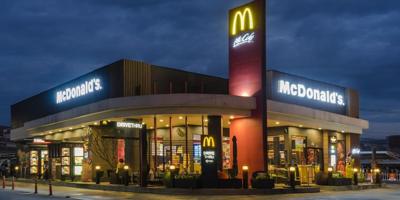


The exterior of a McDonald’s
CHICAGO — A federal judge won't allow a group of four dozen black McDonald's franchisees to pull forward with most of their racial discrimination claims against the world's largest fast food chain, saying the franchisees' claims "that McDonald's engaged in a complex, nationwide, far-reaching, decades-long scheme to undermine black franchisees and remove them from the McDonald’s system" largely don't hold up or arrived too late.
In the Sept. 21 ruling, U.S. District Judge Steven Seeger tossed most of the claims in the sprawling litigation, involving 480 claims on behalf of 48 McDonald's franchisees.
The lawsuit is one of three pending against Chicago-based McDonald's, all accusing the company of carrying out an alleged "pattern and practice" of boxing black franchisees into taking on poorly performing restaurants in lower income and higher crime neighborhoods and communities, allegedly as part of an effort to force them to quit.
The lawsuits assert this alleged discrimination violated McDonald's franchise agreements.
As Judge Seeger described the allegations: "In a nutshell, McDonald’s allegedly set black franchisees up to fail, and denied them equal opportunity to succeed. And then, it showed them the door."
The lawsuit in the current case was led by plaintiff Kenneth Manning, a former McDonald's franchisee who had owned as many as 20 McDonald's franchised restaurants in Georgia, Alabama and North Carolina, from 2001 to 2017.
However, the case was not lodged as a class action. Rather, Manning and 47 other black former McDonald's restaurant franchise owners lodged similar individual complaints in one collective action, filed in 2023.
They are represented in the case by attorneys from the firm of Loevy & Loevy, of Chicago.
In the decision, Seeger questioned the decision to pack so many individual plaintiffs into one lawsuit, comparing it to "the old game of seeing how many people can fit in a phone booth."
However, Seeger also noted the action would face challenges as a class action, as well. While the restaurant owners' discrimination, mistreatment and breach of contract claims are similar, the franchisees' individual experiences may have been too different to allow them to proceed as a class.
Regardless, Seeger said the claims, for the most part, shouldn't be allowed to advance.
Seeger's decision largely followed findings the judge had served up in March, in one of the other McDonald's franchisee discrimination cases pending before him.
In that decision, in the individual case lodged by former McDonald's franchisee Mitchell McPherson, the judge determined the similar discrimination and "pattern and practice" claims had been filed long after the legal time limits to bring such claims had run out.
He said the same timeliness findings apply to the claims in the case lodged by Manning and his co-plaintiffs.
And the discrimination claims that may be considered timely fail to make it past the counter, as the judge said: "The complaint is long on general themes and short on specific facts showing discriminatory intent."
In Manning's specific claims, for instance, the plaintiff had accused McDonald's of interfering with his ability to sell his restaurants to the buyers of his choice, and instead "encouraged him to sell to potential white buyers."
But Seeger said Manning needed to bring more to the table to back his claims.
"Pointing to the race of the buyers preferred by McDonald's won't cut it," the judge said. "The complaint must do more than allege that McDonald's encouraged a sale to buyers who were white."
Seeger did not wipe out the entire complaint, allowing certain breach of contract claims from at least 16 of the plaintiffs to advance.
However, the decision overall appeared to significantly reduce the scope and heft of the black former franchisees' claims against McDonald's.
McDonald's is represented in the case by attorney Patricia Brown Holmes and others with the firm of Riley Safer Holmes & Cancila, of Chicago.