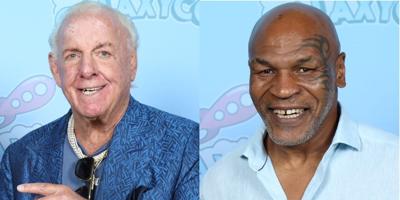


From left, former WWE pro wrestler Ric Flair and former heavyweight boxing champion Mike Tyson
CHICAGO - Former heavyweight boxing champion Mike Tyson and WWE professional wrestler Ric Flair are leading a lawsuit they say is worth at least $50 million, claiming their supposed partners in licensing cannabis products instead made them victims of a racketeering and fraud scheme through which four men allegedly embezzled millions of dollars.
Tyson and Flair, through lawyers with the Chicago firm Willkie Farr & Gallagher, filed their complaint Dec. 19 in federal court in Chicago, with two corporate entities as fellow plaintiffs: Miami-based hemp company LGNDS and CARMA HoldCo, which the complaint identifies as “a global branding company formed in Chicago that specializes in licensing celebrity brands” that sits at the heart of the lawsuit.
Named defendants include Chad Bronstein, who was CARMA’S board chairman and then president; CEO Adam Wilks; Nicole Cosby, who was a founding board member before going to work for CARMA as chief legal and licensing officer; and shareholder James Case, a longtime Bronstein associate.
“Throughout their time at CARMA, Bronstein and Wilks treated CARMA as their own personal piggy bank, using more than $1 million to pay for unauthorized personal travel on private jets, costs associated with Bronstein’s personal yacht, renovations to Bronstein’s personal residence, a mortgage payment for Wilks’ personal residence, and lavish entertainment expenditures for Wilks, including exorbitantly priced meals and travel expenditures, as well as excessive and unapproved compensation and bonuses,” the complaint alleged. “What’s more, Bronstein and Wilks entered into unauthorized agreements on CARMA’s behalf with third parties, which resulted in financial losses and liabilities to CARMA but lined the defendants’ pockets.”
Flair and Tyson said the defendants were repeatedly deceptive and fraudulent, naming as a fellow victim the musical artist known as Future. The lawsuit claims the celebrities signed licensing deals with CARMA, but alleged Bronstein and Cosby instead sold the rights to LGNDS and other unauthorized buyers. Tyson specifically said his CARMA contract granted him express approval over personal appearances, but alleged Wilks nonetheless inked contracts obligating Tyson to several events across the country.
“Bronstein, and later Wilks, demanded that the principal of LGNDS purchase Rolex watches worth at least $50,000 or else they would cancel LGNDS’ contracts with CARMA,” the complaint alleged. “On another occasion, Wilks received an identical Rolex watch worth in excess of $50,000 from the owner of an Amsterdam-based coffee shop which received a license to use Tyson’s likeness without having to pay CARMA’s customary $250,000 upfront licensing fee. Further, Bronstein and defendant James Case — a longtime associate and co-conspirator of Bronstein — demanded that LGNDS give Case a 10% ownership interest in LGNDS, free of charge, as a precondition for LGNDS’ licensing agreements with CARMA.”
The complaint further alleged Bronstein and Wilks had CARMA issue them hundreds of thousands of common shares, and said, although they knew the company to be worth $80 million, they told investors the value exceeded $120 million, then sold their shares for seven-figure profits.
“When certain individuals close to Bronstein began to take note of his conduct, he took measures to silence their criticism, including by using CARMA’s funds to fund paychecks so the critics could hold ‘ghost jobs’ at CARMA,” the complaint alleged. “These pseudo-jobs allowed Bronstein’s would-be critics to collect a paycheck from CARMA without the expectation that they perform any work.”
Tyson and Flair also alleged the same defendants are running similar schemes with Real American Beer, a product marketed around iconography of the late Hulk Hogan, and Real American Freestyle, a wrestling promotion that also had Hogan’s involvement and a broadcasting deal with FOX Nation.
The 76-page complaint include allegations about conduct as far back as Bronstein’s 2019 launch of the marketing technology company Fyllo, and his life sciences company Wesana Health, formed in 2020 with former pro hockey player Daniel Carcillo as a partner. It claims Tyson was a founding partner of CARMA and detailed the intellectual property licensing agreements for his name and likeness as well as the start of Bronstein’s relationship with Flair and the incorporation of Ric Flair Drip, which the retired pro wrestler “believed as a consolidation of his intellectual property for his benefit.”
Instead, according to the complaint, Bronstein and Wilks gave Flair only 47% of the shares in the company, while they each held 16%. Then, without telling CARMA’s board how much they owned, the men had CARMA buy 30% of Ric Flair Drip — Flair allegedly got no money from the deal — then had CARMA buy the remaining 70% interest in September 2022, not with cash, but an equity stake in CARMA.
“Bronstein and Wilks justified this self-dealing as simply right-sizing their ownership of CARMA, as they felt they deserved compensation above what was approved by the board of directors,” the complaint alleged.
CARMA’s executive team asked Bornstein to resign in November 2023, but the complaint alleged Wilks “followed Bronstein’s patterns of fraud and self-dealing” until the board removed him as well, with allegations about his improper roles in business relationships with companies like Green Success, a German distributor of cannabis products, and Mr. Charlie’s, a plant-based fast food company in Beverly Hills, among others.
In all the complaint brings 21 counts, including violations of the Racketeer Influenced and Corrupt Organizations Act, conspiracy, money laundering, wire fraud, extortion, breach of contract, breach of fiduciary duty and securities fraud. In addition to a jury trial, the plaintiffs seek at least $50 million, including treble damages, compensation for legal expenses and forced disgorgement of “all ill-gotten gains,” along with pre- and post-judgment interest.