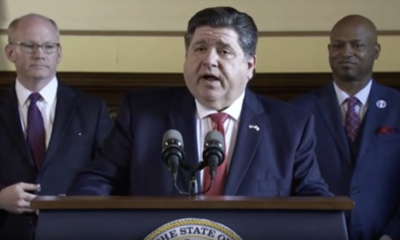


Illinois Gov. JB Pritzker, flanked by Illinois Senate President Don Harmon, left, and House Speaker Emanuel "Chris" Welch, right
CHICAGO — Some of the country's largest pharmaceutical companies have taken aim at a new Illinois law they say unconstitutionally rewrites the rules of a federal drug discount program, forcing them to sell their medications at cheap discounts and allowing health care providers and pharmacy retailers, including CVS and Walgreens, to reap big profits at their expense.
North Chicago-based Abbvie led a group of drug makers in a lawsuit filed Aug. 7 in Chicago federal court, saying they are seeking to "halt an unconstitutional power grab."
"Illinois’s law effectively gives covered entities and commercial pharmacies unfettered authority to demand (pharmaceutical) manufacturers’ property at significantly reduced prices for the benefit of private parties," Abbvie wrote in its complaint.
"Federal courts have recognized the blatant unconstitutionality of such laws and enjoined their enforcement."
New Jersey-based Novartis Pharmaceuticals also sued the state of Illinois the same day, leveling similar accusations.
The lawsuits landed on the same day Illinois Gov. JB Pritzker signed into law the legislation dubbed by supporters as the Patient Access to Pharmacy Protection Act.
Officially docketed as House Bill 2731, the new law, pushed by hospitals and doctors in Illinois, would make it illegal for medication makers to restrict the pharmacies that nonprofit hospitals and clinics can contract with to dispense medications to their patients through a federal drug discount program.
Under that program, commonly known as 340B, pharmaceutical companies are required to offer certain nonprofit hospitals and medical clinics access to prescription drugs at a discount. If the drug makers do not participate in 340B, they could also be blocked from participating in Medicaid or Medicare Part B.
The program is designed to support access to health care in economically troubled communities, particularly, and to support less profitable but vital health care services. Under the program, the so-called "covered entities" are allowed to purchase the discounted drugs, but then mark them up when they are dispensed and pocket the difference, ostensibly to allow them to use 340B as a revenue source to offset their operating costs.
However, pharmaceutical companies have claimed in public statements and in court filings that the hospitals and clinics have now partnered with for-profit pharmacies to "game the system," and essentially use the 340B program to force drug makers to subsidize significant profits for all involved in the program, except the pharmaceutical manufacturers.
In the Novartis filing, for instance, the company pointed to published reports indicating some of the "covered entities" have used their gains from the 340B program to fund stadium naming rights purchases, "build 'a luxury apartment and office complex,'" and "launch 'a film company,'" among other economic ventures that extend well beyond funding their operations.
In response to the alleged excesses, the drug makers say they moved to restrict who could dip into the money pool. Chief among these restrictions were limits on how many pharmacies the hospitals and clinics could partner with to dispense the discounted drugs.
However, rather than address the situation at the federal level, the drug makers say the "covered entities" have enlisted the help of state governments, which have passed laws attempting to block pharmaceutical companies from limiting in any way the ability of hospitals, clinics and pharmacies from participarting in the program and its associated compulsory money stream.
Supporters of the legislation, however, say state laws, like Illinois' HB 2371, are designed merely to preserve the ability of patients to access prescription drugs.
At the time Pritzker signed Illinois' measure into law, for instance, a spokesperson for the governor's office said the new law “strengthens protections for healthcare providers participating in the federal program and preserves access to lower-cost prescription medications through the safety-net providers that millions of Illinoisans rely on."
In their new lawsuits, however, the drug makers say the legislation actually runs afoul of the Constitution on multiple levels. The companies assert the state legislation illegally inserts the state into a program that was established by the federal government and would rewrite the rules without federal consent.
So, they assert, the Illinois law violates the so-called federal Supremacy Clause, which generally establishes that, when state law and federal law conflict, federal law rules.
Illinois' law would create a system under which Illinois would seek to force the companies to do something federal law does not, creating an uneven playing field, which they said is contrary to the desires of the federal lawmakers who set up the program in the first place.
And they asserted the law directly conflicts with the findings of two federal appeals courts, which have ruled drug manufacturers have the right under the law to restrict "the number of contract pharmacy arrangements" that hospitals and clinics can have for dispensing the drugs discounted under 340B.
The pharmaceutical companies further assert the state law amounts to an illegal taking of their property, forcing them to sell their products at a discount to others under a "buy low, sell high" scheme that allows those other private groups to rake in huge profits from the exchange.
The drug companies noted the federal program only requires manufacturers to "offer" their products to the "covered entities" at a discount. It doesn't require them to "sell" them to everyone who makes a demand, they said.
"Illinois has no authority to take AbbVie’s private property for private use," Abbvie wrote in its complaint. "By expanding the circumstances under which drug manufacturers must provide 340B-priced drugs to contract pharmacies, the statute unlawfully appropriates private property for the private benefit of commercial pharmacies and does so without serving any valid public purpose."
Illinois Attorney General Kwame Raoul has not yet responded to the lawsuits in court.
Abbvie is represented in the action by attorneys from the firms of King & Spalding and Kirkland & Ellis, both of Washington, D.C.
Novartis is represented by attorneys with the firms of Armstrong Teasdale, of Chicago and St. Louis; and Hogan Lovells Cadwalader US LLP, of Washington, D.C.