
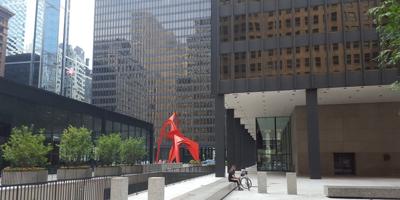


Dirksen Federal Courthouse, Chicago
CHICAGO — A Chicago federal judge has once again ended an attempt from a dozen independent school districts from seven different states trying to force companies to foot the bill for special education services based on allegations stemming from their role in promoting painkiller use, which allegedly caused lasting harm to children in the womb.
U.S. District Judge Manish Shah on Sept. 30 agreed to dismiss claims against advertising agency Publicis Health, electronic health records vendor Practice Fusion and sales consultant ZS Associates.
It was Shah’s second dismissal, he noted, explaining the first complaint failed because the districts didn’t state a claim under the Racketeer Influenced and Corrupt Organizations Act, and the amend complaint’s repleaded state-law claims likewise failed to show “the downstream effects of the opioid epidemic give the districts claims against these defendants.”
Shah identified the defendant companies as working for Purdue Pharma, which introduced OxyContin in 1996, and other drug manufacturers. He said Publicis designed campaigns to promote opioids for off-label conditions, reviewed target lists that ZS Associates prepared alongside McKinsey & Company as part of that firm’s “Project Turbocharge,” which helped triple OxyContin sales even as more than half of prescriptions exceeded federally recommended maximum doses.
Publicis paid $350 million to settle claims from a coalition of prosecutors regarding its work for Purdue and later pleaded guilty to paying Practice Fusion kickbacks for embedding advertising in patients’ records — “designed to look like clinical decision support,” Shah wrote — that doctors would see when writing prescriptions. Practice Fusion reached a federal deferred prosecution agreement in January 2020. ZS Associates has not settled or been named in a plea or prosecution deal.
The root of the amended complaint, Shah said, is the legal theory that the opioid epidemic spiked the condition known as Neonatal Opioid Withdrawal Syndrome (NOWS), with afflicted children being “significantly more likely to need federally mandated special education services, a cost that falls on school districts.”
In dismissing the version of the complaint that carried RICO claims, Shah said “at least three independent decision makers — the physicians who prescribed opioids, the pharmacists who dispensed them and the parents who took them while pregnant — stood between defendants’ alleged predicate acts and the school districts’ costs.”
With only the state law claims present in the amended complaint, Shah first rejected Publicis’ contention that its settlement with the seven states should end the matter, noting no “attorney general purported to represent the school districts, gave them notice, or considered their claims. And the argument that the school districts ratified the settlements by accepting their benefits rests on a factual premise — that money paid by Publicis reached these plaintiffs — that is disputed and cannot be resolved on a motion to dismiss.”
But turning to the public nuisance claim, Shah agreed the districts aren’t private parties that suffered a special legal harm, nor are they public entities empowered to sue on the public’s behalf. He said courts in Maine and West Virginia have issued rulings that harms from widespread opioid misuse are so broad as to make it difficult to bring special injury claims and further wrote the “districts identify no statute or common-law rule in any of the seven states that vests a school board with jurisdiction over the public health or authority to abate nuisances affecting it. And if they did sue in that capacity, they would be asserting the public’s claim, which is the claim the attorneys general have already asserted and, as to Publicis, released.”
The Maryland Supreme Court has already addressed the “public nuisance” claim as relates to controlled substances in a manner favorable to the defendants, Shah said, while adding that none of the seven states have a law allowing a government-entity plaintiff to recover damages from nuisance litigation rather than simply to have the nuisance abated.
As to negligence claims, Shah said the districts failed to make a meaningful argument regarding a Corporate Integrity Agreement Publicis inked with the U.S. Department of Health and Human Services in 2007. He first noted the deal expired in May 2013 while also explaining that type of contract doesn’t create tort duties from a “manufacturer’s vendor to the public.” He also said that whatever the drug makers might’ve done isn’t enough to attach liability to this group of defendants.
“The school districts’ injury is not physical harm to their persons or property but the cost of serving people harmed by someone else — economic loss that is wholly derivative of injuries to third parties,” Shah wrote. “That kind of loss is too remote to be recovered in tort by the party who absorbs it, whatever its foreseeability.”
Shah reviewed the laws of Maine, Tennessee and West Virginia to explain flaws in the derivative nature of the allegations and said in California, Florida, Maryland and New Mexico “the negligence claims for want of a duty running from defendants to them” and the theories that would make these companies liable for losses fail on other grounds.
The civil conspiracy and aiding and abetting claims, Shah said, aren’t standalone claims, and since the complaint doesn’t establish a link between the drugmakers and the school districts, the additional claims are unattached and therefore unsustainable.
Finally, the defendants also raised the alternative argument that the districts’ claims were time barred. Shah said with the nuisance claim already dismissed he didn’t need to resolve the districts’ position that there is no statutory limit when a public nuisance continues, explaining he would “address limitations only as an alternative ground for dismissing the negligence claims and the conspiracy and aiding-and-abetting theories.”
On that front, he said, the pleadings themselves establish the defense. He said the original complaint included the dates that prove the defendants’ points, even though the amended complaint removed that information. Further, named plaintiffs sued in 2019 “and no school district disputes that it knew of its injury by then,” even though the first complaint came in November 2024, past the four-year limit.
Shah broke down timelines and laws of the various states involved and found no situation in which any of the plaintiff districts sued on time, with the exception of Regional School Unit 34 and the Portland School department because Maine law has a six-year window that in this instance stretches back to November 2018.
Those circumstances led Shah to deny the districts a chance to further amend their complaint.
While the Maine districts could have claims remaining, he said, their state law doesn’t allow financial recovery for what is a “derivative economic loss, so an amendment would not help them either.”
The school districts were represented by attorneys from the firms of Mehri & Skalet, of Washington, D.C.; Browne Pelican, of Dallas, Texas; Bailey Glasser, of Washington, D.C.; and the firms of Terrell Hogan Yegelwel and Henrichson Law Group, both of Jacksonville, Florida.
ZS Associates was represented by the firm of Foley & Lardner, of Chicago.
Publicis Health was represented by the firm of Steptoe LLP, of Chicago and Washington, D.C.
And Practice Fusion was represented by the firms of Riley Safer Homes & Cancila, of Chicago; and Lightfoot Franklin & White, of Birmingham, Alabama.
