



WASHINGTON, D.C. — Some members of the U.S. Supreme Court openly conceded their ruling will almost certainly result in Americans paying more for virtually everything shipped or bought in the U.S.
But a unanimous U.S. Supreme Court said they still must clear the way for more lawsuits against freight brokers, as they said federal law cannot be used to shield the shipping middlemen from being targeted in state courts over trucking accidents.
On May 14, the high court said lower courts, including federal judges in Illinois, had improperly used the federal law known as the Federal Aviation Administration Authorization Act (FAAAA) to block lawsuits against freight brokers.
Supreme Court Justice Amy Coney Barrett authored the majority opinion for the unanimous court.
In the ruling, Barrett and her fellow Supreme Court justices agreed the FAAAA law generally blocks anyone from using state laws to regulate much of how interstate trucking operates in the U.S.
But Barrett and the court noted that the law includes some exceptions.
And they said one such exception in the FAAAA law, which allows states to regulate for "safety ... with respect to motor vehicles" means trial lawyers also are free to use state laws to sue freight brokers for accidents caused by truckers those brokers may hire to ship goods.
The matter landed before the U.S. Supreme Court last year, in a case originating in southern Illinois federal court. In that case, plaintiff Shawn Montgomery had sued trucking company Caribe Transport and freight broker C.H. Robinson Worldwide Inc., claiming both should be made to pay for the injuries Montgomery suffered in a crash in 2017.
Montgomery was represented in the initial action by lawyers from the firm of Brown & Crouppen, of St. Louis.
In that incident, according to court documents, a Caribe Transport semi truck driven by Yosniel Varela-Mojena veered off the road and smashed into his truck parked on the side of a highway.
According to court documents, Montgomery suffered severe injuries in the crash, including the amputation of his leg.
While C.H. Robinson did not directly manage Varela-Mojena, Montgomery and his lawyers claimed the broker should still pay because it allegedly negligently hired Caribe, despite knowing the trucking carrier's public safety rating was poor.
In court, however, their attempts to pin liability on C.H. Robinson were curbed first by U.S. District Judge Staci Yandle and then by the U.S. Seventh Circuit Court of Appeals.
In those rulings, the lower courts pointed to an earlier Seventh Circuit decision from 2023, in which appellate judges had ruled brokers were protected from such state law negligent hiring claims by the FAAAA law.
In the earlier ruling, known as Ye v GlobalTranz Enterprises, the Seventh Circuit had specifically rejected the argument that the FAAAA's exception for motor vehicle safety regulations should also enable negiglent hiring lawsuits against trucking brokers when the drivers they hire cause accidents.
So, in the new case brought by Montgomery against C.H. Robinson, Yandle and the Seventh Circuit relied on the earlier ruling in Ye v GlobalTranz to reject the claims against C.H. Robinson.
The question over freight broker liability, however, is one that has divided federal circuit appeals courts, with different circuit courts ruling differently on the question and setting up a patchwork of law in which brokers are shielded by the FAAAA in some states, but not others.
The Supreme Court agreed to take up the appeal of the Montgomery case vs C.H. Robinson to resolve that split and answer the question with some finality.
In their ruling, the Supreme Court said the Seventh Circuit got the law wrong, and the motor vehicle safety exception should be read to allow for lawsuits against brokers, as well as the trucking companies blamed for a crash or other accident.
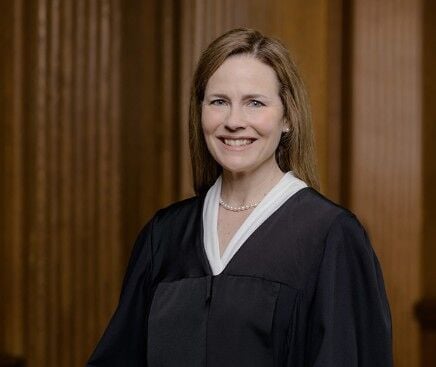
Barrett
That reasoning had been opposed by a coalition of business interests, including the U.S. Chamber of Commerce.
They argued that allowing brokers to be sued under that vehicle safety exception would essentially invalidate the FAAAA's goal of protecting the trucking industry against a potential onslaught of lawsuits and regulation in regulation-heavy and lawsuit-friendly-states, like Illinois.
Allowing such lawsuits, through the vehicle safety exception, would essentially allow the exception to swallow the entire rule, and "would frustrate Congress's design while increasing costs on shippers and consumers without improving safety," the Chamber and its coalition of business groups wrote in a brief filed with the Supreme Court in support of freight brokers.
They noted freight brokers provide vital economic services, helping particularly small trucking operations connect with other businesses looking to ship goods, and helping shippers find trucking firms willing to carry their goods. In all, roughly one-third of all freight in the U.S. is moved through brokers, court documents noted.
By allowing more lawsuits against those brokers, the business groups warned the court would only be introducing more uncertainty into the trucking industry and jacking up costs that would ultimately be paid by American consumers.
Some of the Supreme Court justices acknowledged those concerns.
In a special concurring opinion, Justices Bretty Kavanaugh and Samuel Alito did not discount the industry's concern over how this ruling will affect brokers' ability to secure insurance, for instance.
"In the real world, as the brokers forcefully respond, state tort law can be unpredictable, and the costs to brokers of litigation and insurance may be significant even when brokers prevail in lawsuits. Moreover, the costs of litigation and insurance, as well as the costs of brokers’ conducting more substantial inquiries into trucking companies, will cascade through the economy and be paid in part by American consumers in the form of higher prices," Kavanaugh and Alito wrote.
"The concerns expressed by the brokers are legitimate and weighty."
But they said ultimately, the justices could not avoid concluding a law that allows lawsuits against negligent trucking companies also would not allow lawsuits against brokers for hiring allegedly unsafe trucking companies.
"... It would be even odder to say that the alleged tort—the negligent hiring of an unsafe motor carrier whose truck caused injury—is not an exercise of 'the safety regulatory authority of a State with respect to motor vehicles,'" Barrett wrote in her majority opinion.
And though trucking brokers and business groups don't like the result, they are free to lobby Congress to change the law, the justices said.
"In the end, I do not believe that Congress, through such oblique language in an economic-deregulation statute, simultaneously (i) allowed state tort suits against negligent trucking companies and (ii) categorically preempted state tort suits against upstream brokers who negligently select an unsafe trucking company," Kavanaugh added.