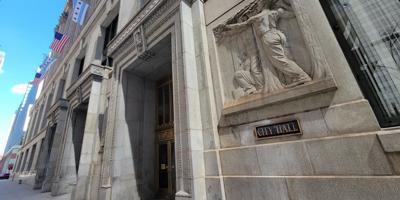



Chicago City Hall
WASHINGTON, D.C. — At least two justices of the U.S. Supreme Court believe Chicago’s city policy of towing and disposing of vehicles for pennies on the dollar to satisfy unpaid parking tickets could amount to an unconstitutional taking of private property.
But the high court said a challenge to the city’s program lacks the legal horsepower to persuade justices to step in, at least for now.
On Oct. 19, the U.S. Supreme Court denied the petition filed by a group of car owners seeking to overturn a decision from a federal appeals court in Chicago in favor of the city.
However, while the high court rejected the appeal, justices Sonia Sotomayor and Neil Gorsuch filed a special statement, cautioning lower courts and cities, like Chicago, against reading too much into the denial.
In the statement authored by Sotomayor, the two particularly noted they believed the U.S. Seventh Circuit Court of Appeals had missed the mark in deciding Chicago’s vehicle seizure program easily clears constitutional hurdles.
"Here, the Seventh Circuit embraced the expansive notion that ’exercise[s] of the City’s police power to enforce its traffic code’ are immune to takings claims," Sotomayor wrote.
But she and Gorsuch said the Chicago-based appeals court not only relied on the wrong legal precedent, but reached a decision that was out of step with the approaches adopted by other federal appeals courts seeking to answer similar questions over similar programs in other states and cities.
“It is still an ’open question’ whether these or any other approaches are consistent with this Court’s precedents," Sotomayor wrote. "Few of these decisions likewise explain the source of any such police-power exception to the Takings Clause — whether the common law, the Constitution, or elsewhere.
“Such questions thus continue to ’benefit from further percolation’ in the lower courts before this Court chooses to intervene.”
The case was one of several lodged by car owners who have claimed the city violated their constitutional rights by seizing and selling their cars, ostensibly to recover debts owed from unpaid parking tickets.
In the case before the Supreme Court, plaintiffs Ryan O’Donnell and Michael Goree sued the city and United Road Towing alleging violation of their Fifth Amendment rights as a result of the graduated forfeiture process through which unpaid tickets can result in losing ownership of vehicles.
The men were represented in the potential class action lawsuit by attorneys Jacie C. Zolna and Benjamin R. Swetland, of the firm of Myron M. Cherry & Associates, of Chicago.
According to court records, the city ultimately sold O’Donnell’s vehicle to URT for scrap value and it relinquished Goree’s to the lienholder. Both men say they should’ve been paid after the disposal or the proceeds should’ve offset their unpaid ticket debt.
Under the city’s program, vehicle seizure begins with a ticket. Vehicle owners can pay in full, agree to an installment plan or contest the violation. If they don’t pay or if they lose the challenge, the city sends a notice that the liability determination is final. Once a vehicle owner gets at least three such notices, or two that have been unresolved for at least a year, the city makes all vehicles registered to that owner eligible to be immobilized.
When the city sends a notice of impending immobilization, it gives the owner 21 days to pay in full or request a hearing. When that window expires, the owner then has 24 hours to pay, start an installment plan, take part in a relief program or request more compliance time. Failure to do so means the city can tow and impound those vehicles.
Once the city impounds a car, it sends another notice granting 21 days to pay and reclaim the vehicle, request an extension or demand an administrative hearing on the validity of the impound or immobilization. Once the city determines a vehicle is unclaimed, it can sell or otherwise dispose of the property.
Plaintiffs, however, say the seizure regime tramples their constitutional rights by seizing and selling off a car worth potentially many thousands of dollars for its so-called scrap value, to settle citations worth hundreds of dollars, robbing the owners of their cars’ value in the process.
In court, however, judges said the city program fell within its so-called “police power” to ensure its laws are enforced. In this instance, they said, it meant enforcement of city traffic code.
In the Seventh Circuit decision, U.S. Seventh Circuit Judge Thomas Kirsch wrote: “The purpose of the forfeiture scheme is to target individuals who — by refusing to pay — have hitherto evaded punishment for their traffic and parking infractions.
“Instead of continuing to issue unanswered tickets, the city institutes a different form of punishment: hindering offenders’ ability to drive by immobilizing, impounding and potentially even disposing of their vehicles. Without this graduated forfeiture scheme, vehicle owners who repeatedly violate the traffic code could evade punishment. The threat of impoundment and disposal forces them to internalize the consequences of their behavior and, accordingly, deters those violations in the first place.”
The appeals court specifically rejected the plaintiffs’ efforts to invoke the Supreme Court’s 2023 decision in Tyler v. Hennepin County, in which the high court ruled local governments cannot seize and auction off homes over unpaid property taxes without paying owners the difference.
The principle that the government “may not take more from a taxpayer than she owes,” Kirsch wrote, isn’t applicable when a government is applying law under police power.
While allowing the decision in favor of the city to stand, the two Supreme Court justices warned Kirsch and other lower courts against such a confident assertion and indicated the question may yet return to the Supreme Court in coming years.
“Where, as here, a person alleges a ’classic taking in which the government directly appropriates private property for its own use’ or to pay an outstanding debt, like a tax lien, the talismanic invocation of the State’s ’law enforcement authority’ may be insufficient to avoid the requirement of just compensation. I again encourage courts considering this issue to take care that due deference to state police powers does not eclipse constitutional rights,” Sotomayor wrote.
Scott Holland contributed to this report.