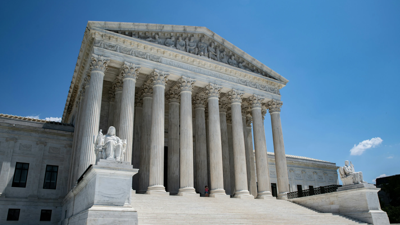



The U.S. Supreme Court stands in Washington.
CHICAGO - The Supreme Court has decided to review whether Cook County's ban on so-called "assault weapons" is actually constitutional.
And the move likely signals constitutional trouble, at best, ahead for similar statewide gun bans in Illinois and other Democrat-dominated states.
On June 30, the U.S. Supreme Court granted a petition from gun owners and the gun rights advocacy group, the Second Amendment Foundation, as they seek to strike down Cook County's ban on AR-15s and a long list of other semiautomatic firearms, which the county has branded as "assault weapons."
The Cook County case has been consolidated for review before the high court with another case over a similar gun ban out of Connecticut. That challenge is also being led by the Second Amendment Foundation.
The SAF and other Second Amendment rights advocates hope the Supreme Court's decision to at last take up cases addressing such gun bans means the high court will end a growing list of other Democrat-pushed laws in Illinois and elsewhere they say trample Second Amendment rights.
“The Supreme Court’s decision to hear these pivotal cases will finally provide the courts the necessary guidance as it relates to the types of arms protected by the Second Amendment,” said SAF Executive Director Adam Kraut, in a statement posted on social media platform, X. “The modern semi-automatic rifles banned in Cook County, Connecticut and elsewhere are among the most commonly owned firearms in the country, placing them well within the scope of the Second Amendment. The Second Amendment protects arms in common use for lawful purposes, and it’s hard to argue that a type of rifle that potentially outnumbers Ford F-150 trucks in America doesn’t meet that standard."
Other Second Amendment rights advocacy groups also hailed the Supreme Court's decision to step in and potentially close off the pathway for more gun bans now and in the future.
Doug Hamlin, CEO and executive vice president of the National Rifle Association, said in a statement: "The Supreme Court’s decision to review the unconstitutional bans of common semiautomatic firearms represents a critical step toward restoring the full scope of the Second Amendment as our Founders intended. Americans have a fundamental right to keep and bear arms for lawful purposes—including the most popular rifles in the country, which law-abiding citizens own by the tens-of-millions for self-defense, community defense, sporting use, and the defense of liberty."
The Cook County case is just one of several legal challenges to so-called "assault weapons" bans raging in courts across the country.
In Illinois, for instance, the courts have wrangled over the constitutionality of Illinois' statewide gun ban, dubbed by supporters as the "Protect Illinois Communities Act," since it was enacted in 2023.
The law includes several provisions banning a long list of semiautomatic firearms and so-called "large capacity magazines," which the state defined as ammunition magazines which can hold more than 10 rounds.
The Cook County ordinance, however, predates the Illinois law and in some ways served as the model for the constitutionally questionable law. The county first banned certain semiautomatic weapons in 1993. But the ordinance was strengthened and lengthened in the years since to ban a longer list of firearms and so-called "large capacity magazines."
The ordinance has also been the subject of long-running legal challenges.
To this point, courts in Illinois, in particular, have refused, overall, to side with challengers.
For the most part, judges, including at the U.S. Seventh Circuit Court of Appeals and other appeals courts, have ruled that the banned weapons are not "arms" protected by the Second Amendment, because the courts say states and other governments have the authority to ban weapons they believe are overly dangerous or too closely related to military-style weaponry.
One federal judge in Illinois, U.S. District Judge Stephen McGlynn in southern Illinois, has ruled the law unconstitutional. However, that decision is on hold, as the Seventh Circuit considers an appeal in that case.
The Seventh Circuit heard oral arguments in the case last September, but has yet to issue a decision, nearly a year later.
The Seventh Circuit’s only ruling on the Illinois gun ban came in response to an attempt to secure an injunction blocking the law. In that ruling, a 2-1 panel ruled AR-15s and other semiautomatic guns banned by the state are not “arms” under the Second Amendment.
To this point, the Supreme Court had declined to step in. However, some justices on the high court had warned that such findings may not ultimately hold up under constitutional tests, particularly those established by the Supreme Court in decisions known as District of Columbia v Heller and New York State Rifle and Pistol Association v Bruen.
In those decisions, the Supreme Court created tests for states and courts to use when evaluating if such restrictions are constitutional. Those tests require courts and lawmakers to evaluate if the weapons being banned are both dangerous and unusual, and if the restrictions are in keeping with U.S. history and tradition dating back to the ratification of the Second Amendment in 1791 and the Fourteenth Amendment in 1868.
Justice Clarence Thomas, for instance, notably called the Seventh Circuit's reasoning "nonsensical," "contrived" and "highly suspect."
In response to the Supreme Court's decision to take up the case challenging Cook County's ban, State's Attorney Eileen O'Neill Burke released a statement, vowing to defend the law in court.
"We will not back down from defending Cook County's long-standing ban on assault weapons," Burke said in a statement. "These weapons of war are designed to inflict maximum carnage and have no place in our communities. Countless victims have already endured the devastating impact of gun violence. We will defend this lawful ordinance before this nation's highest court to continue protecting the people of Cook County."