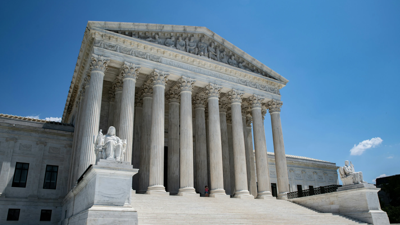


The U.S. Supreme Court stands in Washington.
WASHINGTON – The U.S. Supreme Court has held that Mississippi can continue to count mail-in ballots after Election Day in a ruling that impacts other states, like Illinois and California.
Roughly 30 states accept votes received after Election Day, and the justices found nothing prevents Mississippi from maintaining that practice. Their Monday decision, a 5-4 ruling that drew a dissent from Justice Samuel Alito, is a blow to Republicans who said federal election laws require votes to be counted by Election Day.
“The acceptance of these late-arriving ballots effectively postpones the date on which the electorate’s choice is made, and federal law precludes that postponement,” reads Alito’s dissent, joined by Clarence Thomas, Neil Gorsuch and Brett Kavanaugh.
Justice Amy Coney Barrett authored the majority opinion, detailing a history of leeway for states to finalize their election results. Mail-in ballots must still be postmarked on or before the date of the election, and the U.S. Court of Appeals for the Fifth Circuit was wrong when it ruled they must be counted by that date, Barrett wrote.
“In sum, the election-day statutes require the electorate’s choice to be made on election day,” she added.
“That occurs so long as election day is the deadline for individuals to vote—as it is in Mississippi. But the election-day statutes do not set a deadline for ballot receipt, so they do not prevent Mississippi from counting ballots postmarked before election day yet received afterward.”
U.S. Rep. Darrell Issa sued in California last year, complaining that late-arriving mail-in ballots drag out the process for weeks and gives an edge to Democrats. He is supported in his cause by the group Judicial Watch, but Monday’s ruling is bad news for them.
It’s the same in Illinois, where U.S. Rep. Michael Bost mounted a similar challenge to an Illinois law that allows for counting two weeks after the election.
Critics of such laws, in California and elsewhere, have asserted the change in the law creates new opportunities for dominant parties and powerful campaign organizations to manipulate the system and cheat by counting questionable or illegitimate ballots, allowing potentially thousands of otherwise invalid ballots to sway close election contests.
The lawsuits have argued the laws improperly "dilute" the value of their votes and those cast by others on or before Election Day, in keeping with federal law, before any vote totals can be known.
The administration of former President Joe Biden and the Democratic Party have intervened in court to defend such laws, arguing the laws don't conflict with federal law because they still require all ballots to be mailed on or before Election Day, even if the laws may allow votes to be counted without any independent proof they actually were mailed at all.
In California, the process can be particularly excruciating, as the state routinely takes more than a month to count ballots in a wide assortment of races, including for Congress.
Issa noted two of his Republican colleagues, former U.S. Reps. Michelle Eunjoo Steel and John S. Duarte, both lost their seats in the 2024 general election in that fashion, surging to leads, only to lose "due to late-arriving VBM" (vote-by-mail) ballots, which broke heavily for their Democratic opponents as election officials claimed to continue counting votes for weeks after Election Day.
The Mississippi case drew several amicus briefs, including one from election officials and local governments. They complained that shortening the timeline to count votes would make their jobs even harder.
The Trump administration filed its own brief that failed to sway five justices, even as the DOJ argued “election day has meant the day the ballot box closes.”
“(E)nsuring all ballot boxes close on the same day eliminates incentives and opportunities for fraudulent abuse; leaving them open conflicts not only with the ordinary meaning of ‘election day,’ but also with the very integrity of the election,” it added.