
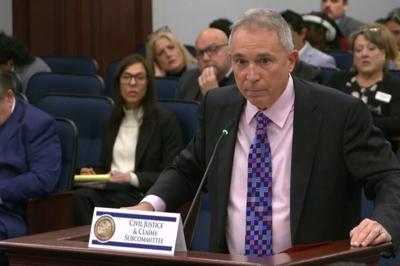


Attorney Daniel Santaniello testifies January 29 before the Florida House’s Civil Justice & Claims Subcommittee.
A Florida House panel last week advanced a bill that would reverse a key 2023 tort reform that provides a presumption for multifamily residential property owners against negligence liability claims when they implement specific anti-crime measures.
Current law provides owners or operators of apartment buildings or condominium projects a presumption against security liability claims when they provide crime-prevention training for employees and install equipment to reduce violent crime, such as security cameras, lighted parking areas, lighted walkways and common areas, and one-inch deadbolts. But House Bill 1423, sponsored by Rep. Michelle Salzman (R-Escambia County), would remove the presumption under certain circumstances.
Under the bill, the owner or operator could lose the liability presumption when two or more serious crimes, such as murder, robbery, sexual battery or firearms offenses, are reported to the owner or operator within two years of a specific liability claim.
The measure passed the Civil Justice & Claims Subcommittee Jan. 29 by a vote of 14-3, despite tort-reform supporters’ testimony against the HB 1423. Groups such as the Florida Justice Reform Institute (FJRI) and the Florida Chamber of Commerce opposed the bill, while the Florida Justice Association, which represents trial attorneys, supported the measure, arguing that it is needed to restore balance and clarity in negligent security cases.
The current law "creates a presumption that unfairly handicaps victims of violent crimes in apartments, dorms, condominiums and other multifamily residents,” Laura Youmans, the association’s legislative and government affairs director, told the subcommittee. She added that juries deciding legal actions filed by crime victims should be able to consider properties’ histories of violent crimes.
But attorney Daniel Santaniello, speaking on behalf of the FJRI, called the bill vague and overbroad, arguing that it would punish multifamily residential property owners who have invested tens of thousands of dollars on security measures in the wake of the 2023 reform.
“This bill, as amended, takes away that (liability) protection,” Santaniello told lawmakers.
The measure’s language about “reported” crime incidents is simply not workable because there are no requirements for police reports or specifics on reporting, he said.
Critics have also pointed out that the 2023 reform was put in place in the wake of spiking insurance costs facing the owners and operators due to premises liability claims, which allege unsafe conditions or seek damages as a result of third-party criminal acts on the property..
“What this Legislature did in 2023 was landmark and needed for the people of the state of Florida,” Santaniello said.
The state House of Representatives’ analysis of the bill indicates that the bill could have negative economic effects on multifamily residential property owners and their insurers.
“By narrowing the circumstances under which an owner or operator may invoke the protective liability presumption, the bill effectively increases their potential exposure to premises liability claims,” the analysis states. “As a result, insurers may view multifamily residential properties as higher-risk, which could lead to higher insurance premiums.”
William Large, the FJRI’s president, told The Florida Record in an email that HB 1423 threatens to dismantle reforms signed into law by Gov. Ron DeSantis.
“Previously, the governor established a ‘safe harbor’ for multifamily residential property owners, granting them a presumption against liability for third-party criminal acts if they implement specific, enumerated security measures,” Large said. “Rep. Salzman’s bill takes away that presumption if someone complained to an owner or principal operator about an unrelated crime.”
Critics of the bill have also argued that the measure could create disincentives to building needed new housing for Florida residents.
“It is a shame that this legislation is being pushed, since the governor’s reforms have done an incredible amount of good to make our apartments and condominiums safer,” Large said.