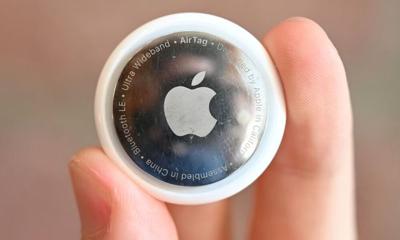



PENSACOLA, Fla. – A Florida woman has filed a lawsuit against Apple alleging the company’s negligence in developing its popular AirTag product led to her “stalking and unwanted tracking.”
Plaintiff Jane Doe M.P. filed her lawsuit in U.S. District Court for the Northern District of Florida, Pensacola Division.
In her 20-page complaint against California-based Apple, the Escambia County resident claims the company “intentionally intruded” on her life by designing, deploying, and maintaining a product and network that “intentionally and continuously geolocated” her.
She argues Apple represented to the public that the AirTag was “stalker-proof” and safe.
“Apple did not merely fail to disclose the AirTag’s risks; it actively misrepresented the product as safe from misuse,” her lawsuit states.
This isn’t the first lawsuit making these claims against Apple.
According to Doe’s complaint, her alleged stalker has been her abuser and former romantic partner for about five years. She has a minor daughter, the suit states.
She claims her alleged stalker used technology, notably Apple’s AirTag, to maintain control over her life and movements.
“Beginning no later than 2021 and continuing through at least July 31, 2026, Plaintiff was repeatedly stalked and tracked by means of concealed tracking devices, including at least one confirmed Apple AirTag, hidden on her person, in her vehicle, or among her belongings by her former romantic partner,” the complaint states.
Doe alleges she did not receive a notification from Apple that she was being tracked by the concealed AirTag. Apple’s safety systems failed to alert her to the presence of the unauthorized tracking device, she claims.
“Plaintiff discovered the tracking not because of any Apple safety feature, but because her stalker mocked her about knowing her whereabouts,” the suit states. “Plaintiff subsequently found information on her stalker’s computer confirming the use of an AirTag to track her location.”
She claims she reported the stalking and tracking to law enforcement, but police filed only a misdemeanor charge for computer tampering. She has since obtained a restraining order against her alleged stalker, her lawsuit states.
“As a consequence of the campaign of tracking and stalking enabled by Apple’s AirTag, Plaintiff has suffered sexual assault, physical violence, stalking, and property destruction resulting in economic loss,” the suit states.
In particular, Doe claims the AirTag-enabled stalking caused her to lose about 30 jobs, as her stalker’s surveillance, smear campaign, and interference destroyed her ability to maintain employment.
“Plaintiff lost her entire freedom; her environment was controlled by her stalker, who manipulated her air conditioning, synced her electronics in the middle of the night, watched and reported her every move, and conducted a relentless smear campaign that destroyed her reputation and livelihood,” the complaint states.
“Plaintiff has been living in a mental prison for five years of cyber stalking.”
Apple introduced the AirTag, a Bluetooth-enabled tracking device the size of a U.S. quarter, in April 2021. The product is designed to help consumers locate personal items like keys or bags.
According to Doe’s lawsuit, prior to and upon the AirTag’s release, domestic violence advocates and cybersecurity technologists publicly warned Apple that the product would be used to stalk, coerce, control, and endanger victims – particularly victims of intimate-partner violence.
The National Network to End Domestic Violence publicly expressed concern in 2021, saying that “it’s extremely important if people are planning to leave an abusive person, they’re able to do so without the person tracking them down and finding them.”
Almost immediately after the AirTag’s release and since, thousands of reports have been made about it being used to stalk victims by placing the product in purses, on or in vehicles, inside belongings, and even sewn into clothing, the lawsuit states.
“From April 2021 through April 2024, Apple received over 40,000 stalking reports, averaging over 1,000 complaints per month,” the filing states.
“In multiple documented instances, AirTag-facilitated stalking led directly to murder or serious violence, including cases in Arizona, Ohio, Indiana, Illinois, and Texas.”
And while Apple has made “incremental” safety improvements, Doe argues they are not enough.
For instance, Apple’s iOS alert system notifies iPhone users when an unknown AirTag appears to be traveling with them. But this alert is significantly delayed, she contends.
“Originally, Apple’s algorithm waited approximately 72 hours before issuing an alert,” her filing states. “Apple later shortened this delay, but users still report not receiving alerts until approximately 8 to 24 hours after tracking begins – a potentially fatal span of time.”
Also, she argues the alert cannot be triggered independently by the user.
“A tracked individual is at the mercy of Apple’s operating system to determine whether and when an alert is issued,” the suit states. “Once dismissed, the alert may not reappear, potentially leaving the victim unable to locate the AirTag.”
In addition, to disable an AirTag that is being used to stalk, a victim must physically locate the device and manually remove its battery, Doe contends.
“But this may require significant expense (such as having a vehicle stripped by a mechanic) and risks contaminating evidence needed for law enforcement,” her filing states.
Doe seeks compensatory damages and actual damages, including relocation expenses and lost wages; punitive damages; an injunctive relief; and attorneys’ fees.
Bailey Glasser LLP in Maryville, Illinois, and Floyd Law in Richmond, Virginia, are representing her in the action.