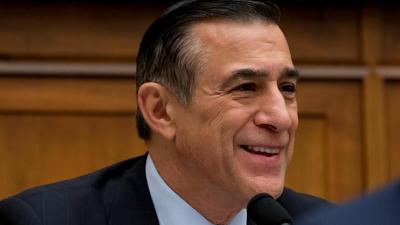



U.S. Rep. Darrell Issa, R-Escondido
WASHINGTON – Last month, a U.S. House of Representatives committee discussed this year’s version of a bill that requires companies that invest in lawsuits to reveal themselves.
And though some states and federal court districts have already implemented that level of transparency, Democrat lawmakers and some groups are sure to fight the Litigation Transparency Act of 2025, introduced by California Republican Darrell Issa.
H.R. 1109 targets agreements in which litigation-funders advance money to plaintiffs attorneys in return for a percentage of whatever is won in court. Since they aren’t traditional loans, they aren’t subject to usury laws, and critics worry that investors ultimately control when or if litigation is settled.
“Our legislation targets serious and continuing abuses in our litigation system that distort our system of justice by obscuring public detection and exploiting loopholes in the law for financial gain,” Issa said earlier this year.
H.R. 1109 won’t prohibit the funding. Instead, the agreements will be disclosed in court, much like defendants must do with their insurance policies. A related bill that forbids funding from sovereign wealth funds and foreign governments is headed to the full House.
Third-party litigation funding (TPLF) has long been a sore spot for defendants who claim it encourages frivolous lawsuits and allows foreign funders to pursue objectives in court like filing lawsuits to weaken the American energy industry. Oklahoma and Georgia passed measures targeting TPLF this year, joining Wisconsin, Indiana, Montana, West Virginia, Louisiana and Kansas.
In federal courts, Delaware, New Jersey and the Northern District of California require disclosure of TPLF agreements.
As Johnson & Johnson attempted a mass settlement of tens of thousands of ovarian cancer claims in a Texas federal court, some plaintiffs firms stood in the way of what would have been a $9 billion agreement. The company felt litigation-funding complicated what was an ultimately unsuccessful plan.
Court documents say Fortress Investment Group lent $24 million to Smith Law Firm, which repaid it with the proceeds of another loan from Elliott Associates. Smith fought to accept J&J’s multibillion-dollar deal, but Beasley Allen led a fight against approval.
Beasley Allen sued Smith and claimed Smith voted yes on the settlement because it owes $240 million to third-party financiers. J&J wondered whether Beasley Allen had its own bills to pay, though partner Andy Birchfield testified his firm did not obtain litigation funding for its claims.
“Litigation funding has permeated the talc litigation,” J&J said in a court filing, in which it accused plaintiff law firms of neglecting their duty to represent clients to meet the demands of their hedge fund financiers instead. “Beasley Allen’s conduct suggests that other undisclosed financial interests are actually driving its decisions relating to the resolution of the talc litigation.”
Plaintiffs lawyers and investors spend hundreds of millions of dollars in advertisements and marketing services, and there’s no financial incentive to screen for bad claims when a mass filing of thousands could pressure a defendant to settle rather than investigate each lawsuit.
Criticisms of the Litigation Transparency Act popped up after the House Judiciary Committee discussed it in November. The National Taxpayers Union thinks the bill would disclose detailed information about plaintiffs’ financial support.
“The scope of this law would affect numerous political and civic organizations that rely on external contributions to support their legal efforts,” it said.
The U.S. Chamber of Commerce has long pushed for a measure like the Litigation Transparency Act to pass. Though it’s a multibillion-dollar industry, “funders operate in the shadows,” the Chamber’s Institute for Legal Reform says.
The disclosure rules in Delaware federal court were in effect in 2023 when it was uncovered that PurpleVine IP, a Chinese firm, was funding intellectual property lawsuits targeting Samsung.
In one case in Texas, it was uncovered that former Samsung IP chief Ahn Seung-ho had shared confidential Samsung information with PurpleVine, leading judge Rodney Gilstrap to call the behavior “dishonest, unfair and repugnant to the rule of law.”