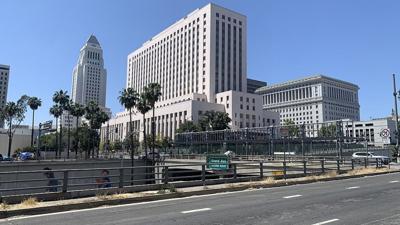


Los Angeles County Superior Court
LOS ANGELES - California has long landed high on the annual list of so-called "Judicial Hellholes" identified by legal reform advocates.
But this year, the American Tort Reform Association said rampant lawsuit abuse, "eye-popping" so-called "nuclear verdicts," and allegations of fraud and racketeering leveled against lawyers and others have earned Los Angeles, alone, the designation as the worst of what it calls America's most abusive court systems.
The American Tort Reform Association released its 2025-2026 "Judicial Hellholes" rankings on Dec. 9.
ATRA compiles and publishes the list each year to to draw attention to some of the country's courts that are the most welcoming to lawsuits and most hostile to businesses and employers in the way judges apply and interpret the law and court rules.
As in previous years, ATRA said that allegedly abusive legal system results in real costs for the state and its residents. Using information supplied by The Perryman Group, ATRA estimated such "lawsuit abuse and excessive tort costs wipe out" nearly $96 billion from California's economy every year, while costing more than 407,000 jobs lost.
This year, ATRA highlighted eight jurisdictions, including state, county and city court systems, it believes should be considered the worst of the worst in the U.S. for laws, policies and rules that enable lawsuit abuse and create hostile and costly legal environments for employers and other drivers of the U.S. economy.
Los Angeles claimed the top spot for the first time.
The second largest city in the U.S. was followed on the list by America's largest metro, New York City, which was ranked No. 2.
Courts in South Carolina which handle allegedly abusive asbestos lawsuits came in at No. 3.
They were followed by Louisiana; Philadelphia's Court of Common Pleas; St. Louis; Cook County, Madison County and St. Clair County, all in Illinois at No. 7; and King County, Washington, and the Washington State Supreme Court, rounded out the list.
While noting L.A. has ordinarily been grouped in with the rest of California's famously plaintiff-friendly court systems, ATRA laid out a list of reasons for why Los Angeles courts stood out from the rest of the Golden State for the top spot on the list.
The report assails Los Angeles courts for being what ATRA describes as hotbeds of extreme, headline grabbing jury verdicts, generating big, relatively easy returns for plaintiffs' lawyers and third party investors who are often backing the lawsuits.
The report particularly called out a "mind-boggling" verdict worth nearly $1 billion awarded to the family of a woman who died at the age of 88 about a year after she was diagnosed with mesothelioma, a cancer allegedly caused by exposure to trace amounts of asbestos in talc from Johnson & Johnson's baby powder.
The verdict included $950 million in punitive damages.
Johnson & Johnson has challenged the verdict, calling it "breathtaking," "unconstitutional" and the result of a "jury process gone awry."
That family's case was one of thousands of such lawsuits lodged against J&J in courts in California and other cases in the country, all of which J&J has asserted are based on "junk science."
The challenges and appeals of that verdict remain pending.
In their report, ATRA noted the L.A. court overseeing the talc case allowed jurors to rely on testimony from an "expert witness," Dr. Stephen Haber, who has "authored only two publications on mesothelioma throughout his career," including one in which he "described an 83-year-old woman who developed mesothelioma with no evidence of prior asbestos exposure." The court allowed plaintiffs' lawyers to use Haber's testimony to pin the blame for the woman's cancer on J&J's baby powder, according to the ATRA report.
"With massive verdicts like these regularly awarded and courts permitting 'junk science' to flood Los Angeles courts, it's no wonder Los Angeles County is the trial bar's third-most popular venue in the country for mesothelioma filings," ATRA wrote in its report.
But the verdicts don't stop at mesothelioma.
In another case, an L.A. jury granted $50 million to a 30-year-old man who was burned when hot coffee spilled on his lap in a Starbucks drive thru, dwarfing the $6.4 million inflation-adjusted verdict famously awarded to a woman who sued after hot coffee spilled in her lap at a McDonald's restaurant.
The report also noted four other "nuclear verdicts" in 2025 in Los Angeles County, including three awards ranging from $32.5 million to $36.4 million in automobile crashes and $27.5 million in an employment retaliation case.
At the same time, ATRA said the potential for relatively easy paydays amid a plaintiff-friendly court also invites alleged fraud and racketeering.
The report noted that Ford Motor Company in May 2025 accused the Knight Law Firm, of L.A., and other lawyers of using California's so-called "lemon law" - an outlier state law which allows car owners to sue car makers over allegedly defective automobiles - to allegedly defraud Ford and other car makers and allegedly inflate their billing.
Defendants have asked a court to dismiss the lawsuit and that motion remains pending.
California plaintiffs filed more than 25,000 lemon law cases in the state in 2024, up from 22,000 in 2023.
In other litigation, in July 2025, rideshare giant Uber filed suit against lawyers who allegedly conspired with "a network of 'pre-selected medical providers'" to perform medically unnecessary procedures and provide other medical care to people who suffered minor or "non-existent injuries from minor collisions between 2019 and 2024."
The alleged racketeering conspiracy was allegedly enabled by California's state-mandated $1 million rideshare insurance policy limit, "which made accident claims highly lucrative and provided an incentive to exaggerate injuries and artificially inflate medical expenses."
The report noted that the clients likely did not know what was happening.
The report noted that such insurance requirements and abuse have caused rideshare services to be significantly more expensive, while generating less money for drivers, with "approximately 45% of the fare of every Uber ride" going to "mandated insurance costs."
The report further took aim at court systems in L.A. and California, generally, for playing host to a torrent of other lawsuits centered on other unique California laws.
These included:
- Thousands of allegedly abusive lawsuits targeting employers and other businesses with questionable disability access claims. While the lawsuits center on the federal Americans with Disabilities Act, they seek to primarily collect under California's state Unruh Civil Rights Act, which allows them to claim $4,000 per violation, plus attorney fees. Violations can include "something as minor as a missed sign or faded parking lot paint," leading to "hundreds of thousands of dollars in liability."
Such lawsuits typically target small businesses, including breweries, hotels, bars and restaurants, "because they lack the resources to defend themselves and are more likely to settle;
- Privacy lawsuits under the California Invasion of Privacy Act against companies for using "date tracking pixels," or "cookies" to produce "targeted ads" on Facebook and elsewhere online. Plaintiffs do not need to show they suffered any actual harm to sue;
- Thousands of lawsuits under the California Private Attorney General Act (PAGA), which ATRA said has come to also be known as the "Sue Your Boss" law. Under the law, workers who believe their employer has violated a provision in California's labor laws can invoke the PAGA law and step into place of the state of California to sue on behalf of all of their coworkers.
This has continued in California, despite a 2022 ruling from the U.S. Supreme Court, which declared that the PAGA law doesn't allow employees to simply ignore employer arbitration agreements, which would otherwise preclude them from suing their employer for allegedly shorting their overtime pay or other claims under California labor law.
ATRA noted PAGA filings have ebbed a bit in 2025, after surging in 2024 shortly after the state enacted reforms intended to at least mitigate the damage from such lawsuits to the state's economy;
- Continued rampant lawsuits under the state's so-called Prop 65 measure, another unique California provision which allows plaintiffs ti sue if tests detect "even the slightest, non-threatening trace of more than 1,000 chemicals that state environmental regulators deem carcinogenic or otherwise toxic."
According to the report, California courts generated 1,204 settlements, collectively worth $43.7 million through the first 10 months of 2025, up nearly 60% compared to 2024 and an increase of 350% since 2020.
ATRA noted that 90% of such settlements go to the lawyers who bring the complaints. That means plaintiffs' lawyers have collected $38 million to date from Prop 65 suits in 2025 alone; and
- Environmental litigation targeting plastics makers over a "plastics pollution crisis." L.A. County is among those who have partnered with trial lawyers to sue PepsiCo and others over alleged environmental harms from single-use plastic bottles and other plastic products.
At the same time, ATRA noted reformers and the business community are also closely watching the California Supreme Court to see if they may further cement Los Angeles's and California's courts hold on the top spot in their "Judicial Hellhole" rankings.
The state high court is set to deliver a decision on whether to uphold lower courts' rulings creating a new judicial standard, under which manufacturers can be sued for not releasing improved products fast enough.
Known as the "duty to innovate," the standard would allow lawsuits to be brought against manufacturers if plaintiffs can establish a company was "researching and developing another product that it 'knew' was 'safer'" than existing products "and did not release that product fast enough" - even if its existing products are not "defective or unreasonably dangerous."
While the case before the California Supreme Court applies to a dispute over pharmaceuticals, observers have noted that standard "could be used against any manufacturer," including "software, phone, car, and medical-device manufacturers," opening a new potential avenue for trial lawyers to target businesses in California's courts.